TEL:+86 132 6656 7067





800G ZR and ZR+ coherent optical transceivers extend high-capacity Ethernet connectivity beyond conventional short-reach data center links. By integrating coherent transmission and digital signal processing into pluggable modules, these solutions support amplified DWDM networks, metropolitan interconnects, and regional data center connections.
1. Overview of 800G ZR and ZR+ Optical Transceivers
As cloud computing, AI infrastructure, and hyperscale data centers expand, network operators increasingly need to connect facilities across metropolitan and regional distances. Traditional short-reach optical transceivers are designed for connections within data centers or across comparatively short fiber routes. Longer connections may require additional optical transport equipment, external amplification, and wavelength management.
800G ZR and ZR+ optical transceivers address these requirements through coherent optical technology. A coherent module combines a tunable laser, optical transmitter and receiver components, and a digital signal processor (DSP) to transmit high-capacity signals over single-mode fiber. Depending on the implementation, the module can connect directly to a compatible router or switch port and operate over an appropriate DWDM optical path.
The main distinction is the intended transmission environment. 800ZR targets standardized, high-capacity, single-span data center interconnects, while 800G ZR+ implementations extend transmission capability through different coherent modes and optical network configurations. The achievable distance depends on the module, modulation format, fiber characteristics, optical signal-to-noise ratio, and amplification or line-system design.
2. What Is 800ZR?
800ZR is a coherent optical interface defined by the Optical Internetworking Forum (OIF). The OIF 800ZR Implementation Agreement specifies a single-wavelength 800G coherent line interface for single-span, amplified links in the approximate 80–120km range, targeting noise-limited point-to-point DWDM applications such as data center interconnects.
Its purpose is to make high-capacity coherent transmission available in compact pluggable modules, reducing the need for a separate transponder in supported network architectures. Rather than relying on four or eight independent short-reach optical channels, an 800ZR module transmits an aggregate 800G signal on a single coherent wavelength.
With a compatible host platform and suitable optical line system, 800ZR can simplify connections between separate data centers or network facilities. Actual reach is determined by the complete optical path, including fiber attenuation, amplifier noise, span losses, connector losses, and the system's operating margin.
3. What Is 800G ZR+?
800G ZR+ generally refers to extended-reach 800G coherent implementations that go beyond the baseline 800ZR operating profile. ZR+ is associated with interoperable coherent specifications and modes that can support a broader range of optical network conditions, including longer distances and more complex DWDM deployments.
ZR+ implementations may use different modulation formats, baud rates, forward error correction schemes, and probabilistic constellation shaping. These parameters affect spectral efficiency, receiver performance, and the distance that can be achieved over a particular optical path.
Depending on the module and network design, 800G ZR+ can serve metropolitan and regional data center interconnects over several hundred kilometers. Some system configurations may support longer distances, but those results cannot be assumed for every transceiver or optical line system.
4. 800G ZR vs. 800G ZR+
| Parameter | 800ZR | 800G ZR+ |
|---|---|---|
| Primary objective | Standardized 800G coherent connectivity for single-span DCI | Extended-reach coherent connectivity across a wider range of optical network conditions |
| Typical application | Point-to-point data center interconnects | Metro DCI, regional interconnects, and DWDM transport networks |
| Transmission reach | OIF-defined application range of approximately 80–120km for amplified, single-span links | Often several hundred kilometers, depending on operating mode and system design |
| Optical architecture | Single-wavelength coherent transmission | Coherent transmission with implementation-dependent modulation and FEC options |
| Optical infrastructure | Typically an appropriate amplified DWDM link | May use amplified DWDM systems, multiple spans, and more advanced optical line infrastructure |
| Interoperability | Designed around the applicable OIF 800ZR Implementation Agreement | Depends on the specific ZR+ interoperability specification, operating mode, and compatible line system |
| System planning | Validate span loss, amplification, and OSNR | Validate end-to-end optical performance, amplifier configuration, span count, and supported modulation mode |
The choice between 800ZR and ZR+ should be based on the target reach and the existing optical infrastructure. A standardized 800ZR implementation can be attractive for a straightforward single-span DCI link. ZR+ may be more appropriate when a longer route or a broader set of optical network conditions needs to be supported.
5. Coherent Technology, Modulation, and DSP
Coherent optical transmission preserves information about the amplitude and phase of an optical signal, enabling the receiver to recover more information than direct-detection systems typically do. This capability supports advanced modulation formats and improves the ability to compensate for optical impairments over long fiber routes.
Coherent modulation formats
800G coherent modules may support dual-polarization 16QAM and, in selected implementations, probabilistic constellation shaping (PCS-16QAM). Different modulation formats offer different trade-offs between spectral efficiency and the optical signal quality required by the receiver.
Higher-order modulation can improve spectral efficiency, helping carry more data within a given optical channel bandwidth. However, it generally requires better optical signal-to-noise ratio and a more favorable end-to-end link budget. More robust modes may improve reach at the cost of spectral efficiency or aggregate capacity, depending on the implementation.
Digital signal processing
The coherent DSP performs high-speed signal processing to recover data and compensate for transmission impairments. Its functions can include chromatic dispersion compensation, polarization demultiplexing, adaptive equalization, carrier recovery, and forward error correction.
Integrated processing enables the module to handle complex optical transmission functions within a pluggable package. However, DSP capabilities, supported modulation modes, FEC behavior, and host interfaces remain implementation-specific and must be verified against the selected product's documentation.
6. Form Factors, Host Interfaces, and Optical Connections
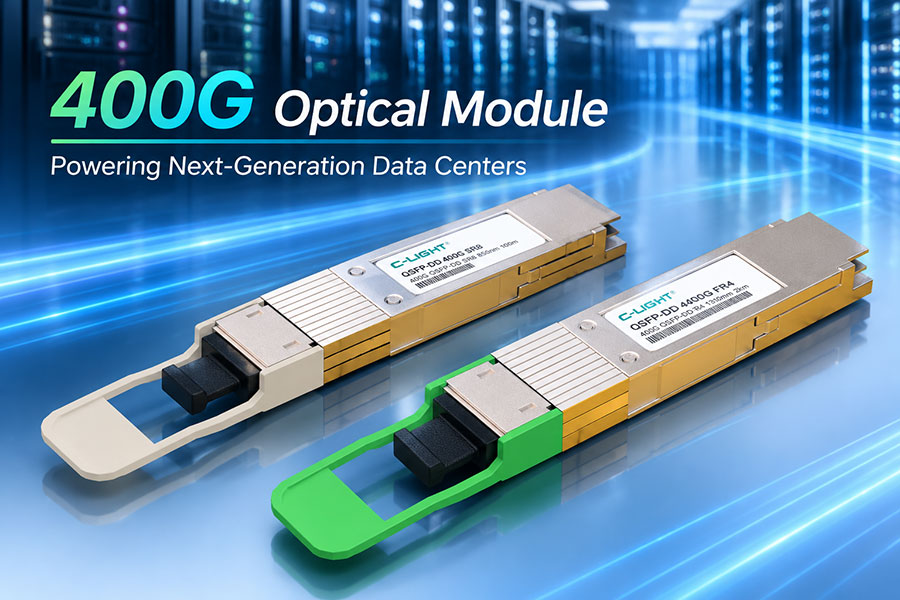
800G coherent transceivers are available in pluggable form factors including QSFP-DD and OSFP. The choice affects mechanical integration, host compatibility, power delivery, cooling, and front-panel port density.
| Design consideration | QSFP-DD | OSFP |
|---|---|---|
| Package | High-density double-density QSFP form factor | Form factor designed for high-speed, high-power optical modules |
| Host integration | Requires an 800G-capable QSFP-DD port and supported coherent interface | Requires an 800G-capable OSFP port and supported coherent interface |
| Thermal requirements | Must remain within the platform's power and cooling limits | Must remain within the platform's power and cooling limits |
| Optical interface | Commonly duplex LC for applicable coherent modules | Commonly duplex LC for applicable coherent modules |
| Typical deployment | Compatible routers, switches, and optical transport platforms | Compatible routers, switches, and optical transport platforms |
Both form factors can support coherent 800G applications, but physical dimensions alone do not establish compatibility. The host port must support the module's electrical interface, power requirements, thermal profile, management functions, and operating mode.
For optical connectivity, coherent modules commonly use a duplex LC connector to couple the module to a single-mode fiber path. The actual network may also include DWDM multiplexers, demultiplexers, amplifiers, ROADMs, and intermediate patch panels. These elements must be compatible with the module's wavelength range, channel plan, and optical performance requirements.
7. Applications in Data Center Interconnects
Campus and metro DCI
When data centers are separated by tens of kilometers or more, coherent 800G optics can provide high-capacity links over single-mode fiber. 800ZR is suited to supported single-span applications, while ZR+ can address longer metro routes where the module and optical system meet the required performance targets.
Regional cloud infrastructure
Cloud operators may need to connect facilities across a region for workload distribution, storage access, service continuity, and traffic engineering. ZR+ implementations can provide a pluggable coherent interface for selected regional links, subject to the reach and optical margin supported by the design.
AI data center interconnects
AI training and inference infrastructure can generate substantial traffic between compute clusters, storage systems, and separate data center locations. 800G coherent DCI links can extend high-bandwidth connectivity beyond the data hall and help connect distributed infrastructure without requiring every link to use a separate external transponder.
IP over DWDM and routed optical networks
Coherent pluggable modules can allow supported routers to connect directly to a DWDM optical line system. This architecture can simplify network design by consolidating optical transmission functionality into the router or switch interface. The deployment still requires appropriate optical engineering, line-system compatibility, and operations monitoring.
8. Optical Link Budget and Network Planning
Coherent modules can provide extended reach, but the performance of the link depends on more than fiber distance. Operators need to evaluate the optical path and its accumulated impairments before selecting a transmission mode.
Span loss: Calculate the loss of each fiber span, including connectors, patch panels, splices, and passive components.
Optical signal-to-noise ratio: Confirm that the received OSNR meets the required threshold for the selected modulation and FEC mode.
Amplifier design: Evaluate gain, noise figure, output power, and the placement of optical amplifiers where required.
DWDM channel plan: Verify wavelength tuning range, channel spacing, filter compatibility, and the supported C-band or L-band operating range.
Chromatic and polarization effects: Confirm that the coherent DSP and system configuration support the expected dispersion and other impairments.
FEC and operating mode: Confirm the supported line mode at both endpoints and the expected pre-FEC and post-FEC performance.
Optical margin: Preserve sufficient engineering margin for component variation, aging, maintenance, and changes in the optical path.
An amplified link's reach rating cannot be applied directly to a completely unamplified route. Similarly, reach figures measured with one amplifier configuration or fiber type should not be assumed for a different system without validation.
9. C-LIGHT 800G ZR and ZR+ Coherent Transceiver Options
The C-LIGHT 800G OSFP optical transceiver portfolio lists coherent options for extended-reach connectivity, including the CL800GOSFPZR+ configuration. The 800G QSFP-DD portfolio also lists an 800G ZR+ coherent configuration for supported networking platforms.
Listed product configurations include an 800ZR mode with a specified reach of approximately 120km and ZR+ modes using 16QAM or PCS-16QAM for longer-distance applications. The product matrix lists reach values varying by configuration, including approximately 340km and up to 500km for certain ZR+ modes. These figures should be treated as configuration-specific product values rather than universal guarantees for all optical routes.
| Product configuration | Optical approach | Listed reach | Typical use |
|---|---|---|---|
| 800G ZR | Coherent, single-wavelength 800G transmission | Approximately 120km in the listed product configuration | Supported point-to-point DCI links |
| 800G ZR+ with 16QAM | Coherent extended-reach mode | Approximately 340km in the listed product matrix | Selected metro and regional links |
| 800G ZR+ with PCS-16QAM | Coherent transmission with probabilistic constellation shaping | Up to approximately 500km in the listed product matrix | Selected extended-reach DWDM applications |
These reach figures depend on the exact product variant and optical system. Before ordering, confirm the applicable datasheet, supported wavelength range, modulation and FEC modes, power consumption, operating temperature, host compatibility, and line-system requirements.
10. Frequently Asked Questions
10.1 What is the main difference between 800ZR and 800G ZR+?
800ZR follows the OIF 800ZR Implementation Agreement for single-wavelength, single-span coherent DCI links. 800G ZR+ describes extended-reach coherent implementations that can support different operating modes and longer distances, depending on the specification and optical system.
10.2 Can 800ZR transmit over 120km?
The OIF-defined application range for amplified single-span 800ZR links is approximately 80–120km. Whether a particular 120km route is supported depends on the module, optical line system, span loss, and OSNR. The distance should be validated rather than assumed from the interface name alone.
10.3 How far can an 800G ZR+ transceiver transmit?
Many 800G ZR+ implementations target several hundred kilometers. The supported distance varies with modulation format, FEC, baud rate, fiber characteristics, amplification, and other optical system parameters. Always consult the exact product specification and link design.
10.4 Do 800G ZR and ZR+ modules require DWDM equipment?
Both are designed for coherent optical networking, and many applications use a DWDM line system. The required equipment depends on whether the link is amplified, the number of wavelengths sharing the fiber, and the system architecture. A module's datasheet should identify its intended optical operating conditions.
10.5 Can QSFP-DD and OSFP coherent modules be used interchangeably?
No. QSFP-DD and OSFP use different physical interfaces. The host must support the correct form factor as well as the module's electrical interface, power, cooling, management, and coherent operating modes.
10.6 What should be checked before deploying an 800G coherent link?
Confirm the exact module variant, supported reach and modulation mode, host compatibility, wavelength range, optical line system, span loss, OSNR, amplifier configuration, FEC settings, power requirements, and operational monitoring capabilities.
11. Summary
800G ZR and ZR+ coherent optical transceivers provide high-capacity connectivity for data center interconnects, metro networks, and regional cloud infrastructure. 800ZR focuses on standardized single-span DCI links, while ZR+ extends the range of potential applications through implementation-specific coherent modes and optical system configurations.
Choosing the right module requires matching transmission reach, modulation format, optical line infrastructure, host interface, and operational requirements. Careful validation of the complete optical path helps ensure that an 800G coherent deployment meets its capacity and reliability targets.
Planning an 800G data center interconnect?
Review the 800G OSFP and 800G QSFP-DD options to evaluate coherent connectivity for your network design.
Contact C-LIGHT >

 >
 >
 >
 >
 >
 >
 >