TEL:+86 132 6656 7067




25G NRZ and 50G PAM4 represent two important stages in the development of high-speed Ethernet signaling. 25G NRZ uses two signal levels and carries one bit per symbol, while 50G PAM4 uses four signal levels and carries two bits per symbol. This allows a 50G PAM4 lane to deliver roughly twice the data rate without requiring a proportional increase in symbol rate.
The difference affects electrical bandwidth, optical component requirements, signal integrity, receiver design, FEC, transceiver form factor and network architecture. 25G NRZ remains closely associated with 25GbE and SFP28 deployments, while 50G PAM4 is widely used as a higher-speed single-lane technology in SFP56 and multi-lane architectures.
1. 50G PAM4 vs 25G NRZ at a Glance
| Feature | 25G NRZ | 50G PAM4 |
|---|---|---|
| Modulation | NRZ / PAM2 | PAM4 |
| Signal Levels | 2 | 4 |
| Bits per Symbol | 1 | 2 |
| Typical Data Rate | 25Gb/s class | 50Gb/s class |
| Approximate Symbol Rate | 25 GBd class | 25 GBd class |
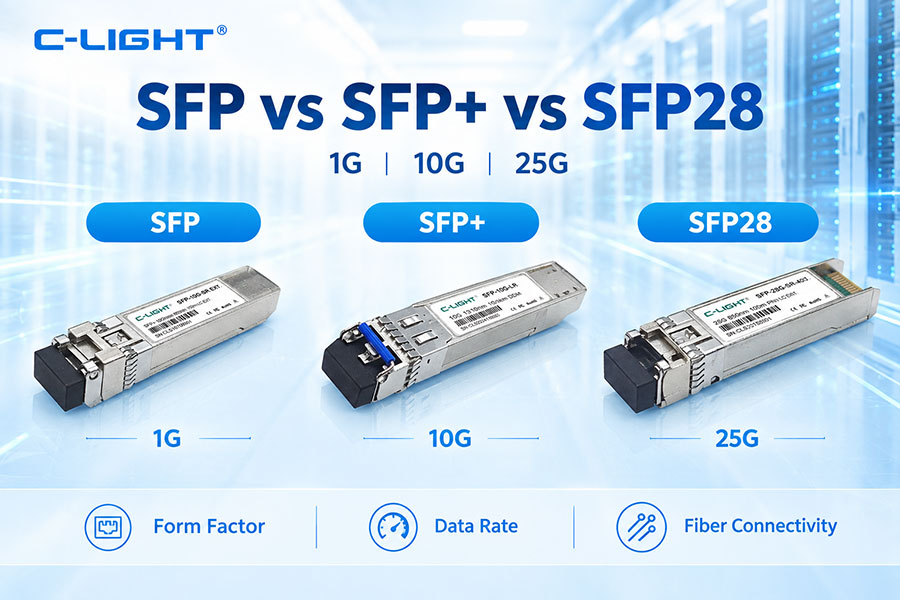
| Common Form Factor | SFP28 | SFP56 |
| Signal Complexity | Lower | Higher |
| Signal Margin | Generally more tolerant | More sensitive to noise and distortion |
| FEC | Depends on application | More important in many higher-speed PAM4 systems |
2. What Is 25G NRZ?
25G NRZ is a two-level signaling format used to transmit approximately 25Gb/s-class data over a single electrical or optical lane.
NRZ can also be described as PAM2 because it uses two amplitude levels. Each symbol represents one binary bit, so the signaling rate is closely related to the transmitted bit rate.
25G NRZ became an important technology for 25GbE server and switch connections and is commonly associated with SFP28 optical transceivers.
3. What Is 50G PAM4?
50G PAM4 uses four amplitude levels to encode two bits into each symbol. With two bits carried by every symbol, a signaling rate in the 25-GBd class can support approximately 50Gb/s of data before accounting for protocol and encoding overhead.
This approach allows networking equipment to increase lane throughput without doubling the symbol rate. 50G PAM4 technology has therefore become an important building block for SFP56 interfaces and higher-speed multi-lane Ethernet architectures.
4. Why PAM4 Can Double the Data Rate
The fundamental difference can be summarized mathematically:
NRZ: 1 symbol = 1 bit
PAM4: 1 symbol = 2 bits
For example, at approximately 25 GBd:
25 GBd NRZ ≈ 25Gb/s
25 GBd PAM4 ≈ 50Gb/s
The practical data rate also depends on encoding, framing and protocol overhead, so these values describe the signaling concept rather than the exact application-layer throughput.
5. Signal Levels and Eye Diagrams
NRZ has two signal levels and therefore one primary eye opening. PAM4 has four amplitude levels and three eye openings.
Because the total voltage range is divided into more levels, each PAM4 eye is smaller than the corresponding NRZ eye for a similar overall signal swing. This reduces the available vertical noise margin and places greater demands on transmitter linearity, receiver sensitivity and signal quality.
6. Bandwidth Efficiency
One of the biggest advantages of 50G PAM4 is improved bandwidth efficiency. PAM4 can carry twice as many bits per symbol as NRZ, allowing higher data rates without requiring a proportional increase in baud rate.
This is particularly valuable because electrical traces, connectors, packages, lasers and other high-speed components become increasingly difficult to operate as symbol rates continue to rise.
The industry has therefore used PAM4 to increase lane capacity while keeping the underlying bandwidth requirements closer to the previous generation.
7. Signal Quality and Noise Sensitivity
The higher information density of PAM4 comes with tighter signal-quality requirements. The four amplitude levels are closer together, so noise, distortion, reflections and nonlinearity can have a greater effect on the recovered signal.
NRZ has a simpler two-level structure, which generally provides greater amplitude separation and makes the signal easier to distinguish under similar conditions.
This is an important reason why moving from 25G NRZ to 50G PAM4 is not simply a matter of changing the nominal data rate.
8. Optical Transceiver Architecture
25G NRZ and 50G PAM4 transceivers can use different optical and electrical architectures even when their external packages look similar.
A typical 25G optical interface is associated with SFP28 and a single 25G-class lane. A 50G PAM4 interface is commonly associated with SFP56 and a single 50G-class electrical lane.
Cisco's current SFP56 portfolio, for example, includes 25G and 50G operating modes in compatible product families and identifies 50G interfaces with PAM4 signaling. :contentReference[oaicite:0]{index=0}
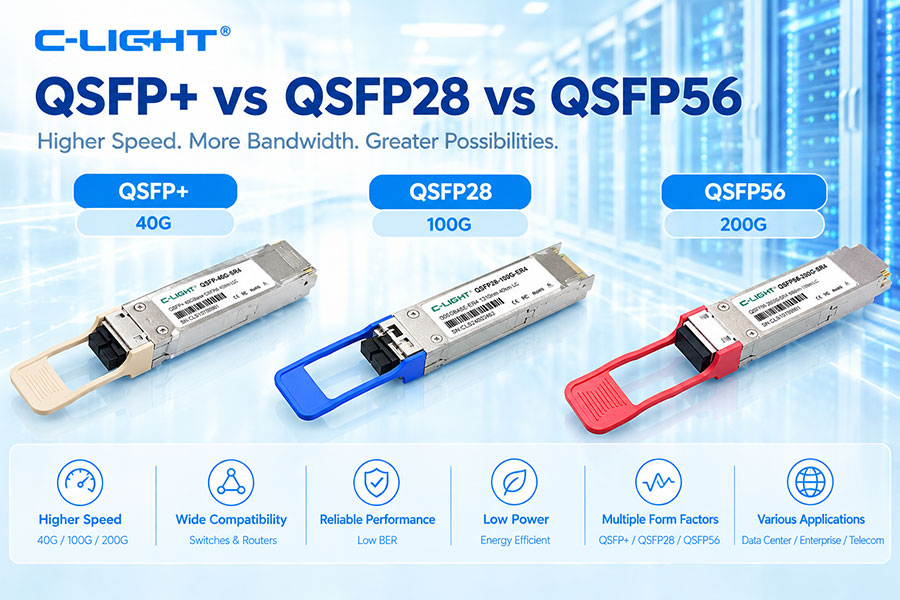
9. SFP28 vs SFP56
| Parameter | SFP28 | SFP56 |
|---|---|---|
| Typical Ethernet Rate | 25GbE | 50GbE |
| Typical Signaling | 25G NRZ | 50G PAM4 |
| Electrical Lanes | 1 | 1 |
| Data per Symbol | 1 bit | 2 bits |
| Form Factor | SFP28 | SFP56 |
| Position in Speed Evolution | 25G-class single-lane connectivity | 50G-class single-lane connectivity |
The SFP56 form factor was developed to provide a 50G-class single-lane interface while maintaining the familiar SFP-style module footprint. Industry documentation describes SFP56 as a single-lane 50G PAM4 electrical interface and highlights its role as a migration path from 25G SFP28. :contentReference[oaicite:1]{index=1}
10. FEC Requirements
Forward Error Correction is particularly relevant to PAM4 because the smaller signal separation makes the system more sensitive to transmission impairments than a comparable NRZ link.
Whether FEC is required depends on the specific Ethernet standard and optical interface. Some early IEEE technical discussions explicitly identified FEC as necessary for certain 50G PAM4 optical approaches, while actual commercial interfaces should be evaluated according to their applicable standard and module specification. :contentReference[oaicite:2]{index=2}
11. DSP and Receiver Complexity
25G NRZ can often be implemented with a relatively straightforward signal path because only two signal levels need to be distinguished.
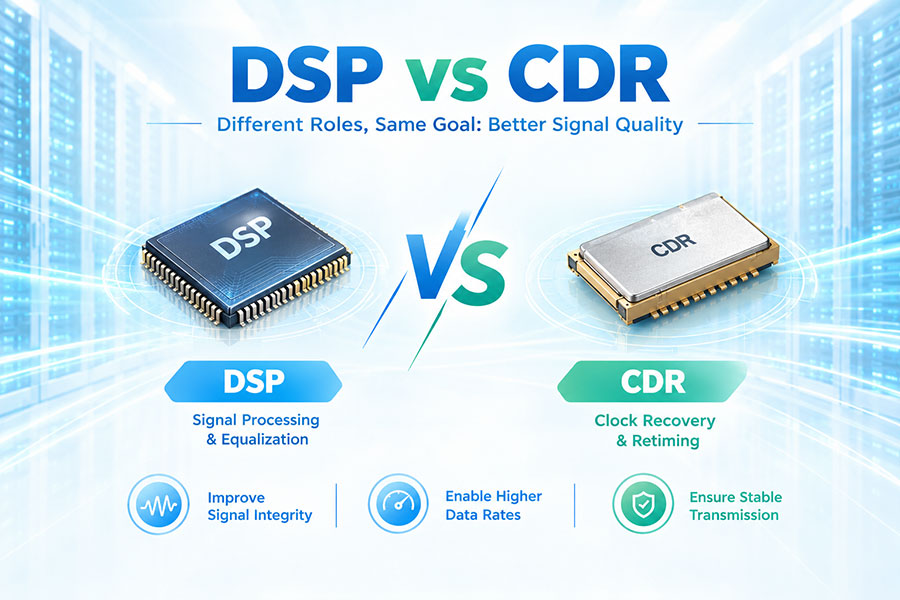
50G PAM4 receivers must reliably distinguish four amplitude levels and can require more sophisticated equalization, clock recovery and signal-processing functions. Modern PAM4 systems may incorporate DSP or other processing to compensate for channel loss and maintain adequate error performance.
The exact processing architecture depends on the host interface and optical transceiver design.
12. Optical Reach and PAM4 vs NRZ
Modulation format alone does not determine optical reach. The achievable distance also depends on wavelength, laser technology, receiver sensitivity, fiber type, optical power budget, FEC and the complete transceiver architecture.
In general, PAM4 can provide higher lane capacity but has tighter signal-quality requirements. An NRZ module operating at a lower data rate may have a more forgiving optical link budget under comparable conditions.
For this reason, 50G PAM4 and 25G NRZ should not be compared by modulation format alone when selecting an optical transceiver for a specific reach.
13. Power Consumption
Power consumption depends on the optical components, electrical interface, DSP implementation, data rate and transceiver generation.
Although PAM4 reduces the required symbol rate compared with an equivalent higher-speed NRZ design, it can introduce additional signal-processing and implementation complexity. The actual power difference between a 25G NRZ and 50G PAM4 module therefore depends on the specific product rather than the modulation format alone.
14. Cost and Port Density
50G PAM4 allows more data to travel through a single high-speed lane, which can increase bandwidth per port and reduce the number of lanes needed for higher-capacity networking architectures.
However, PAM4 transceivers can require more sophisticated electronics and tighter manufacturing requirements. The economics therefore depend on the complete system, including switch ASICs, SerDes, optics, port count and power.
Industry discussions around 50G specifically highlighted the reuse of 25G-class electrical technology and the ability to move from 25G to 50G without proportionally increasing the signaling bandwidth. :contentReference[oaicite:3]{index=3}
15. 25G NRZ Applications
| Application | Typical Use of 25G NRZ |
|---|---|
| Server-to-Switch | 25GbE connections in data centers |
| ToR Switching | Server access-layer connectivity |
| Enterprise Networks | 25G uplinks and aggregation links |
| Storage Networks | Selected high-speed storage interfaces |
| Legacy-to-New Migration | Upgrade path from 10G-class networking |
16. 50G PAM4 Applications
| Application | Typical Use of 50G PAM4 |
|---|---|
| 50GbE Server Connectivity | Single-lane 50G networking |
| Switch-to-Switch Links | Higher bandwidth per electrical lane |
| 400G Ethernet | Multiple 50G PAM4 lanes can form higher-capacity interfaces |
| Network Upgrades | Transition from 25G-class to 50G-class single-lane connectivity |
| High-Speed Data Centers | Higher port capacity and lane efficiency |
IEEE and Ethernet Alliance materials describe 50G PAM4 as a foundational signaling technology for 50GbE and for multi-lane architectures leading to higher Ethernet speeds. :contentReference[oaicite:4]{index=4}
17. 50G PAM4 vs 25G NRZ: Which Factors Matter Most?
| Network Requirement | Key Consideration |
|---|---|
| 25GbE server connectivity | 25G NRZ and SFP28 compatibility |
| 50GbE single-lane networking | 50G PAM4 and SFP56 support |
| Limited electrical bandwidth | PAM4 can increase data per symbol |
| Simpler signal processing | NRZ has fewer signal levels |
| Higher lane capacity | PAM4 provides two bits per symbol |
| Longer or more demanding optical links | Check optical budget, FEC, DSP and exact module specifications |
18. 50G PAM4 vs 25G NRZ: Summary
25G NRZ and 50G PAM4 use different signaling strategies to achieve different lane capacities. NRZ represents one bit with each symbol, while PAM4 uses four amplitude levels to represent two bits per symbol. This allows 50G PAM4 to achieve approximately twice the data rate of 25G NRZ at a similar symbol-rate class.
The advantage of PAM4 comes with additional signal-quality challenges. Its smaller eye openings and greater sensitivity to noise and distortion can increase the importance of receiver design, equalization, DSP and FEC.
25G NRZ remains a practical choice for 25GbE-class networking, while 50G PAM4 provides a higher-capacity single-lane technology for 50GbE and the multi-lane architectures used in higher-speed Ethernet.
 >
>

 >
>
 >
>
 >
>
 >
>
 >
>
 >
>
 >
>