TEL:+86 132 6656 7067





400G QSFP-DD ER4 optical transceivers provide 400Gbps connectivity over single-mode fiber for extended-reach data center interconnects, metro infrastructure, and high-capacity Ethernet networks. Using LAN-WDM technology and a duplex LC interface, ER4 supports transmission distances of up to 40km in specified link conditions.
1. Overview of 400G QSFP-DD ER4 Optical Transceivers
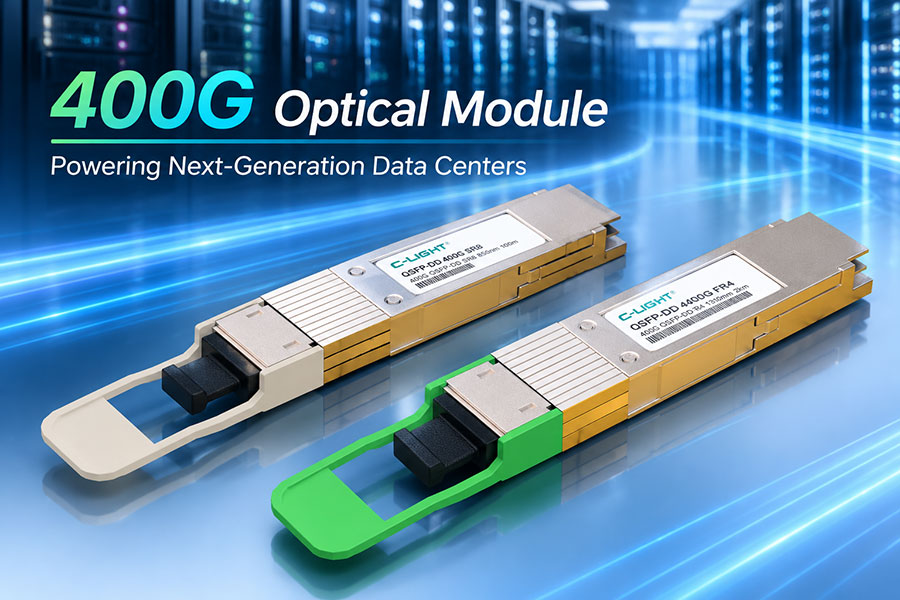
A 400G QSFP-DD ER4 optical transceiver is designed for high-bandwidth connections that extend beyond the typical reach of short- and medium-distance data center optics. It combines the QSFP-DD hot-pluggable form factor with four optical channels operating at approximately 100Gbps per channel to deliver an aggregate data rate of 400Gbps.
Unlike parallel optical designs that require multiple fiber pairs or ribbon-fiber connections, ER4 uses wavelength-division multiplexing to carry multiple optical channels over a duplex single-mode fiber link. This architecture can simplify fiber management on long-reach connections while providing the bandwidth required by modern switching and routing systems.
The C-LIGHT 400G QSFP-DD portfolio includes the 400G QSFP-DD ER4 optical transceiver, identified by the part number CL400GQDDER4. The listed configuration supports 400G transmission over single-mode fiber, uses LAN-WDM wavelengths, and provides a duplex LC optical interface.
2. Transmission Architecture and Optical Technology
Four-channel LAN-WDM transmission
ER4 uses LAN-WDM to combine four optical channels with closely spaced wavelengths into a multiplexed signal. On the transmit side, the module converts electrical data into optical signals and combines the wavelength channels for transmission through the fiber. At the receiving end, the optical channels are separated and converted back into electrical signals.
This wavelength-multiplexed architecture enables four high-speed optical channels to share a duplex single-mode fiber connection. The exact wavelength plan, optical transmitter and receiver characteristics, and performance limits must be verified against the selected module's datasheet.
QSFP-DD host interface
QSFP-DD provides a compact, high-density package for 400G networking equipment. The host system supplies the high-speed electrical interface, while the transceiver performs the required electrical-to-optical and optical-to-electrical conversion. Host electrical lane configuration, modulation, management support, and forward error correction behavior depend on the applicable module specification and platform design.
Physical fit alone does not guarantee interoperability. A deployment should verify the required 400G Ethernet interface, supported transceiver type, firmware and management compatibility, and the optical link requirements of the connected equipment.
3. Key Specifications of 400G QSFP-DD ER4
| Parameter | Specification |
|---|---|
| Product type | 400G QSFP-DD ER4 optical transceiver |
| Part number | CL400GQDDER4 |
| Aggregate data rate | 400Gbps |
| Optical channel architecture | 4-channel wavelength-division multiplexing |
| Optical channel rate | Approximately 100Gbps per channel |
| Wavelength technology | LAN-WDM |
| Fiber type | Single-mode fiber (SMF) |
| Listed transmission distance | Up to 40km, subject to link conditions and module specifications |
| Optical connector | Duplex LC |
| Form factor | QSFP-DD |
| Management and interoperability | Verify the specific module datasheet, supported management interface, and host platform requirements |
These values summarize the listed ER4 configuration. Optical power limits, receiver sensitivity, link budget, power consumption, operating temperature, FEC requirements, and standards conformance should be checked in the detailed datasheet for the exact part number before deployment.
4. Link Budget and 40km Deployment Requirements
A 40km reach rating is not a guarantee that every fiber route of the same length will operate successfully. Actual performance depends on the transceiver's optical characteristics and the condition of the installed fiber link.
Before deploying ER4, evaluate the following factors:
Optical loss: Account for fiber attenuation, connector insertion loss, patch panels, splices, and any additional passive components. Confirm that the total channel loss is within the module's supported operating budget.
Fiber quality: Use suitable single-mode fiber and confirm that the installed cable plant supports the required reach. Inspect connector end faces and clean interfaces before testing.
Connector and polarity: Verify the duplex LC connection, transmit-to-receive fiber mapping, and correct end-to-end patching.
Dispersion and channel performance: Confirm that the selected optical interface supports the intended route and that the link meets the relevant optical specifications.
FEC configuration: Confirm the required error-correction mode and host configuration at both ends. Do not assume that FEC settings can be changed independently of the Ethernet interface or platform requirements.
Operating environment: Check module temperature limits, airflow, power requirements, and the thermal capabilities of the switch or router.
5. ER4 vs. Other 400G Optical Transceiver Options
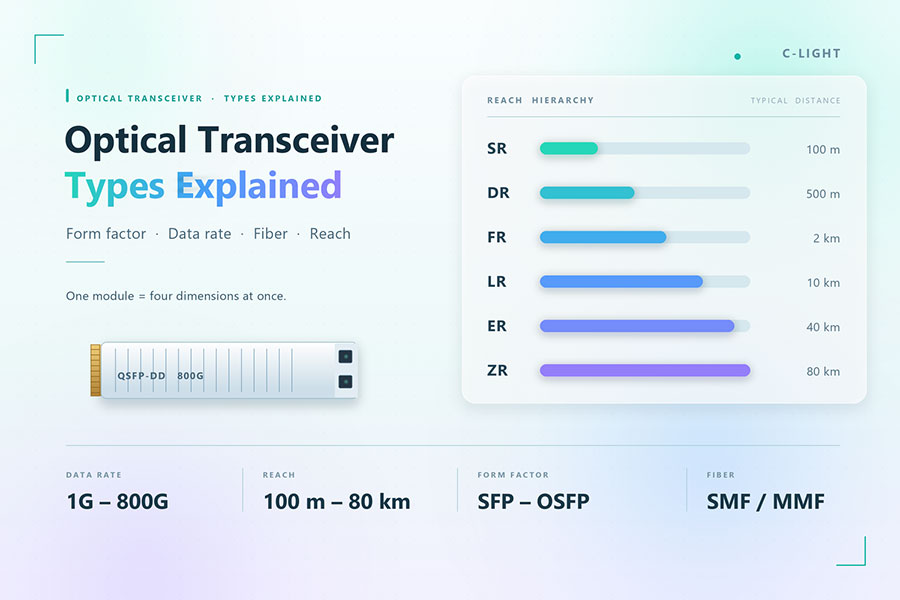
Choosing the appropriate 400G optical architecture depends on the distance between devices, existing fiber infrastructure, port density, and the required optical performance. ER4 is intended for 40km-class links; shorter-reach optics may be more economical when long-distance transmission is unnecessary.
| Optical type | Typical reach class | Fiber | Optical architecture | Typical application |
|---|---|---|---|---|
| 400G DR4 | 500m | SMF | Parallel single-mode optics | Short data center links |
| 400G FR4 | 2km | SMF | Four wavelengths using CWDM | In-building and campus interconnects |
| 400G LR4 | 10km | SMF | Four wavelengths using CWDM | Data center and metro links |
| 400G LR4-20 | 20km | SMF | Extended-reach wavelength-multiplexed optics | Longer enterprise and metro routes |
| 400G ER4 | 40km | SMF | Four-channel LAN-WDM | Extended-reach DCI and transport links |
| 400G ZR / ZR+ | Typically 100km-class and beyond, depending on implementation | SMF | Coherent optical transmission | Long-distance DCI and optical transport |
The reach values above are general solution classes, not substitutes for product-specific specifications. ZR and ZR+ solutions use coherent technology and have different system requirements from direct-detection ER4 optics. For links substantially longer than 40km, compare the optical budget, line-system design, reach target, and total cost before selecting a coherent alternative.
Related product options are available in the 400G QSFP-DD optical transceiver portfolio, including DR4, FR4, LR4, LR4-20, and longer-distance solutions.
6. Applications of 400G QSFP-DD ER4
Data center interconnects
ER4 can support high-capacity connections between data centers or network facilities where a route exceeds the reach of conventional 10km-class optics. The duplex LC interface also fits many existing single-mode fiber installations, subject to link and interface compatibility checks.
Metro and enterprise networks
Enterprise campuses, service-provider facilities, and metro network locations may require 400G connections across extended fiber routes. ER4 provides a potential option when the distance and link budget fit within its supported operating limits.
High-capacity Ethernet aggregation
In networks that aggregate traffic from multiple high-speed access or distribution links, 400G connectivity can increase uplink capacity and reduce the number of physical interfaces required for a given bandwidth target. ER4 extends these benefits to selected long-reach single-mode connections.
AI and high-performance computing infrastructure
Distributed computing facilities may need high-bandwidth links between network domains or separate buildings. ER4 can serve these links when a 40km-class optical interface is suitable. It is not automatically the best choice for every AI cluster: short connections within a rack or data hall may be better served by DAC, AEC, multimode optics, or shorter-reach single-mode transceivers.
7. Compatibility, Installation, and Validation
Successful deployment requires more than selecting a 400G module with the correct physical form factor. Verify the complete link at both ends, including the host platform, optical interface, fiber route, and error-correction configuration.
Host compatibility: Confirm QSFP-DD port support, firmware requirements, recognized module coding, and the specific 400G interface supported by the switch or router.
End-to-end optical matching: Use compatible optical modules on both sides and confirm that the wavelength plan, reach class, and optical specifications match.
Fiber-path inspection: Check the fiber type, LC patching, polarity, connector cleanliness, route length, and measured insertion loss.
Diagnostic checks: Review digital diagnostic information where supported, including module temperature, supply voltage, transmit optical power, receive optical power, and laser bias readings.
Error monitoring: Check link stability, FEC statistics where applicable, pre-FEC and post-FEC errors if exposed by the platform, and packet-error counters during sustained traffic testing.
Operational validation: Test under representative traffic and ambient conditions before placing the link into production.
For projects with multiple equipment platforms or uncertain fiber loss, bench testing and a pilot deployment can help verify interoperability before large-scale installation.
8. Frequently Asked Questions
8.1 What is the maximum transmission distance of a 400G QSFP-DD ER4 transceiver?
The listed reach for the C-LIGHT CL400GQDDER4 is up to 40km over single-mode fiber. Actual achievable distance depends on the installed link loss, optical specifications, fiber condition, and system configuration.
8.2 What is the difference between 400G ER4 and 400G LR4?
ER4 targets a 40km-class reach and uses LAN-WDM technology, while LR4 is generally designed for a 10km-class reach using CWDM. The optical architecture, power budget, and detailed interface characteristics differ, so the appropriate module depends on the intended route and platform requirements.
8.3 Does 400G QSFP-DD ER4 use single-mode or multimode fiber?
ER4 is designed for single-mode fiber. Multimode fiber is intended for different short-reach optical architectures and should not be substituted for the specified ER4 link without an explicitly supported design.
8.4 Can a 400G QSFP-DD ER4 module work in any QSFP-DD switch port?
No universal compatibility can be assumed from the form factor alone. The host must support the relevant 400G Ethernet interface, module power and thermal requirements, management implementation, and vendor compatibility requirements. Check the switch documentation and module datasheet before installation.
8.5 Is ER4 always a better choice than ZR or ZR+?
No. ER4 is a direct-detection solution for a specified extended-reach application. ZR and ZR+ use coherent technology and are designed for different long-distance transmission requirements. The right choice depends on link distance, network architecture, line-system availability, interoperability, and total deployment cost.
9. Summary
400G QSFP-DD ER4 optical transceivers address 40km-class 400G connectivity requirements using four-channel LAN-WDM transmission over single-mode fiber and a duplex LC interface. They are suitable for selected data center interconnects, metro links, enterprise infrastructure, and distributed computing networks where the optical link budget and host interface align with the module specifications.
For a reliable deployment, confirm the precise product datasheet, supported Ethernet interface, fiber loss, connector path, FEC configuration, host compatibility, and environmental requirements. These checks help establish whether ER4 is the most appropriate solution for the intended route.
Need a 400G optical solution for a long-reach network?
Review the 400G QSFP-DD product range or contact the technical team to discuss reach requirements, host compatibility, and optical link validation.
Contact C-LIGHT >

 >
 >
 >
 >
 >
 >
 >