TEL:+86 132 6656 7067





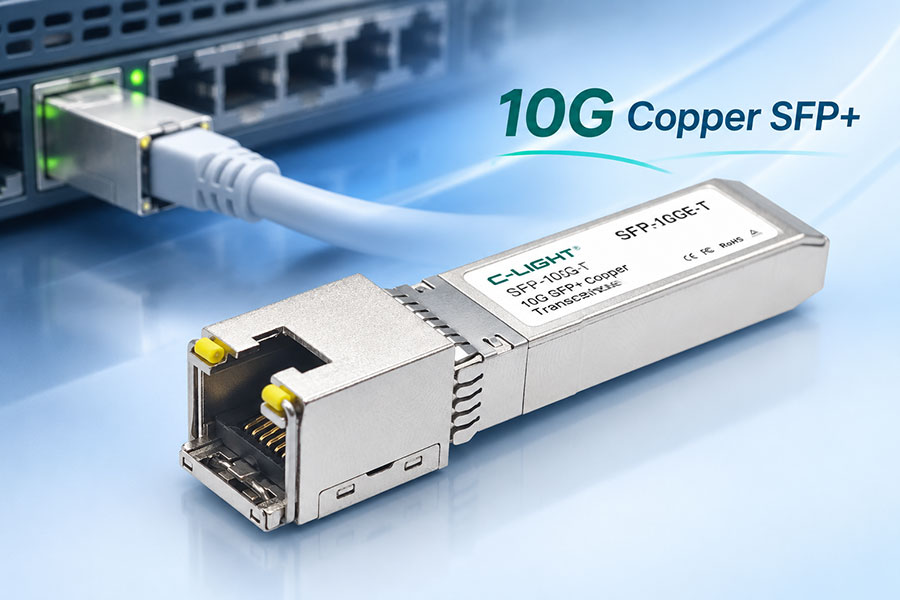
10G copper SFP+ transceivers provide 10 Gigabit Ethernet connectivity through an RJ45 port installed in a compatible SFP+ switch or network device. They allow network operators to connect servers, switches and other Ethernet equipment using twisted-pair copper cabling rather than optical fiber. Multi-rate models can also support lower Ethernet speeds, making them useful for mixed-speed enterprise networks and short-distance data center connections.
1. What Is a 10G Copper SFP+ Transceiver?
A 10G copper SFP+ transceiver, commonly called a 10GBASE-T SFP+ module, is a pluggable network interface that converts the host's SFP+ electrical signaling into 10GBASE-T Ethernet over twisted-pair copper cable.
The module plugs into a compatible SFP+ port and provides an RJ45 socket for a standard Ethernet patch cable. At the host side, it interfaces with the SFP+ electrical connection; at the cable side, its integrated copper PHY handles the signaling required for 10GBASE-T communication.
Unlike an optical SFP+ module, a copper SFP+ transceiver does not transmit data using a laser and optical fiber. It provides an electrical Ethernet connection over copper cabling, making it suitable for applications where RJ45 connectivity and short link distances are preferred.
2. How 10GBASE-T Copper SFP+ Works
The module contains copper Ethernet physical-layer circuitry that processes the high-speed electrical signal and transmits data through the RJ45 interface. The connected device must support a compatible Ethernet mode for the link to establish correctly.
For a typical switch-to-server connection, the switch's SFP+ port hosts the copper module, and an Ethernet cable connects the module's RJ45 socket to the server's 10GBASE-T network port. The server can then communicate with the switch over the configured Ethernet link.
Host-Side Interface
The module uses an SFP+ electrical interface compatible with the host port's supported signaling and module specifications.
Copper-Side Interface
The RJ45 connector provides 10GBASE-T Ethernet connectivity over supported twisted-pair cabling.
Multi-Rate Operation
Supported models can negotiate a common Ethernet speed with the link partner, depending on the module and host capabilities.
Module Management
Depending on the model, the host may access module identification, temperature, voltage or other diagnostic information.
Multi-rate support must be verified for the exact model. The presence of an RJ45 connector does not guarantee that every SFP+ copper module supports 1G, 2.5G, 5G and 10G operation.
3. Key Specifications of 10G Copper SFP+ Modules
| Parameter | Typical Specification | Selection Consideration |
|---|---|---|
| Form factor | SFP+ | Host equipment must support the specific copper module. |
| Maximum data rate | 10Gbps | Confirm 10GBASE-T support at both ends. |
| Cable connector | RJ45 | Matches standard twisted-pair Ethernet patch cables. |
| Transmission medium | Balanced twisted-pair copper | Cable category and installation quality affect supported performance. |
| Typical 10G reach | Up to 30m for many standard 10GBASE-T SFP+ modules | Some specific designs advertise longer reach under defined cable conditions. |
| Supported speeds | Model-dependent; may include 10G, 5G, 2.5G and 1G | Check supported rates and negotiation behavior. |
| Power consumption | Varies by design; some modules require around 2–3W or more | Verify maximum power against the host's port budget. |
| Thermal requirements | Depends on module power and operating-temperature rating | Check cage airflow, neighboring modules and switch limits. |
| Management | Model-dependent diagnostics | Confirm supported telemetry and host reporting behavior. |
These are general selection guidelines, not universal specifications. Copper modules can consume more power and generate more heat than comparable short-reach optical modules, so the host's power and thermal limits deserve particular attention.
4. Copper SFP+ vs. Optical SFP+
Copper and optical SFP+ modules both use the SFP+ form factor, but they serve different cabling and deployment requirements.
| Characteristic | 10G Copper SFP+ | 10G Optical SFP+ |
|---|---|---|
| Network interface | RJ45 | Optical connector, commonly LC duplex |
| Transmission medium | Twisted-pair copper cable | Multimode or single-mode fiber |
| Typical short-reach deployment | Server and switch connections over supported copper cabling | Switch-to-switch or server-to-switch links using optical fiber |
| Common reach examples | Often up to 30m at 10G for standard modules | SR commonly reaches hundreds of meters on suitable multimode fiber; LR commonly supports up to 10km on single-mode fiber |
| Existing cabling | Can reuse compatible copper Ethernet infrastructure | Requires compatible fiber and optical connectors |
| Power and heat | Often relatively high for an SFP+ module | Varies by optical design and reach; short-reach optics are often lower power |
| Distance flexibility | Limited by the copper module and cable specification | Offers options from short-reach to extended-distance links |
For a short link with existing copper cabling, a copper SFP+ module may reduce the need to install fiber. For longer links, dense switch deployments or environments with strict thermal constraints, optical SFP+ modules may be a better fit.
5. Cable Category and Transmission Distance
Cable selection is critical to 10GBASE-T performance. Category 6A cabling is a common choice for 10GbE structured cabling, while many SFP+ copper modules are specifically qualified for shorter links using Cat6A or Cat7 cable.
| Cable Type | Practical Consideration | Deployment Guidance |
|---|---|---|
| Cat5e | Commonly used for lower Ethernet rates; not the default choice for guaranteed 10GBASE-T reach. | Use only where the exact link requirements and equipment specifications support the intended speed. |
| Cat6 | May support 10GBASE-T over limited distances depending on cable construction and installation conditions. | Check the module's cable qualification and the installed channel characteristics. |
| Cat6A | Common choice for 10GBASE-T structured cabling and short copper SFP+ links. | Follow the module's stated reach and cabling requirements. |
| Cat7 | Can support high-performance copper Ethernet when the cable and connection system meet the required specifications. | Confirm connector and channel compatibility rather than relying on the category label alone. |
The total channel includes patch cords, patch panels and other connection points, not just the cable segment between the switch and server. Excessive length, poor termination, electromagnetic interference and installation defects can affect link stability.
6. Power Consumption and Thermal Management
Power consumption is one of the most important considerations when deploying copper SFP+ modules at scale. The integrated 10GBASE-T PHY performs substantial electrical signal processing, and the resulting heat must be removed through the module housing and the host system's cooling path.
In a switch with many populated SFP+ ports, the aggregate module power can become significant. For example, 24 modules consuming 2.5W each would draw 60W in total, excluding the switch ASIC, fans and other components.
Before deployment, evaluate:
Port power budget: Confirm that the host supports the module's maximum power requirement.
Airflow: Check the switch's cooling design and the effect of adjacent modules.
Operating temperature: Verify that the module remains within its specified case-temperature range.
Port density: Consider the aggregate heat generated when multiple copper modules operate simultaneously.
Thermal alarms: Review available diagnostics and host alerts where supported.
A module that works in an isolated test may not be suitable for every port in a fully populated switch. Validate thermal performance in the actual host platform and intended operating conditions.
7. Server and Switch Connectivity Applications
Server-to-switch links
A copper SFP+ module can connect a compatible switch port to a server equipped with a 10GBASE-T RJ45 NIC. This approach is useful when the server already uses copper Ethernet cabling and the link falls within the module's supported distance.
Top-of-rack switching
In a top-of-rack deployment, copper SFP+ modules can provide short-distance connectivity between a switch and nearby server ports. Cable management and port-level thermal limits should be considered when many connections are installed in a compact rack.
Enterprise network upgrades
Organizations upgrading from Gigabit Ethernet may use multi-rate copper modules in compatible platforms to connect devices operating at different Ethernet speeds. This can help preserve parts of an existing copper cabling infrastructure during a staged network upgrade.
Lab and test environments
Short copper links can be practical for network labs, server test benches and equipment validation where RJ45 interfaces are convenient and optical fiber is unnecessary.
8. Multi-Rate Ethernet and Auto-Negotiation
Some 10G copper SFP+ modules support multiple Ethernet rates, such as 10GBASE-T, 5GBASE-T, 2.5GBASE-T and 1000BASE-T. The supported speeds depend on the module's copper PHY, host interface and the capabilities of the link partner.
Auto-negotiation allows compatible endpoints to establish a mutually supported operating mode. However, the module's copper-side rate negotiation does not mean that every host SFP+ port supports all possible Ethernet modes. The host-side electrical interface and software configuration must also be compatible.
When deploying multi-rate modules, confirm:
The supported Ethernet rates listed in the product datasheet.
The host port's electrical interface and operating mode.
Whether the switch supports the module's rate negotiation behavior.
The cable category and maximum reach for each supported speed.
Whether the link partner supports auto-negotiation or requires a configured speed.
Do not assume that a module advertised as 10G/5G/2.5G/1G will deliver every rate over the same cable distance. Reach can differ by speed and cable conditions.
9. Switch Compatibility and Deployment Checks
Compatibility involves mechanical fit, electrical signaling, module identification, firmware support, power consumption and thermal requirements. A copper module can fit an SFP+ cage but still be unsupported by the host device.
Before selecting a module, check the switch or router model, hardware revision, software version, supported transceiver list and port configuration. Also verify the module's maximum power and whether the host supports its copper-side Ethernet modes.
For multi-vendor environments, validate the intended module on the target platform whenever possible. Monitor link status, negotiated speed, module diagnostics and interface error counters during acceptance testing.
10. C-LIGHT 10G Copper SFP+ Product Options
C-LIGHT offers a multi-rate copper SFP+ product family with RJ45 connectivity for compatible Ethernet equipment. The family includes modules for different cable distances, speed combinations and operating-temperature requirements.
CLSFP10GTX1 — 10G/5G/2.5G/1G Copper SFP+
This model is listed for multi-rate Ethernet connectivity with an RJ45 interface and a stated maximum reach of 30m. It is suited to compatible short-distance server and switch connections where Cat6A/Cat7 cabling meets the product requirements.
| Parameter | Published Product Information |
|---|---|
| Form factor | SFP+ |
| Supported data rates | 10G/5G/2.5G/1000M |
| Connector | RJ45 |
| Listed reach | 30m |
| Listed power consumption | Up to 2.3W |
| Operating temperature | Commercial-temperature variant listed |
CLSFP10GTX2 — Multi-Rate Copper SFP+ for Extended 5G Reach
C-LIGHT lists this model for 10G/5G/2.5G/1000M operation, with a stated reach of up to 100m at 5G. The specified distance applies to the relevant operating mode and should not be interpreted as a 100m 10G link.
| Parameter | Published Product Information |
|---|---|
| Form factor | SFP+ |
| Supported data rates | 10G/5G/2.5G/1000M |
| Connector | RJ45 |
| Listed reach | Up to 100m at 5G |
| Listed power consumption | Up to 2.3W |
| Cable requirement | Confirm the cable category and channel conditions for the selected rate |
CLSFP10GTX3I — Extended-Reach Multi-Rate Copper SFP+
This C-LIGHT model is listed for 10G/5G/2.5G/1G/100M operation, with an advertised 10G reach exceeding 80m on Cat6/Cat7 cabling under the product's stated conditions. It also lists support for temperature and voltage monitoring and an industrial operating-temperature range.
| Parameter | Published Product Information |
|---|---|
| Part number | CLSFP10GTX3I |
| Form factor | SFP+ |
| Supported data rates | 10G/5G/2.5G/1000M/100M |
| Connector | RJ45 |
| Listed 10G reach | More than 80m on Cat6/Cat7 under specified conditions |
| Power consumption | Up to 1.8W as listed by C-LIGHT |
| Operating temperature | -40°C to 85°C |
| Diagnostics | Temperature and voltage monitoring listed |
11. Copper SFP+ vs. Direct-Attach Copper (DAC)
Copper SFP+ transceivers and passive or active DAC cables both support short-distance network connections, but they work differently.
| Characteristic | RJ45 Copper SFP+ | SFP+ DAC |
|---|---|---|
| Connection type | Pluggable module with RJ45 port and separate Ethernet cable | Integrated cable with SFP+ connectors attached at both ends |
| Host-side signaling | Host SFP+ electrical interface with copper PHY conversion | Direct high-speed electrical connection between compatible ports |
| Cabling | Twisted-pair Ethernet, subject to module and cable specifications | Purpose-built twinax cable |
| Common use | Connecting SFP+ ports to RJ45 server or network interfaces | Connecting two compatible SFP+ ports over a short distance |
| Speed negotiation | May support multiple Ethernet rates depending on the module | Depends on the DAC, host ports and supported link configuration |
| Key constraint | Power, temperature and supported copper reach | DAC length, signal integrity and host compatibility |
A copper SFP+ module is useful when one endpoint has an SFP+ port and the other has an RJ45 Ethernet port. A DAC cable is generally more appropriate when both endpoints have compatible SFP+ ports and the connection is within the supported DAC distance.
12. Troubleshooting 10G Copper SFP+ Links
| Symptom | Possible Cause | Recommended Check |
|---|---|---|
| No link established | Unsupported module, incorrect speed configuration or cabling issue | Verify host support, link-partner capability, cable condition and interface settings. |
| Link negotiates at 1G or 5G instead of 10G | Multi-rate negotiation, cable limitations or endpoint configuration | Check both endpoints' supported speeds and the cable category. |
| Intermittent link flaps | Marginal cable performance, interference, overheating or compatibility issues | Inspect the cable route, review module temperature and examine switch logs. |
| Module temperature is high | High module power, insufficient airflow or host power constraints | Check the module's power rating and the host's cooling configuration. |
| Module is not recognized | Platform restrictions, unsupported identification data or software limitations | Check the switch support matrix, firmware and module compatibility. |
| High interface error counters | Cable faults, electrical interference or PHY negotiation problems | Test the cable, check interface diagnostics and verify the negotiated mode. |
When troubleshooting, record the module part number, host device, negotiated speed, cable type and length, module temperature where available, and switch interface counters. These details help separate cabling faults from module, host or configuration issues.
13. How to Select the Right 10G Copper SFP+ Module
Use the following criteria when choosing a module for a server or switch deployment:
Identify the host port: Confirm that the switch or network device supports the required SFP+ copper module.
Confirm the endpoint: Check the server NIC or other device's supported RJ45 Ethernet speeds.
Measure the cable route: Include patch cords and intermediate connections in the total channel length.
Select the required speed: Verify whether the link needs 10G only or multi-rate support.
Choose the cable category: Match Cat6, Cat6A or Cat7 cabling to the module's published distance and operating conditions.
Check power and cooling: Ensure the host supports the module's maximum power and thermal load.
Validate compatibility: Review the platform support list and test the intended configuration when possible.
For installations requiring longer distances, compare an extended-reach copper SFP+ model with an optical SFP+ alternative. The best option depends on the required reach, existing cabling, port power, cooling and total deployment cost.
14. Frequently Asked Questions
14.1 What is the maximum distance of a 10G copper SFP+ transceiver?
Many standard 10GBASE-T SFP+ modules support up to 30m over specified Cat6A/Cat7 cabling. Some extended-reach models advertise longer links under defined conditions. Always use the exact model's datasheet rather than assuming a universal distance.
14.2 Can a copper SFP+ module connect to a server with an RJ45 port?
Yes, if the module is installed in a compatible SFP+ host port and the server's RJ45 NIC supports a matching Ethernet mode. The cable and distance must also meet the module's specifications.
14.3 Is a 10G copper SFP+ module compatible with every SFP+ switch?
No. Compatibility depends on the switch model, software, supported module list, electrical interface, power budget and thermal requirements.
14.4 Does a copper SFP+ module support 1G and 2.5G Ethernet?
Some multi-rate models support 1G, 2.5G and 5G in addition to 10G. Other models may support fewer rates. Check the exact part number and the host's supported operating modes.
14.5 Is copper SFP+ better than optical SFP+?
Neither is universally better. Copper SFP+ provides an RJ45 interface for short links, while optical SFP+ offers different reach options and may reduce module power or heat for some applications. Selection depends on the network design.
14.6 What should be checked when deploying many copper SFP+ modules?
Check aggregate power consumption, host thermal limits, airflow, cable routing, port compatibility and the expected negotiated speeds. These factors become increasingly important in high-density switches.
15. Conclusion
10G copper SFP+ transceivers provide a practical way to connect compatible SFP+ switches to servers and Ethernet devices through RJ45 copper cabling. Standard 30m modules suit many short-distance links, while selected multi-rate models offer additional speed options or extended reach under specified cable conditions.
Reliable deployment depends on matching the module to the host, endpoint, cable category, link distance and thermal environment. C-LIGHT's copper SFP+ product family includes 30m, 5G extended-reach and industrial-temperature options, allowing network designers to select a configuration based on the actual connection requirements.
Need a copper SFP+ solution for server or switch connectivity?
Confirm the host model, required Ethernet speed, cable type and link distance to identify a suitable module.
 >

 >
 >
 >
 >
 >
 >
 >