TEL:+86 132 6656 7067





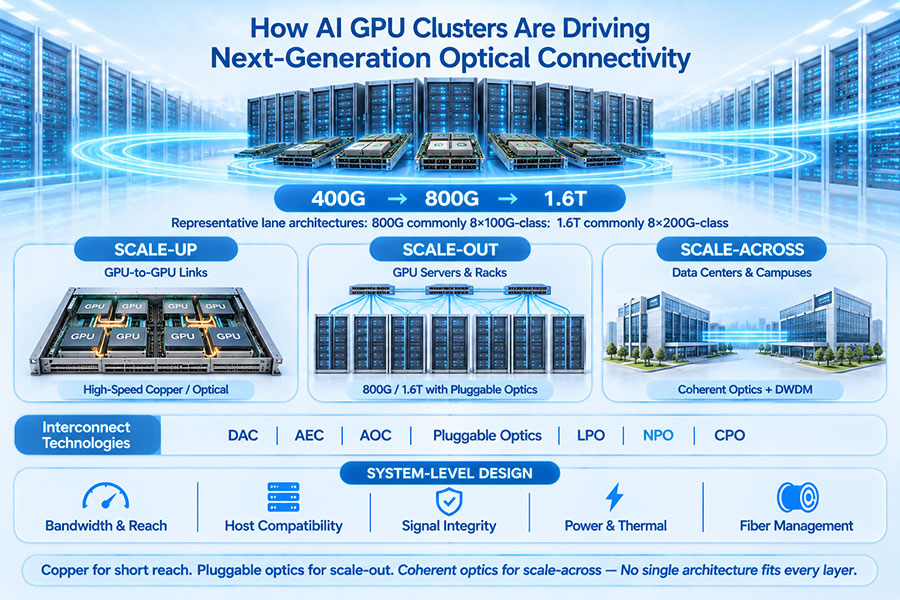
AI data centers are placing unprecedented demands on network infrastructure. Large training clusters connect hundreds or thousands of accelerators through high-capacity fabrics, generating continuous traffic during distributed training, collective communication and data exchange. As accelerator performance increases, the network must deliver more bandwidth without allowing interconnect power, signal degradation and physical port density to become limiting factors.
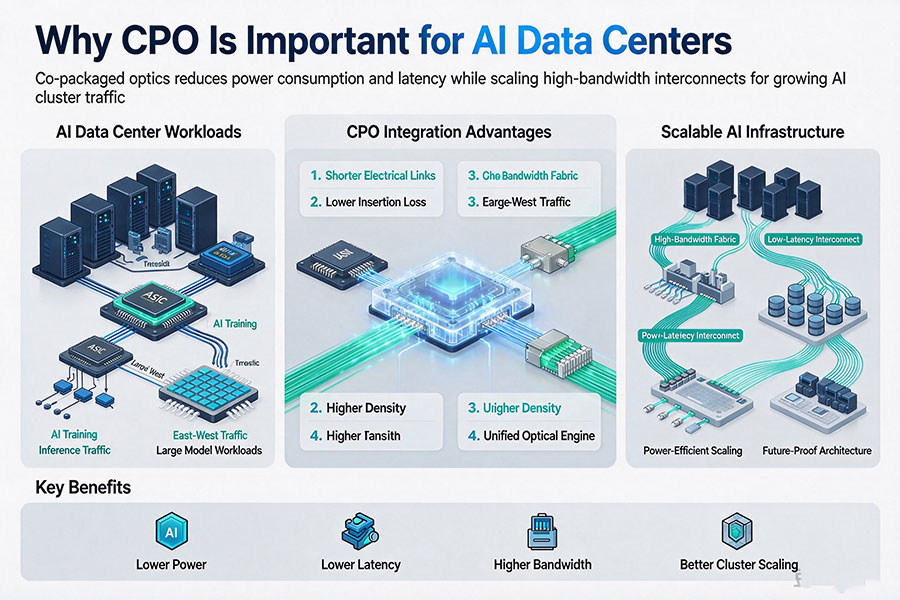
Traditional pluggable optical transceivers have supported data center networking for years, but the electrical connections between switch ASICs and front-panel modules become increasingly difficult to scale at higher data rates. Co-Packaged Optics (CPO) addresses this challenge by integrating optical engines close to the switching chip. This architecture can reduce electrical interconnect losses, increase optical bandwidth density and improve the energy efficiency of high-capacity AI networks.
CPO is not simply a replacement for every pluggable transceiver. Its importance lies in providing another way to scale optical I/O as AI infrastructure moves toward higher switch capacities, faster SerDes lanes and denser accelerator interconnects.
1. AI Data Centers Are Creating New Network Bottlenecks
Modern AI training depends on communication between accelerators as well as computation within individual GPUs or other processing devices. Distributed workloads frequently use operations such as AllReduce, AllGather, ReduceScatter and All-to-All communication to exchange model parameters, gradients and intermediate data.
When hundreds or thousands of accelerators participate in a workload, network performance can influence how efficiently the computing resources are utilized. Congestion, insufficient bandwidth and communication delays can affect collective operations and increase the time required to complete distributed jobs.
AI infrastructure therefore needs network systems that can scale alongside accelerator performance. Several constraints are becoming more significant:
Higher aggregate bandwidth: More accelerators and faster computing devices generate increasing traffic between servers and switches.
Higher per-lane data rates: Faster electrical SerDes interfaces place greater demands on PCB channels, connectors and signal conditioning.
Increasing port density: Switches need more high-speed optical connections within limited front-panel and chassis space.
Power and cooling limits: Optical modules, switch ASICs and electrical interfaces all contribute to the power and thermal requirements of network equipment.
Scalable network topology: AI clusters require sufficient path capacity and predictable communication performance as the number of connected devices grows.
These constraints are related. Increasing switch capacity without improving the optical and electrical interfaces can simply move the bottleneck from the switching chip to the network connections around it.
2. Why Traditional Pluggable Optics Face Scaling Pressure
Pluggable optical transceivers are widely used because they provide a modular, serviceable way to connect switches, servers and other network equipment. A transceiver is installed in a front-panel cage, where it converts electrical signals from the host into optical signals for fiber transmission and converts received optical signals back into electrical form.
The challenge is the electrical path between the switch ASIC and the front-panel transceiver. High-speed signals must travel through package connections, PCB traces and connectors before reaching the module. As lane rates increase, this channel introduces greater insertion loss, reflections and crosstalk challenges.
Conventional DSP-retimed optical modules compensate for electrical signal degradation through additional processing. This improves link tolerance, but the DSP and associated circuitry consume power and generate heat. LPO and LRO architectures attempt to reduce module-side processing, but they still depend on the electrical channel between the host and the front-panel module.
Port density creates another constraint. Each pluggable module requires physical space, an electrical interface, fiber access and sufficient cooling. As switch bandwidth grows, accommodating more high-speed modules can become difficult within a fixed chassis size.
3. How CPO Addresses the AI Networking Challenge
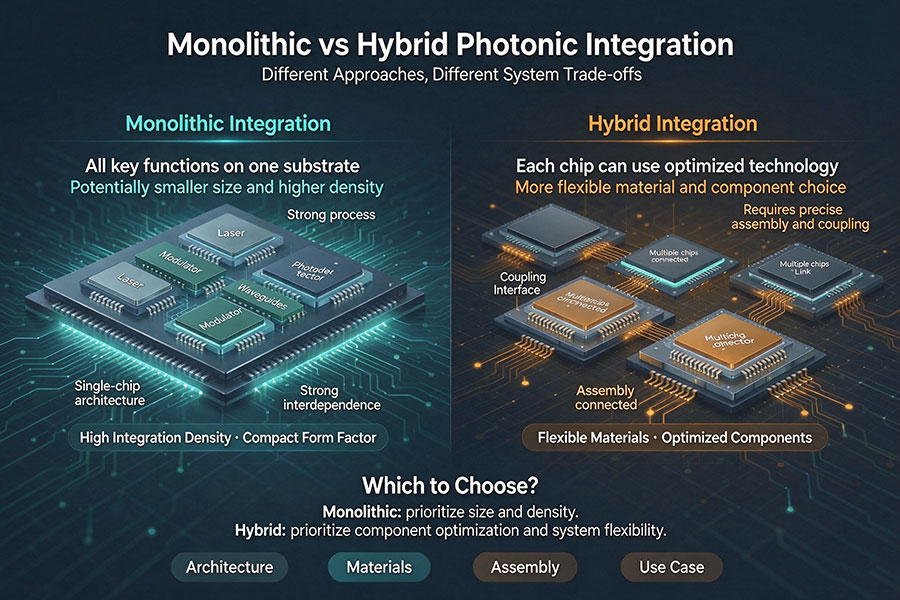
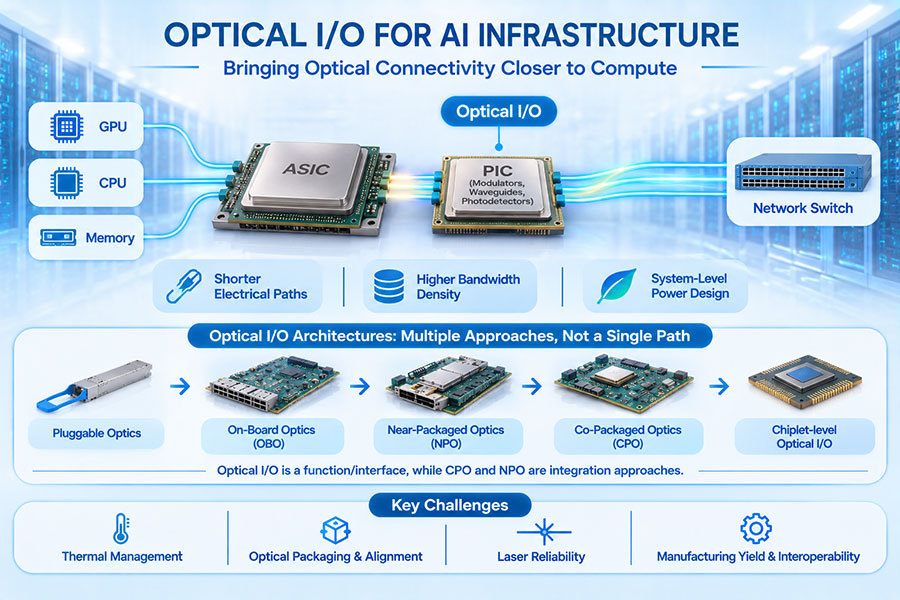
Co-Packaged Optics places optical engines next to the switch ASIC on a shared advanced package substrate or closely integrated package assembly. This changes where electrical-to-optical conversion takes place.
In a conventional pluggable architecture, high-speed electrical signals travel from the ASIC across the board to the front panel. In a CPO architecture, the signals travel over much shorter package-level connections to optical engines located around the ASIC. These engines convert the electrical data into optical signals, which then travel through fiber connections outside the package.
The reverse process occurs for incoming traffic. Photodetectors inside the optical engines convert received light into electrical signals, and the recovered signals are delivered to the switch ASIC through short electrical connections.
A typical CPO system includes several important components:
Switch ASIC: Performs packet processing, forwarding and switching functions.
Optical engines: Provide electrical-to-optical and optical-to-electrical conversion.
Photonic integrated circuits (PICs): Contain optical waveguides, modulators, photodetectors and other photonic components.
Electronic integrated circuits (EICs): Provide electrical drive, amplification and control functions.
Laser source: Supplies optical carriers, often through an external laser architecture.
Fiber connections: Carry optical signals between the CPO package and other network devices.
By moving optical conversion closer to the ASIC, CPO reduces the length of high-speed electrical connections and allows optical I/O to be integrated more closely with the switching system.
4. CPO Helps Reduce Network Power Consumption
Power efficiency is one of the main reasons CPO is attracting attention in AI data center infrastructure. As switch bandwidth increases, the energy required to move data can become a significant part of the overall system power budget.
In a traditional architecture, electrical signals must travel across a relatively long channel between the ASIC and front-panel optical module. Signal loss along this path may require retiming and additional signal-conditioning functions. These functions consume power in both the host and the optical module.
CPO shortens the electrical connection to a package-level path. This can reduce channel loss and lower the need for power-intensive signal compensation between the ASIC and optical engine.
Potential power benefits include:
Lower electrical interconnect power: Shorter connections reduce the electrical channel loss that must be overcome.
Reduced retiming requirements: Some CPO designs can avoid conventional module-side DSP retiming.
Improved energy efficiency per bit: More data can be transferred with less interconnect energy when the complete architecture is properly optimized.
Reduced cooling pressure: Lower interconnect power can reduce the heat generated by the optical I/O subsystem.
Power-saving figures vary by implementation and measurement boundary. For example, Broadcom has published claims of greater than 3.5 times power-consumption savings for its CPO technology, while its October 2025 announcement reported a 65% reduction in optics power compared with pluggable solutions in a particular deployment context. These are vendor-specific results, not universal values for all CPO systems.
A fair comparison must consider the switch ASIC, optical engines, external laser source, host electrical interfaces and cooling system. Module-level or optics-only savings should not automatically be interpreted as the same percentage reduction in total switch or data center power.
5. CPO Increases Optical Bandwidth Density
AI switches must support a growing number of high-speed network connections. Traditional front-panel optics are constrained by the physical dimensions of module cages, connector access, fiber routing and cooling requirements.
CPO changes the way optical interfaces are distributed. Multiple optical engines can be positioned around the switch ASIC, with optical connections routed from the package to fiber arrays. This allows a high aggregate optical bandwidth to be concentrated around the switching chip rather than relying entirely on front-panel module slots.
Higher bandwidth density can help switch designers:
Support greater aggregate optical I/O capacity within a compact package.
Reduce dependence on the available number of front-panel transceiver cages.
Connect high-capacity switch ASICs to more optical channels.
Develop higher-radix network systems without increasing chassis dimensions at the same rate as bandwidth.
Bandwidth density is especially important as switch ASIC capacities advance. The challenge is not simply achieving a higher data rate on one optical link; it is connecting a large number of links while controlling power, package size and thermal load.
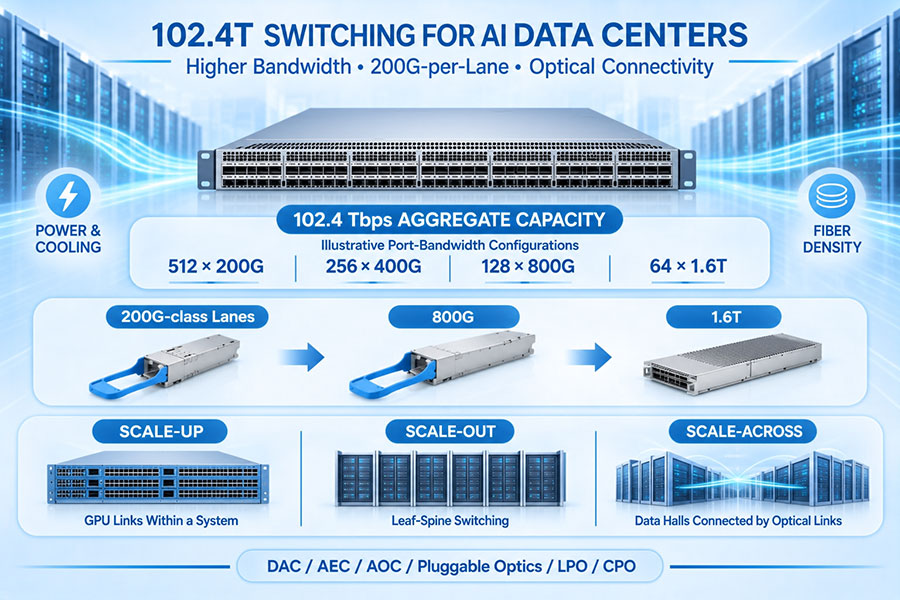
6. CPO Supports the Evolution of AI Scale-Out and Scale-Up Networks
AI data center networking includes several communication domains. CPO can contribute to more than one of them, although the deployment requirements differ according to the distance, topology and type of traffic.
Scale-Out Networking
Scale-out networks connect servers and accelerator nodes across racks and data center clusters. Ethernet and InfiniBand fabrics are common approaches, with leaf-spine and other multi-tier topologies used to provide connectivity and path diversity.
Optical links are important because connections between racks and switches may exceed the practical reach of passive electrical copper. CPO can increase the optical I/O capacity of high-radix switches and reduce the electrical interconnect burden inside those switches.
Scale-Up Networking
Scale-up networks connect tightly coupled accelerators within a server, rack or larger compute domain. These links require high bandwidth and low communication overhead. Copper remains important for many short-reach scale-up connections, but increasing lane rates and bandwidth density are driving interest in optical I/O closer to compute devices.
CPO and related optical I/O technologies can support this transition by integrating optical engines near switching or compute silicon. However, the specific implementation depends on the accelerator architecture, packaging approach and required connection distance.
Scale-Across and Data Center Interconnect
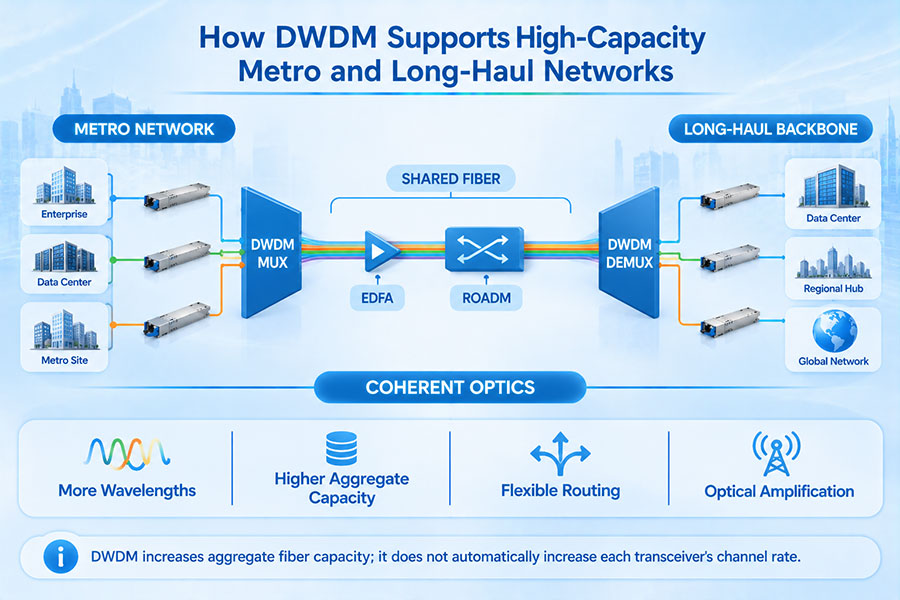
Scale-across networking connects separate data center buildings or facilities. These links often require longer optical reach and may use coherent optics and DWDM systems. CPO can improve the optical I/O density of network equipment, but it does not replace the coherent transmission technology or optical line systems required for long-distance links.
| Network Domain | Primary Connectivity Requirement | Potential CPO Contribution |
|---|---|---|
| Scale-Up | Very high bandwidth between tightly coupled compute devices | Optical I/O close to accelerator or switching silicon as electrical reach becomes constrained |
| Scale-Out | High-capacity connections among servers, racks and switches | Higher optical I/O density and lower ASIC-to-optics electrical interconnect power |
| Scale-Across | Connectivity between buildings or data center facilities | Dense optical interfaces in network equipment, alongside appropriate coherent and DWDM systems |
7. CPO Can Improve the Scaling Path for High-Capacity Switches
AI network switches must handle large amounts of east-west traffic between accelerator nodes. As the number of connected devices increases, switches need higher aggregate bandwidth, more ports and sufficient capacity to avoid excessive oversubscription.
Increasing switch ASIC bandwidth is only part of the challenge. The optical interfaces must also provide enough aggregate capacity to connect the switch to the rest of the fabric. If the ASIC capacity grows faster than the available optical I/O bandwidth, the network design may become constrained by the interfaces rather than the switching core.
CPO addresses this mismatch by allowing many optical channels to be integrated around a high-capacity ASIC. This creates a more direct relationship between switch silicon capacity and optical I/O capability.
For large AI clusters, this can help support:
Higher-radix leaf and spine switches.
Greater aggregate network bandwidth per switch.
More compact optical I/O arrangements.
Reduced dependence on long high-speed electrical traces.
Network designs that can scale with future switch and accelerator generations.
CPO does not automatically solve network congestion or eliminate the need for careful topology design. Oversubscription, traffic distribution, routing, congestion control and failure recovery remain important factors in AI fabric performance.
8. External Laser Sources Help Address CPO Reliability and Thermal Requirements
Laser integration is an important consideration because silicon photonics does not efficiently generate light on its own. CPO systems therefore need a suitable optical source to supply light to the modulators inside the optical engines.
One approach is to use an external laser source (ELS). Instead of placing all laser devices directly beside the high-power switch ASIC, the system uses separate laser modules to supply continuous-wave optical power through fiber connections.
This arrangement can offer several advantages:
Thermal separation: Laser sources can be positioned away from the hottest area of the switch package.
Serviceability: External laser modules can be replaced without replacing the entire switch package.
Reliability management: Laser-related maintenance can be separated from the optical engine and ASIC assembly.
Design flexibility: The laser subsystem can be developed and qualified independently of the main package.
External laser architectures also introduce additional fiber connections, optical coupling losses and power-distribution requirements. The laser source must provide sufficient optical power for the number of channels it serves while maintaining stable output and appropriate operating conditions.
9. CPO Deployment Challenges in AI Data Centers
Although CPO can address several limitations of conventional optical connectivity, integrating photonics and high-performance electronics into one package introduces new engineering requirements.
Thermal Management
Switch ASICs can generate substantial heat, while photonic components may be sensitive to temperature changes. Integrating both close together makes thermal isolation, heat spreading and cooling design critical. Temperature variation can affect laser behavior, modulator characteristics and optical performance.
Optical Coupling and Fiber Attachment
CPO packages require dense optical connections between the photonic engines and external fiber arrays. Precise alignment, low coupling loss and mechanical stability are necessary for consistent performance. Fiber routing must also protect connections from stress and damage during assembly and operation.
Manufacturing Yield
CPO combines electronic dies, photonic integrated circuits, optical interfaces and advanced packaging. A defect in one component or assembly stage can affect the complete package. High-volume deployment therefore depends on repeatable manufacturing processes, test coverage and effective yield management.
Serviceability
Front-panel pluggable optics can usually be replaced individually without removing the switch. An optical engine integrated into a CPO package may be much harder to replace independently. External laser modules can improve serviceability, but failures within the package can still require more extensive equipment maintenance.
Interoperability and Standards
CPO requires coordination across optical interfaces, electrical connections, management functions, packaging and fiber attachment. Industry agreements help define parts of the ecosystem, but a published implementation agreement does not make every vendor's CPO engine or switch automatically interchangeable.
| Challenge | Potential Impact | Engineering Focus |
|---|---|---|
| Thermal interaction | Optical performance variation and reliability concerns | Thermal isolation, heat spreading and operating-temperature control |
| Fiber coupling | Insertion loss and connection instability | Precision alignment, low-loss coupling and mechanical protection |
| Package yield | Higher manufacturing cost and reduced production output | Process control, testing and assembly optimization |
| Repairability | More complex field maintenance | Replaceable external lasers, diagnostics and system-level service planning |
| Interoperability | Limited compatibility across implementations | Defined interfaces, management specifications and platform qualification |
10. CPO vs. Pluggable Optics, LPO and NPO for AI Networks
CPO is one of several architectures intended to improve optical connectivity as data rates and switch capacities increase. Each approach makes a different trade-off between electrical channel length, integration, power, flexibility and maintenance.
| Architecture | Optical Engine Location | Main Advantage | Key Consideration |
|---|---|---|---|
| DSP-Based Pluggable Optics | Front-panel removable module | Mature ecosystem and straightforward replacement | Longer electrical path and module DSP power |
| LPO | Front-panel removable module | Lower module power by removing conventional DSP retiming | Greater dependence on host SerDes and electrical channel quality |
| NPO | Separate optical engine near the ASIC on the host board | Shorter electrical path while retaining a separate engine | Board-level integration and serviceability requirements |
| CPO | Optical engine integrated beside the ASIC on a shared package | Very short electrical path and high optical bandwidth density | Advanced packaging, thermal management and repair complexity |
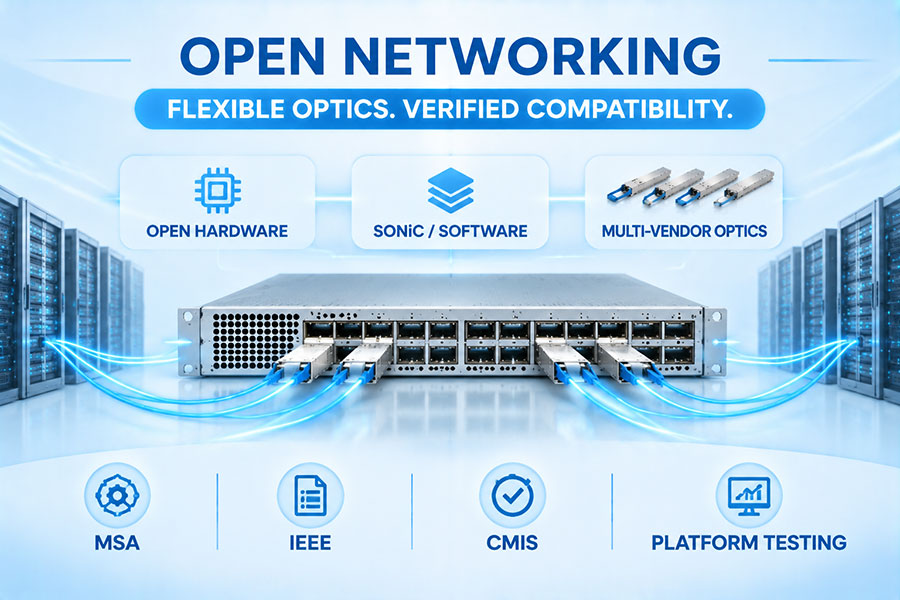
Pluggable optics remain attractive where flexibility, field replacement and multi-vendor compatibility are important. LPO can reduce module power while preserving the pluggable form factor. NPO moves the optical engine closer to the ASIC without fully integrating it into the package.
CPO provides the highest degree of proximity between the switching chip and optical engine among these architectures. It is particularly relevant where electrical channel loss and front-panel density become major constraints, but it also requires more extensive changes to package design and system maintenance.
These approaches are not necessarily mutually exclusive across an entire data center. Different network layers and equipment generations may use different optical architectures according to their bandwidth, reach, cost and serviceability requirements.
11. Industry Development and the Road Toward CPO Adoption
CPO has progressed from research and engineering demonstrations toward commercial switch platforms. The industry is working on optical engine integration, external laser interfaces, package reliability, fiber attachment and system-level testing.
Several developments illustrate this progress:
Commercial platform development: Semiconductor and networking vendors are introducing CPO-based switch and AI connectivity platforms.
Reliability validation: Hyperscale operators and component suppliers are reporting extended operating tests to evaluate link stability and system reliability.
External laser standardization: The OIF has published external laser interface agreements, including ELSFP-02.0 in January 2025.
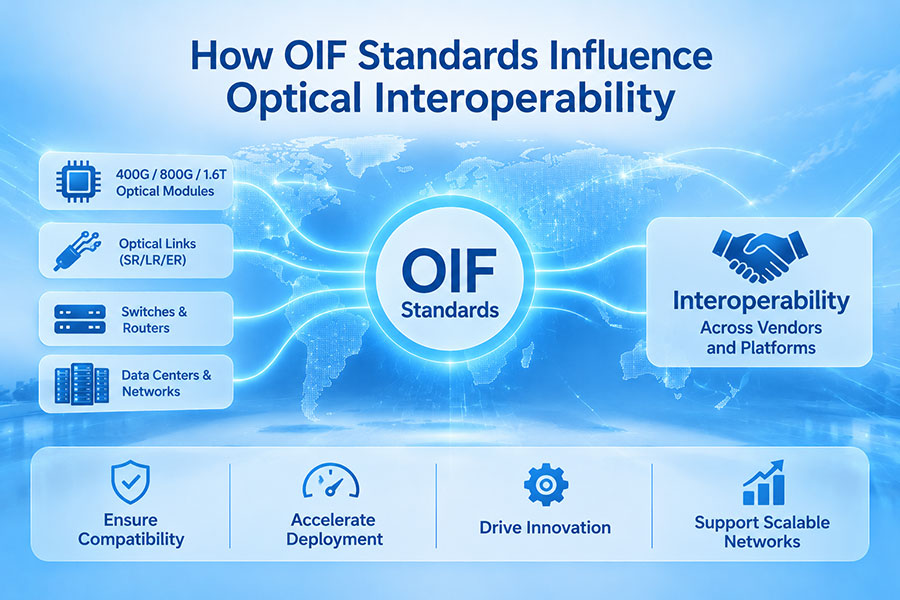
CPO module specifications: The OIF's 3.2T CPO module implementation agreement, published in March 2023, provides a defined reference for aspects of co-packaged optical interfaces.
Research into scale-up optics: Recent technical work is examining how optical I/O can extend beyond traditional switch ports toward closer integration with AI accelerators.
These developments do not mean that CPO will replace pluggable optics across all data center networks in the near term. Adoption depends on manufacturing capacity, system economics, reliability, maintenance models and the pace at which electrical interconnects reach their practical limits.
12. Conclusion
CPO is important for AI data centers because it addresses the growing gap between switching capacity and the ability of conventional electrical and optical interfaces to scale efficiently. By placing optical engines beside switch ASICs, CPO shortens high-speed electrical connections, reduces interconnect loss and creates opportunities for higher optical bandwidth density and lower energy consumption per bit.
These advantages are relevant to high-capacity AI network switches and emerging optical I/O architectures for accelerator connectivity. External laser sources, silicon photonics and advanced packaging are central technologies supporting this transition.
However, CPO also introduces demanding requirements for thermal management, fiber coupling, manufacturing yield, reliability and serviceability. It should be evaluated as a system architecture rather than simply as a replacement for a front-panel optical module.
As AI clusters continue to expand, pluggable optics, LPO, NPO and CPO will each have roles in different network environments. The appropriate choice depends on bandwidth density, transmission distance, platform design, power budget and maintenance requirements. More information about available optical transceiver solutions can support the evaluation of high-speed optical connectivity requirements.
Discuss data rates, host platforms, transmission distances and optical interface requirements with the technical team.
Contact C-LIGHT >

 >
 >
 >
 >
 >
 >
 >