TEL:+86 132 6656 7067





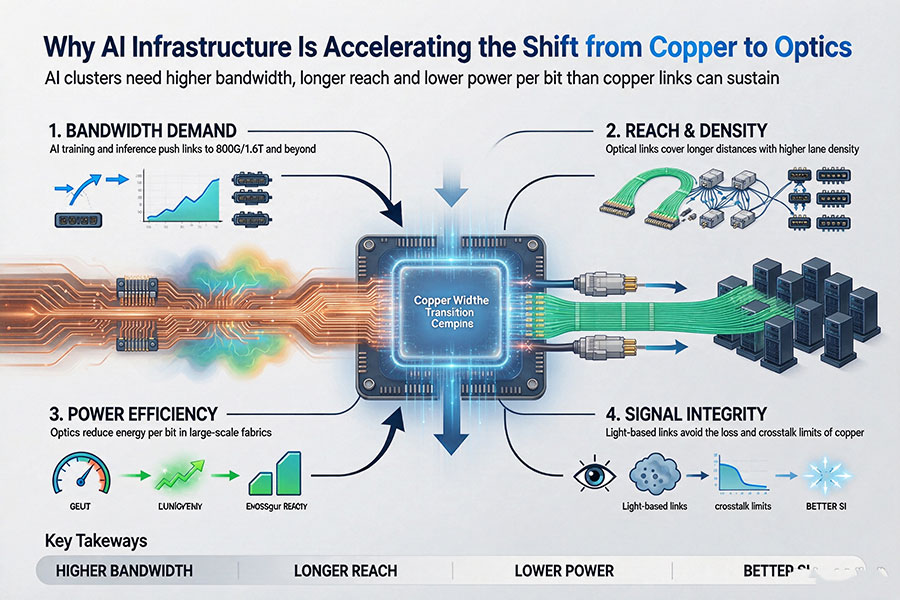
AI infrastructure is changing the economics of data center connectivity. As accelerator clusters grow, the network must move increasingly large volumes of data between GPUs, switches, memory systems and storage. Copper remains effective for short electrical connections, but rising lane speeds, tighter power budgets and higher port densities are making its reach limitations harder to accommodate. Optical interconnects are therefore moving closer to compute and switching hardware, extending their role beyond traditional rack-to-rack and data center links.
1. AI Workloads Are Increasing Interconnect Requirements
AI training and inference depend on communication between large numbers of accelerators. A GPU does not operate in isolation: distributed workloads exchange model parameters, gradients, activations and intermediate results across the cluster. Operations such as AllReduce, AllGather, ReduceScatter and All-to-All can generate substantial network traffic, particularly when models are distributed across multiple servers or racks.
This changes the demands placed on the infrastructure. A conventional enterprise network may prioritize general-purpose connectivity and variable user traffic. An AI fabric must also support sustained high-throughput communication, predictable latency, congestion control and efficient use of accelerator resources. When network links cannot keep pace with compute, accelerators may spend time waiting for data rather than performing calculations.
As clusters expand, connectivity requirements grow at several levels:
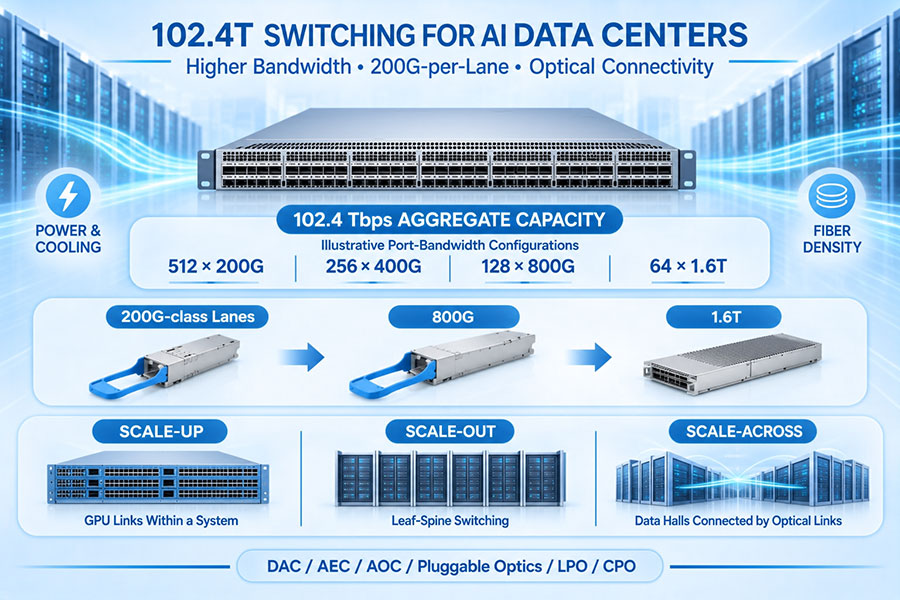
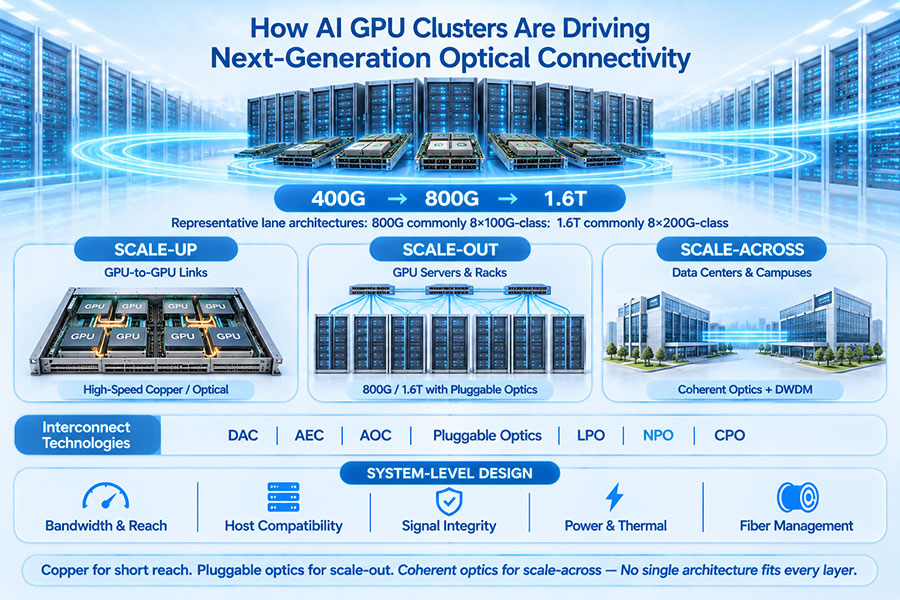
Scale-up: Connections among accelerators within a tightly coupled compute domain. Electrical links remain important in many current rack-scale architectures, but expanding the domain increases the pressure on link bandwidth and reach.
Scale-out: Connections between servers, racks and network switches. High-speed Ethernet and InfiniBand fabrics increasingly rely on optical transceivers and active optical cables for links beyond practical passive-copper distances.
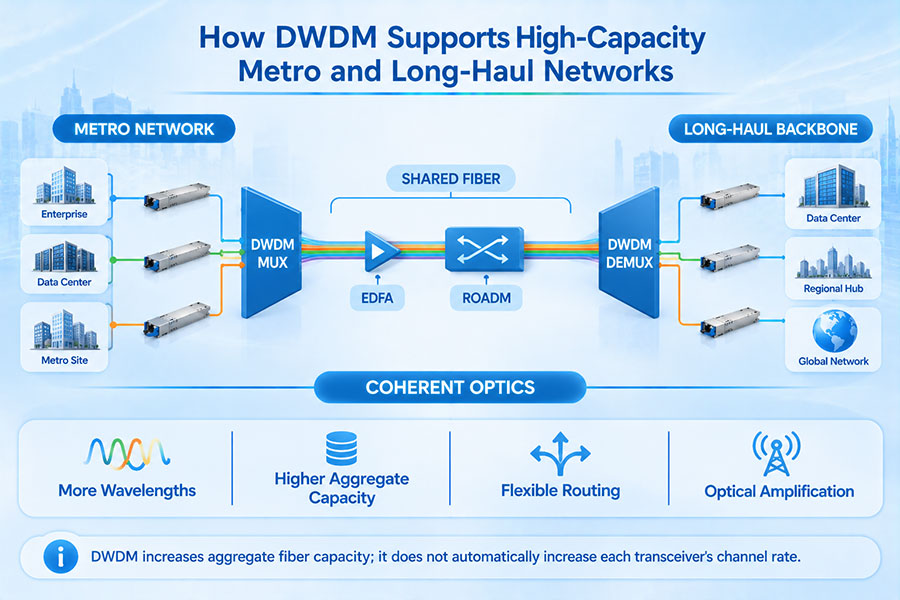
Scale-across: Connections between data center buildings, campuses or geographically separated facilities. Fiber-based transmission is essential for these longer distances, often supported by DWDM and coherent optical technologies.
The result is not simply a need for faster cables. AI infrastructure requires more aggregate bandwidth, more connections, higher bandwidth density and better energy efficiency across the entire network.
2. Higher Electrical Lane Speeds Are Narrowing Copper's Reach
Copper carries electrical signals directly between connected devices. Its advantages are substantial: passive direct-attach copper cables are relatively simple, economical and power-efficient, making them well suited to short connections inside servers and racks.
However, electrical signals lose strength as they travel through copper conductors. At higher data rates, insertion loss, frequency-dependent attenuation, reflections, crosstalk and other channel impairments make signal integrity increasingly difficult to maintain. The receiver must distinguish rapidly changing signal levels despite the degradation introduced by the transmission channel.
As SerDes lane rates increase, the available electrical channel budget becomes more restrictive. Cable construction, connector quality, PCB traces, equalization and host design all influence the maximum practical reach. Active electronics can extend copper connectivity, but they introduce additional components, power consumption, cost and design complexity.
This is particularly important for AI systems using high-radix switches and accelerator platforms. A connection that is practical at one lane rate may become difficult to implement at the next generation without shortening the cable, changing the cable technology or moving the electrical-to-optical conversion point closer to the processor.
3. Optical Fiber Offers a Different Scaling Path
Optical links convert electrical data into light, transmit it through fiber and convert it back into electrical signals at the receiving end. Because optical fiber does not suffer from the same high-frequency electrical attenuation and electromagnetic coupling issues as copper cables, it can support high-speed transmission over distances that are difficult for direct electrical links.
Fiber also offers practical advantages in dense data center environments:
Longer reach: Optical links can connect equipment across racks, rows and buildings without relying on long high-speed electrical channels.
High bandwidth density: Multiple optical lanes or wavelengths can carry large amounts of data through compact fiber assemblies.
Low susceptibility to electromagnetic interference: Fiber does not conduct electrical signals and is not affected by electromagnetic interference in the same way as copper.
Reduced cable bulk over longer distances: Fiber assemblies can be easier to route than large bundles of high-speed copper cables, although connector protection and bend-radius requirements remain important.
Architectural flexibility: Optical links can connect pluggable transceivers, active optical cables, near-package optical engines and co-packaged optical systems.
Optics do not eliminate every connectivity challenge. Optical modules still require electrical interfaces, laser sources, photodetectors, thermal management and control circuitry. Fiber links also require careful attention to insertion loss, connector cleanliness, polarity, optical power budgets and compatibility. The advantage is that optical transmission provides a more scalable medium when electrical reach and density become limiting factors.
4. Power Consumption Is Becoming a System-Level Concern
Power efficiency is one of the strongest drivers behind the copper-to-optics transition, but the comparison depends on the complete link architecture. Passive copper cables consume no power themselves, and short copper links can be more energy-efficient than optical alternatives. The situation changes when electrical channels require retimers, stronger equalization or other active circuitry to maintain signal integrity.
At high speeds, power is consumed by SerDes circuits, transmitters, receivers, DSPs, retimers and supporting components. The location of these components also matters. A long electrical path between a switch ASIC and an optical module can require more signal conditioning than a design that places the optical engine closer to the ASIC.
Optical architectures are evolving to reduce this overhead:
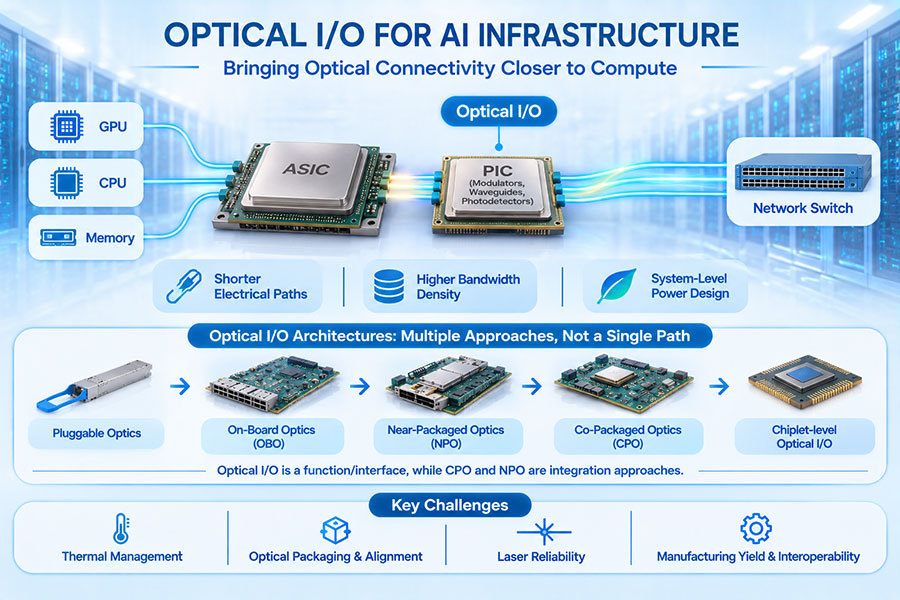
Conventional pluggable optics: Optical conversion takes place in a removable module installed in a switch or server port. This approach offers established serviceability and a mature supply chain.
Linear-drive pluggable optics (LPO): The architecture reduces or removes conventional retiming DSP functions in the module, relying more heavily on the host electrical interface and system-level signal design. It can reduce power and latency, but places greater demands on host and link engineering.
Near-package optics (NPO): Optical engines are placed close to the main ASIC, shortening the high-speed electrical connection between them while retaining a degree of separation from the package.
Co-packaged optics (CPO): Optical engines are integrated within or alongside the switch ASIC package, reducing the length of high-speed electrical paths and increasing opportunities for bandwidth density and power optimization.
These approaches are not interchangeable solutions for every platform. Their suitability depends on thermal design, manufacturing yield, fiber attachment, field replacement, optical engine reliability, system integration and ecosystem maturity.
5. Bandwidth Density Is Reshaping Data Center Architecture
AI infrastructure is increasing the number of high-speed connections required around each compute and switching platform. A system may need to connect many accelerators, network interfaces and switching devices while operating within strict limits for rack space, power delivery and cooling.
Simply adding more copper cables creates routing and management challenges. Large cable bundles occupy space, restrict airflow and complicate installation. As port speeds rise, maintaining the required electrical channel performance across a dense collection of connections becomes more difficult.
Optical connectivity provides additional flexibility for high-density interconnection. Fiber can be routed through structured cabling systems, patch panels and distribution frames, while MPO/MTP assemblies support multiple fibers in a compact connector format. Duplex LC connections remain common for many two-fiber interfaces.
At the equipment level, optical integration can also change switch design. Moving optical engines closer to the ASIC may reduce the space needed for conventional pluggable cages and create opportunities for higher front-panel or package-level bandwidth density. These benefits depend on the specific platform and should be evaluated alongside serviceability, cooling and fiber-management requirements.
6. Copper and Optics Will Coexist Across Different Connection Distances
The transition is not a complete replacement of copper by fiber. Different connection technologies remain suitable for different distances, bandwidths, power budgets and maintenance requirements. A practical AI data center will generally use a combination of electrical and optical interconnects.
| Connection technology | Typical application | Main advantages | Important considerations |
|---|---|---|---|
| Passive DAC | Short server-to-switch or equipment connections | Low cost, low power and simple deployment | Reach is limited by data rate and electrical channel quality |
| Active copper cable (AEC/ACC) | Short-to-intermediate electrical connections | Active signal conditioning can extend copper reach | Requires power and adds electronic components |
| Active optical cable (AOC) | Server-to-switch and rack interconnections | Integrated optical endpoints and fiber transmission | Fixed cable assembly; endpoint compatibility matters |
| Pluggable optical transceiver | Switch uplinks, server links and rack-to-rack connections | Flexible fiber plant, replaceable modules and multiple reach options | Requires correct wavelength, fiber, connector and optical budget |
| NPO and CPO | High-density connections close to switch or accelerator ASICs | Shorter electrical paths and potential power and density improvements | Integration, thermal management, reliability and servicing complexity |
| Coherent optics and DWDM | Data center interconnect and longer-reach optical transport | High capacity over longer fiber spans and efficient wavelength utilization | Higher system complexity and line-system requirements |
For short connections, passive DAC can remain the most economical option. AEC and ACC solutions can serve applications where additional electrical reach is needed. AOC and pluggable optical modules become attractive when distance, cable density or signal integrity makes copper less practical. NPO and CPO address a different problem: reducing the electrical distance between high-speed silicon and optical transmission.
7. 800G and 1.6T Optics Are Accelerating the Transition
The move toward 800G and 1.6T connectivity reflects the growing bandwidth requirements of AI clusters and high-capacity switching platforms. Higher aggregate data rates require more capable electrical interfaces, optical transmitters and receivers, and increasingly sophisticated thermal and signal-integrity engineering.
800G optical modules are already part of the high-speed data center ecosystem. Form factors such as OSFP and QSFP-DD support different platform designs, while optical interface types such as SR8, DR8, 2DR4 and 2FR4 address different fiber types, lane configurations and transmission distances. Selection must follow the host platform's supported interface and the module's exact optical specifications.
1.6T designs raise the requirements further. They increase the pressure on electrical lane speeds, optical integration, module power consumption and thermal management. This makes the placement of optical conversion increasingly important: keeping a high-speed electrical signal inside a short, controlled region can be more practical than extending it through a long cable or board-level channel.
For network designers, the transition involves more than selecting a higher-speed transceiver. The complete system must account for switch capacity, port configuration, fiber infrastructure, optical budgets, cooling, cable routing and interoperability.
Relevant product information: 800G OSFP Optical Transceiver and Optical Transceiver Solutions.
8. Deployment Challenges Extend Beyond Optical Performance
Although optical technology addresses many limitations of electrical transmission, deployment at scale introduces its own engineering and operational requirements.
Fiber infrastructure and connector management
High-density fiber systems require consistent connector types, polarity, keying and fiber mapping. MPO/MTP trunk cables and breakout assemblies must match the transceiver's lane configuration. Connector inspection and cleaning are essential because contamination can increase insertion loss or cause unstable links.
Thermal management
High-speed optical modules and integrated optical engines generate heat. Dense switch platforms must provide adequate airflow and cooling capacity while maintaining the specified operating temperature. CPO and NPO designs also require careful thermal coordination between optical components and high-power ASICs.
Interoperability and link validation
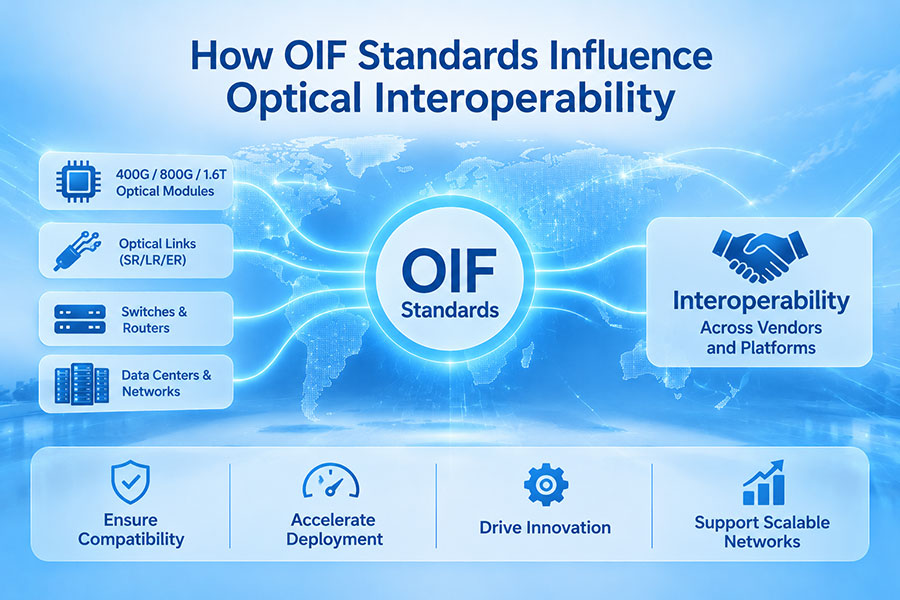
Matching nominal data rates is not sufficient to guarantee a working link. Engineers must verify form factor, electrical interface, optical wavelength, fiber type, connector, transmission distance, FEC behavior, host coding and vendor compatibility. Link validation should include optical power measurements, diagnostics, error monitoring and testing under representative operating conditions.
Reliability and serviceability
Pluggable modules are relatively straightforward to replace in the field. NPO and CPO can reduce electrical channel length, but may make optical engine replacement and fiber handling more complex. Operators must consider failure isolation, repair procedures, spare strategies and system-level reliability before adopting a new architecture.
9. The Future Network Will Be Hybrid, Not Copper-Free
AI infrastructure is accelerating the shift toward optics because network bandwidth, reach and density are becoming central constraints on system scaling. Higher electrical lane rates reduce the practical reach of copper, while optical technologies offer a path to connect equipment across greater distances and support denser high-capacity fabrics.
However, copper remains valuable where connections are short and its cost, power and latency advantages are compelling. Optical adoption will expand according to the requirements of each connection rather than through a single industry-wide replacement event. Pluggable optics, AOCs, LPO, NPO, CPO and coherent transmission will each serve different parts of the network as their ecosystems mature.
For optical connectivity requirements, transceiver selection or customized interconnection solutions, Contact C-LIGHT.
 >

 >
 >
 >
 >
 >
 >
 >