TEL:+86 132 6656 7067





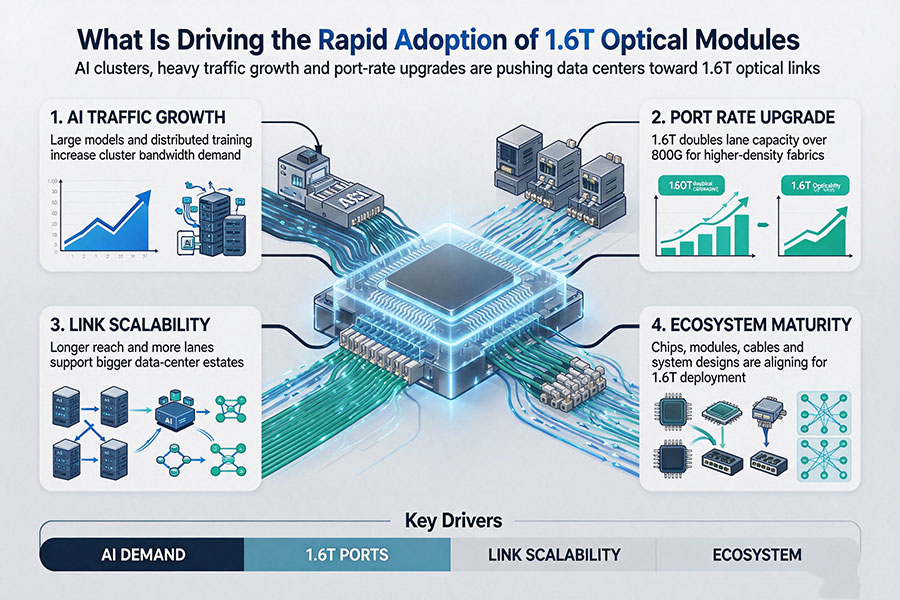
The transition from 800G to 1.6T optical connectivity is becoming a major development in AI data center infrastructure. As hyperscale operators deploy larger accelerator clusters and higher-capacity switching platforms, network interfaces must carry more traffic without proportionally increasing port count, cable density or power consumption. A 1.6T optical module doubles the aggregate data rate of an 800G module, but reaching that capacity also requires advances in electrical signaling, optical components, DSP technology, thermal management and system integration.
1. AI Cluster Growth Is Increasing Demand for 1.6T Bandwidth
AI training and inference increasingly depend on communication among large numbers of GPUs, XPUs and other accelerators. Distributed workloads exchange model parameters, gradients, activations and intermediate data across multiple servers and racks. Operations such as AllReduce, AllGather and All-to-All can generate sustained, high-volume traffic that places significant demands on the network fabric.
As accelerator deployments expand, network capacity must grow alongside compute performance. Adding more 800G ports is one way to increase aggregate bandwidth, but it also increases the number of physical connections, optical modules, switch ports and fiber paths required. Higher-capacity interfaces offer another scaling path: moving from 800G to 1.6T can provide twice the nominal bandwidth per port.
This is particularly relevant to high-radix Ethernet and InfiniBand switches. A 1.6T interface can support greater traffic capacity within a given port footprint, helping network architects build larger fabrics while managing front-panel density and cabling complexity.
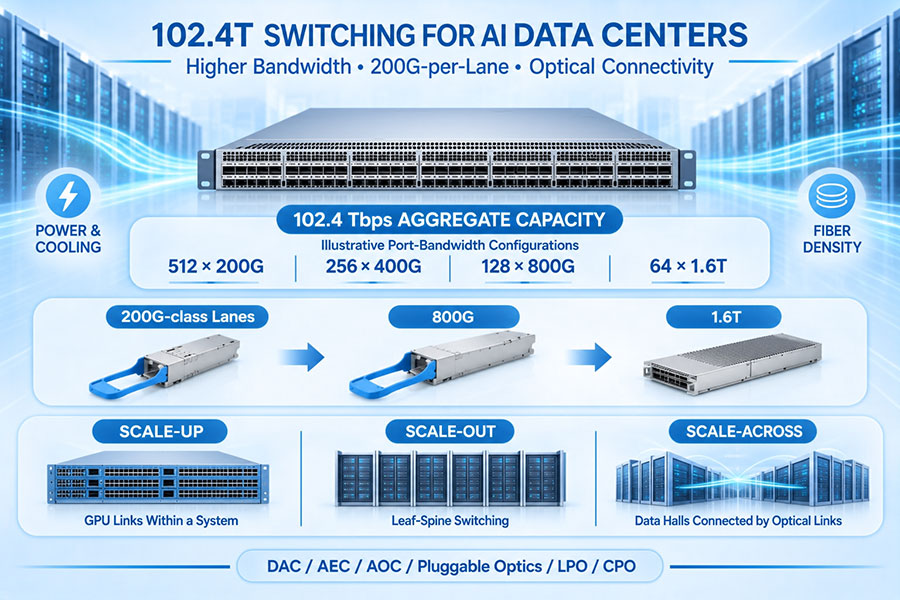
The demand is not limited to one connection layer. Scale-out networks need high-capacity links between servers and switches, while scale-across networks connect data center buildings and campuses. Different optical technologies will serve these applications, but the broader need for higher-capacity interconnects is common to both.
2. The Transition to 200G-per-Lane Signaling Makes 1.6T Possible
One of the most important technical developments behind 1.6T modules is the move toward 200G-class electrical and optical lanes. Rather than doubling the number of lanes used by an 800G design, many 1.6T client interfaces use eight lanes operating at approximately 200Gb/s each.
A common implementation uses eight 200G PAM4 lanes to deliver an aggregate line rate of 1.6Tb/s. PAM4 represents two bits per symbol through four signal levels, allowing more information to be transmitted per symbol than NRZ signaling. This higher spectral efficiency helps increase lane capacity without requiring a proportional increase in symbol rate.
However, doubling lane speed is not a simple component substitution. Higher-speed signaling places stricter requirements on transmitter linearity, receiver sensitivity, channel loss, clock recovery, equalization and error correction. Electrical interfaces must maintain adequate signal integrity between the host ASIC and optical module, while the optical path must meet its own performance requirements.
The IEEE 802.3dj development work and associated 200G-per-lane ecosystem are important to this transition. Commercial product implementations must still be checked against their applicable standards, MSA specifications and vendor datasheets.
3. Higher Bandwidth per Port Improves Network Density
AI data centers must accommodate growing bandwidth requirements within limited rack space, power distribution capacity and cooling infrastructure. Increasing the number of physical ports can create additional challenges in switch layout, cable routing, airflow and maintenance.
Moving from 800G to 1.6T increases the capacity available through an individual interface. In a compatible platform, this can reduce the number of interfaces needed to deliver a given aggregate bandwidth target or provide more capacity through the same number of ports.
For example, a network design that previously required two 800G links to provide 1.6Tb/s of nominal aggregate capacity may be able to use one 1.6T interface instead, provided the switch, host, optical module and network architecture support that configuration. This does not automatically reduce every system's total cost or power, but it creates additional design flexibility.
Higher port capacity also supports breakout architectures. Depending on the module and host implementation, a 1.6T interface may support configurations that divide its aggregate capacity into multiple lower-speed connections. These options can help connect different generations of equipment, although breakout support must be confirmed for the exact product.
4. Power Efficiency and Thermal Constraints Are Shaping Module Design
Power consumption is a major consideration in large AI data centers. Thousands of high-speed network interfaces can contribute significantly to the total electrical load and cooling requirements. As data rates increase, the power consumed by DSPs, drivers, TIAs, laser sources and other electronic components becomes an important part of system design.
A 1.6T module cannot be evaluated only by its aggregate data rate. Engineers also need to consider power per bit, module temperature, optical performance under thermal stress and the cooling capability of the host platform.
Several technology approaches are being developed to improve the efficiency of high-speed optical connectivity:
Advanced optical DSPs: Newer process technologies and architecture optimizations aim to increase processing capability while reducing power consumption per transmitted bit.
Silicon photonics: Photonic integration can combine multiple optical functions on a silicon platform, potentially improving integration density and manufacturing scalability.
Linear-drive optics: LPO and related linear architectures reduce or remove some conventional module DSP functions in suitable systems. They can lower power consumption, but require careful host-channel design and interoperability validation.
Improved thermal design: Module housing, heat-transfer interfaces, airflow and switch-level cooling must be designed around the power and temperature characteristics of the complete platform.
These approaches involve trade-offs. A lower-power architecture may place greater demands on the host ASIC, while a highly integrated optical engine can introduce different servicing and thermal-management requirements. There is no single design that is optimal for every 1.6T application.
5. New Optical DSPs and 3nm Technology Are Supporting Commercial Deployment
The optical DSP is a central component in many high-speed pluggable transceivers. It processes electrical signals, supports transmission and reception functions, and helps manage the signal impairments associated with high-speed interfaces. At 1.6T, the DSP must support more demanding lane rates while meeting strict power, size and thermal constraints.
Recent platform developments show how semiconductor suppliers are preparing for this generation. In March 2026, Marvell announced an expanded 1.6T optical DSP portfolio, including its Ara-family products and related connectivity technologies. The company described 3nm-based DSP designs, 8×200G transmit-retimed optics and additional options for link reliability and flexible electrical-to-optical lane mapping.
These developments are significant because the 1.6T ecosystem requires more than an optical module design. It depends on coordinated progress in DSPs, SerDes, laser drivers, TIAs, photonic components, packaging and test equipment. The availability of these components influences how quickly module manufacturers can qualify and deliver products at scale.
Advanced semiconductor process nodes can help improve integration and power efficiency, but they do not remove the physical challenges of high-speed optical transmission. System-level performance still depends on the complete electrical and optical signal path.
6. Multiple 1.6T Optical Interfaces Are Emerging
1.6T is an aggregate data-rate category rather than a single optical interface. Different module types use different optical lane arrangements, wavelengths, fiber counts and reach specifications. Selecting a module therefore requires more than checking its 1.6T label.
| Interface type | Optical architecture | Typical application characteristics | Connection considerations |
|---|---|---|---|
| 1.6T DR8 | 8 × 200G PAM4 parallel optical lanes | Short-reach single-mode fiber links, commonly specified around 500m | Parallel-fiber connection; MPO-family connector configuration depends on product |
| 1.6T DR8-2 | 8 × 200G PAM4 parallel optical lanes | Extended-reach parallel single-mode fiber applications, with product-specific reach | Verify fiber count, connector mapping and optical budget |
| 1.6T 2×FR4 | Two groups of four wavelength channels | Duplex-fiber architectures using wavelength multiplexing for longer reach | Typically uses multiple wavelengths and duplex LC interfaces; verify exact implementation |
| 1.6T coherent variants | Coherent modulation and digital signal processing | Longer-reach data center interconnect and optical transport applications | Line-system compatibility, modulation, OSNR and FEC requirements are important |
The table describes broad interface categories rather than universal specifications. Reach, connector type, wavelength plan, power consumption and host interface vary by product. For example, Coherent's published 1.6T-DR8 OSFP product specifies eight 200G PAM4 lanes, a dual MPO-12 interface and a 500m single-mode fiber application. Other 1.6T products can use different optical arrangements.
Engineers should confirm the module datasheet, applicable IEEE or MSA requirements, host port configuration and fiber plant before selecting an interface.
7. Switching Platforms Must Be Ready for 1.6T
Optical module availability alone does not determine adoption. A 1.6T link requires compatible electrical interfaces, switch ASICs, SerDes, firmware, management functions and supporting network infrastructure. If a switch platform does not support the required lane rate or module form factor, a 1.6T transceiver cannot simply be installed as a direct replacement for an 800G module.
Switch capacity is another consideration. Higher-capacity switching platforms can provide the aggregate bandwidth needed to make 1.6T interfaces useful at scale. Network operators must coordinate switch generations, port speeds, breakout configurations, cabling and network topology when planning an upgrade.
Forward error correction also requires attention. FEC behavior is defined by the applicable interface and system implementation. Engineers should verify whether FEC is performed by the host, module or both, and ensure that the transmitter, receiver and switch use compatible configurations.
This platform dependency helps explain why product announcements, sampling, customer qualification and large-scale deployment occur at different times. A module can be technically available before the corresponding switch systems and data center infrastructure are ready for broad adoption.
8. Silicon Photonics and CPO Are Expanding the Design Options
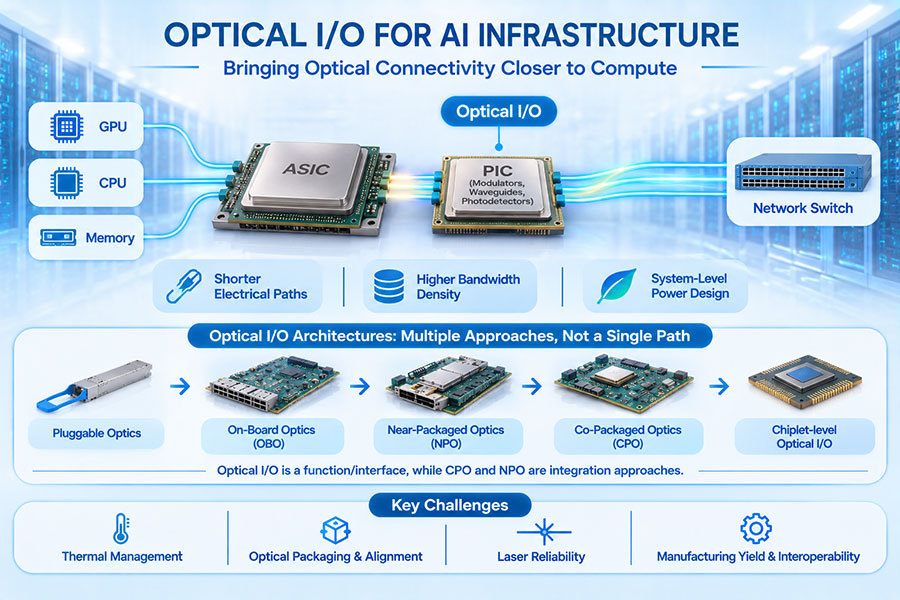
As electrical lane speeds rise, the distance between the switch ASIC and optical conversion becomes increasingly important. Longer electrical channels can require more signal conditioning and consume additional power. This is encouraging interest in optical integration approaches that move the electrical-to-optical conversion point closer to the switching silicon.
Silicon photonics integrates optical functions on a silicon-based photonic platform. It can support compact optical engines and the integration of multiple photonic components. It is a technology platform, not a specific module form factor, and can be used in pluggable as well as more deeply integrated optical architectures.
Near-package optics place optical engines close to the main ASIC while keeping them separate from the chip package. Co-packaged optics integrate optical engines within or alongside the ASIC package. Both approaches aim to shorten high-speed electrical connections and improve bandwidth density and power efficiency.
These architectures are relevant to the wider 1.6T transition, but they should not be treated as immediate replacements for all pluggable modules. Pluggable optics retain advantages in field replacement, maintenance and deployment flexibility. NPO and CPO introduce additional considerations around thermal management, fiber attachment, packaging reliability and serviceability.
9. Supply Chain Capacity Is Becoming a Key Adoption Factor
The 1.6T transition depends on a complex supply chain. Optical modules require high-performance DSPs, laser chips, photodetectors, optical components, substrates, connectors and precision packaging. Increasing production volume requires sufficient component capacity as well as stable manufacturing yields and repeatable test processes.
TrendForce reported in April 2026 that demand for 800G and higher-speed optical transceivers was rising alongside AI data center expansion. Its analysis identified constraints in key optoelectronic components, including EML lasers and continuous-wave laser sources, as well as precision optical alignment and thermal-management challenges. It also noted that suppliers were expanding capacity and using longer-term procurement arrangements to improve component availability.
These constraints matter for 1.6T because its production ramp depends on multiple specialized components becoming available at the same time. A shortage in one critical component can affect the output of the entire module, even when other parts of the manufacturing process have sufficient capacity.
Module manufacturers must therefore invest in optical alignment, assembly automation, high-speed testing, reliability validation and supply-chain coordination. Production capability is not measured only by the number of designs announced; it also depends on qualified products, manufacturing yield and the ability to meet customer delivery schedules.
10. 800G Will Remain Important During the 1.6T Transition
The adoption of 1.6T does not mean that 800G will immediately disappear. Data center operators typically upgrade infrastructure in stages, according to switch refresh cycles, accelerator deployment schedules, network capacity requirements and procurement budgets.
800G platforms already have an established product ecosystem and a growing installed base. They will continue to serve many AI scale-out networks while 1.6T systems move through qualification and deployment. Some operators may use 800G for connections where the available switch platform or network design does not yet require 1.6T capacity.
Industry reporting in 2026 also indicates that 1.6T production is advancing while 800G continues to account for substantial shipment volume. This is a normal feature of a technology transition: new generations enter deployment before the previous generation has completed its commercial lifecycle.
For network planners, the decision should be based on actual bandwidth demand, switch compatibility, power budgets, fiber infrastructure and total cost of ownership rather than on data rate alone.
11. What 1.6T Adoption Means for Optical Network Design
The shift to 1.6T will affect more than transceiver specifications. It will influence the design and operation of AI data center networks in several ways:
Higher-capacity switch interfaces: Network platforms will need to support 1.6T ports and the corresponding electrical signaling requirements.
More demanding optical testing: Transmit power, receiver sensitivity, wavelength accuracy, eye quality, BER and FEC performance require careful validation against product specifications.
Fiber infrastructure planning: Connector type, polarity, fiber count, insertion loss, cleanliness and cable routing must match the selected optical interface.
Thermal and power engineering: Module power, airflow, heatsink design and switch-level cooling must be evaluated together.
Interoperability validation: Host coding, management interface, firmware, lane mapping and optical specifications must be compatible across the complete link.
Lifecycle planning: Operators need to coordinate 800G deployments, 1.6T adoption, spare inventory and future network capacity requirements.
These considerations make system-level validation increasingly important. A higher-speed module delivers practical value only when the entire link operates reliably under the intended conditions.
12. Conclusion: 1.6T Is the Next Step in AI Data Center Connectivity
The rapid adoption of 1.6T optical modules is driven by a combination of AI cluster expansion, rising bandwidth requirements, 200G-per-lane signaling, higher port-density targets and the need to manage power and thermal constraints. Advances in optical DSPs, silicon photonics and high-speed packaging are helping the industry move from product demonstrations toward commercial deployment.
However, the transition depends on more than module performance. Compatible switching platforms, stable component supply, manufacturing capacity, fiber infrastructure and system-level qualification all influence deployment speed. 800G will remain an important part of the market while 1.6T adoption expands across new data center generations.
For optical connectivity requirements, transceiver selection or customized interconnection solutions, Contact C-LIGHT.
 >

 >
 >
 >
 >
 >
 >
 >