TEL:+86 132 6656 7067





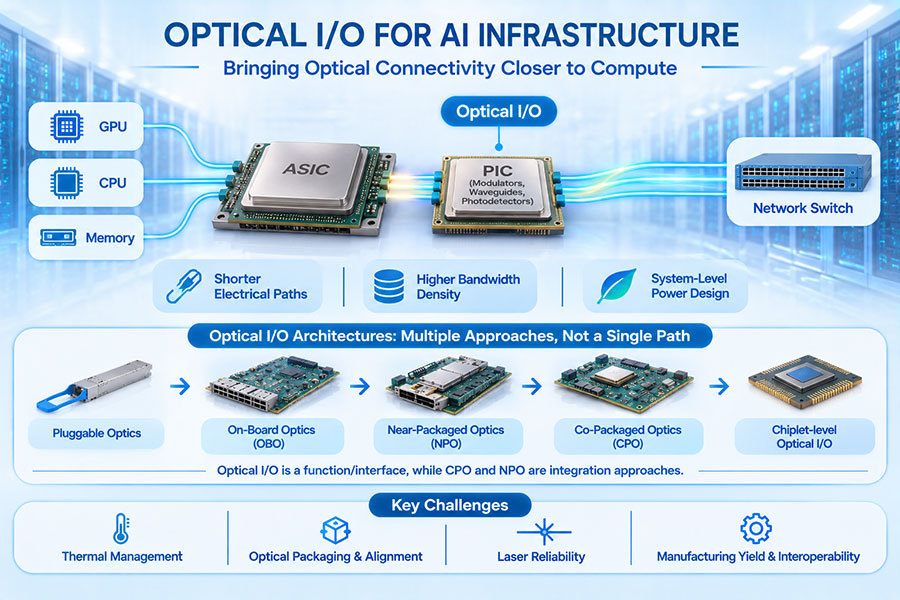
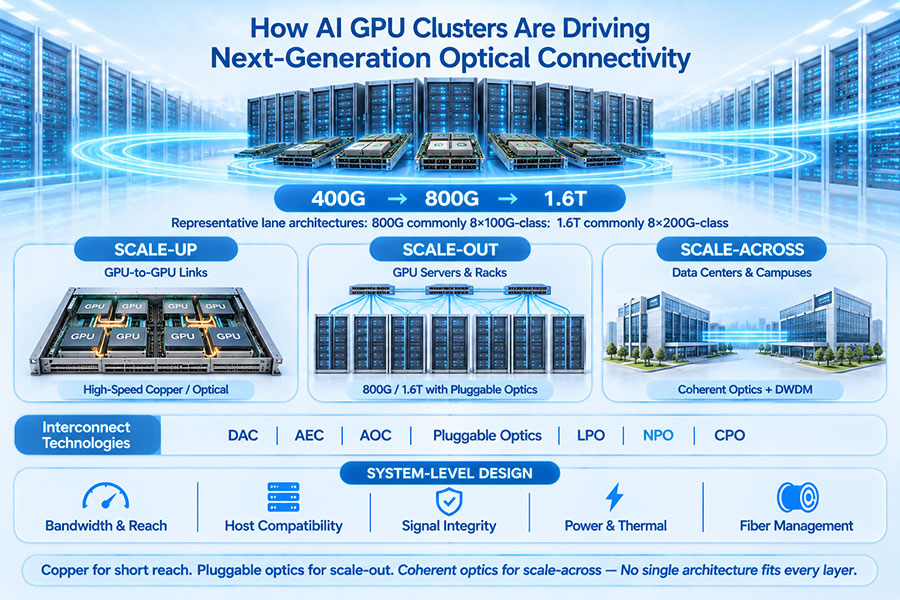
Co-Packaged Optics (CPO) is gaining attention as data center switch bandwidth increases and conventional electrical connections between switch ASICs and front-panel optical transceivers become more difficult to scale. By placing optical engines close to the switching chip, CPO can shorten electrical interconnects, improve bandwidth density and reduce some sources of power consumption. However, integrating photonic devices, electronic circuits, fiber connections and high-power silicon into one package introduces a different set of engineering challenges.
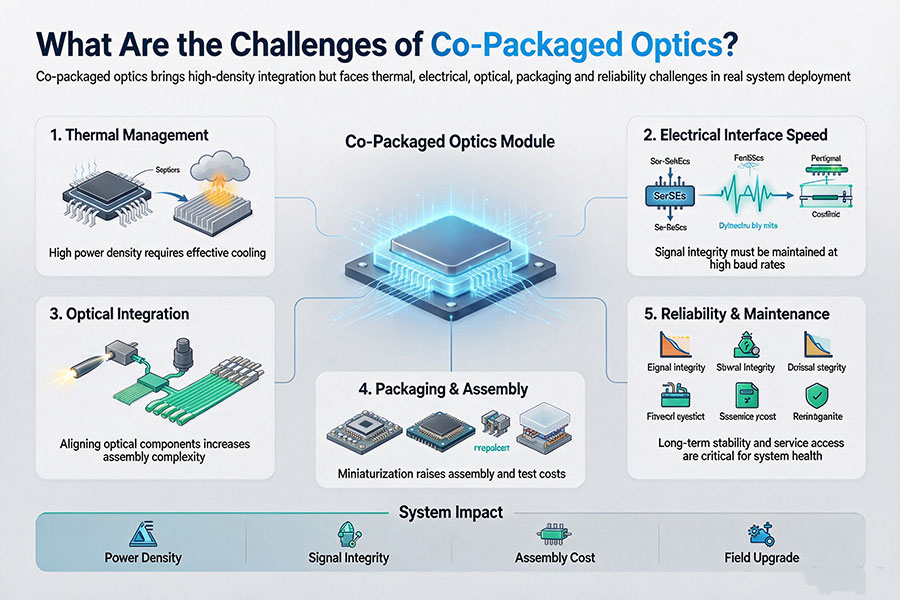
The main obstacles are not limited to optical performance. Thermal management, precision fiber coupling, advanced packaging, manufacturing yield, production testing, reliability and field serviceability all influence whether CPO can be deployed economically at scale. These challenges must be addressed together because a weakness in one part of the package can affect the performance and reliability of the complete switching system.
1. Why CPO Is Technically Challenging
Conventional pluggable optical transceivers are separate components. They can be manufactured, tested and qualified independently before being installed in a switch. CPO changes this arrangement by placing optical engines beside the switch ASIC on a shared advanced package substrate or closely integrated package assembly.
This integration shortens the electrical path between the ASIC and optical engine, but it also brings components with different operating requirements into close proximity. The switch ASIC generates substantial heat, while photonic devices can be sensitive to temperature changes. Optical fibers require precise alignment, and the package must maintain electrical and optical performance despite mechanical stress and thermal cycling.
CPO therefore requires coordinated engineering across several disciplines:
Photonic integrated circuit and electronic integrated circuit design.
Advanced semiconductor packaging and high-density electrical interconnects.
Thermal management and power delivery.
Optical coupling, fiber attachment and connector design.
Wafer-level, package-level and system-level testing.
Reliability qualification, maintenance and supply-chain coordination.
2. Thermal Management and Heat Dissipation
Thermal management is one of the most important CPO challenges. High-capacity switch ASICs can generate substantial heat, while optical engines contain components whose performance may vary with temperature. Placing these devices close together increases the potential for thermal interaction.
Thermal Crosstalk Between ASIC and Optical Engine
Heat generated by the switch ASIC can travel through the package substrate, interposer and surrounding structures toward the photonic components. This thermal coupling can change the operating temperature of modulators, photodetectors and other optical elements.
Temperature changes can affect optical behavior in different ways. For example, microring resonators are particularly sensitive to resonance shifts caused by temperature variation. Their operating wavelength may move away from the intended channel unless temperature control or active tuning is provided.
Different Components Have Different Thermal Requirements
The ASIC, PIC, EIC and laser source do not necessarily have the same preferred operating conditions. A cooling arrangement optimized for the switch ASIC may not provide the ideal temperature stability for every photonic component.
Cooling Architecture
Designers may use heat spreaders, thermal interface materials, package-level thermal isolation, optimized cold plates and liquid-cooling systems. The appropriate solution depends on ASIC power density, package construction, optical-engine placement and system airflow.
Liquid cooling can be useful in high-power CPO systems, but it is not a universal requirement for every implementation. Thermal design must be validated against the actual package and chassis conditions.
Thermal engineering must also consider temperature cycling, not just steady-state temperature. Repeated heating and cooling can create mechanical stress across materials with different coefficients of thermal expansion, potentially affecting package reliability and optical alignment.
3. Optical Fiber Coupling and Alignment
Optical coupling is another major challenge because CPO requires fiber connections to be attached to compact photonic engines with high precision. Unlike conventional electrical connections, optical coupling can be sensitive to very small alignment errors.
The optical fiber core and the waveguide inside a silicon photonic chip have different dimensions and optical properties. Light must transfer efficiently between them. Poor alignment can increase coupling loss, reduce received optical power and weaken the available link margin.
Common coupling approaches include:
| Coupling Method | Operating Principle | Engineering Consideration |
|---|---|---|
| Edge Coupling | Light enters or exits the PIC through a waveguide facet at the chip edge. | Requires accurate lateral, vertical and angular alignment between the fiber and waveguide. |
| Grating Coupling | A grating structure directs light between an optical fiber and an on-chip waveguide. | Coupling efficiency depends on wavelength, polarization and alignment conditions. |
| Lens-Assisted Coupling | Microlenses or other optical elements help focus and direct light between interfaces. | Adds optical components and assembly tolerances that must be controlled. |
Large fiber arrays make the problem more demanding. A package may require many optical channels, and small positioning errors can affect multiple connections. The fiber array unit (FAU), V-groove structure, adhesive, connector and package substrate must all maintain their intended positions.
Mechanical stability is equally important after assembly. Temperature changes, vibration, package warpage and material expansion can shift the relative positions of optical components. A coupling arrangement that performs well immediately after manufacturing must also remain stable over the intended operating life.
4. Advanced Packaging Complexity
CPO relies on advanced packaging technologies to integrate the switch ASIC, optical engines and high-density electrical connections. Depending on the design, this may involve silicon interposers, redistribution layers (RDL), through-silicon vias (TSVs), micro-bumps, 2.5D integration or other heterogeneous packaging techniques.
These structures must support high electrical bandwidth while accommodating optical interfaces and thermal requirements. As package dimensions and the number of integrated components increase, manufacturing tolerances become more difficult to control.
| Packaging Challenge | Potential Impact | Engineering Requirement |
|---|---|---|
| Package warpage | Changes in relative component position and optical alignment | Mechanical modeling, material selection and process control |
| High-density interconnects | Electrical discontinuities, loss and crosstalk | Controlled impedance, routing and interconnect geometry |
| Thermal expansion mismatch | Stress on bumps, interfaces and optical connections | Compatible materials and thermal-cycle qualification |
| Large package dimensions | More difficult fabrication, handling and assembly | Advanced substrate processing and precision assembly |
| Optical engine integration | Higher assembly complexity and potential yield loss | Known-good-die screening and reliable bonding processes |
One important concern is that CPO combines components manufactured through different processes. A photonic die, electronic die and switch ASIC may each pass their individual tests but still encounter problems during final assembly. Package-level performance therefore depends on both component quality and the reliability of the integration process.
5. Manufacturing Yield and Cost
Manufacturing yield is a major factor in determining whether CPO can compete economically with conventional optical connectivity. In a pluggable architecture, optical modules can be tested independently and only qualified units are installed in the switch. CPO requires multiple optical engines and a high-value ASIC to operate together within a tightly integrated package.
This creates a compound-yield problem. If a package contains multiple optical engines, the probability that every engine and its associated assembly process performs correctly affects the final package yield. Even when individual components have high yields, integration-related defects can reduce the number of complete packages that pass final testing.
For example, potential failure sources include:
Defects in PICs, EICs or optical components.
Bonding and interconnect defects during package assembly.
Fiber alignment errors and excessive coupling loss.
Package warpage or mechanical damage.
Thermal performance outside the required operating range.
Electrical or optical performance failures discovered during final testing.
Manufacturers can improve yield through known-good-die testing, more effective assembly process control, optical alignment automation, redundant channels and improved inspection methods. However, these measures may add equipment, test time, material or package complexity.
Cost is also affected by advanced substrates, photonic fabrication, fiber attachment, specialized test equipment and the need for coordinated manufacturing across multiple suppliers. CPO's lower interconnect power does not automatically make the complete system less expensive. The total cost must include manufacturing yield, qualification, maintenance and system-level operating expenses.
6. Testing and Measurement Are More Difficult
CPO requires electrical and optical testing at multiple stages. Conventional semiconductor test equipment can measure electrical characteristics, but photonic devices also require optical access, alignment and measurement of optical performance.
Testing becomes more complicated when the optical engine is integrated into a package with a large switch ASIC. Engineers need to verify not only the individual photonic components but also the electrical interfaces, optical connections and behavior of the complete assembly.
Wafer-Level Testing
Wafer-level testing can identify defects in PICs and EICs before they are integrated into the final package. Photonic testing may require optical probes, fiber alignment systems and specialized instrumentation to measure insertion loss, responsivity, modulation behavior and other optical characteristics.
Package-Level Testing
After assembly, the optical engine must be tested through its actual electrical and optical interfaces. Package warpage, fiber alignment and connector access can make repeatable test connections difficult.
System-Level Testing
Final qualification must confirm that the CPO assembly operates correctly with the switch ASIC and external network interfaces. This includes signal integrity, optical power, BER, thermal behavior, monitoring functions and reliability under representative operating conditions.
| Test Stage | Typical Test Focus | Main Difficulty |
|---|---|---|
| Wafer Level | PIC and EIC functionality, optical loss and electrical characteristics | Optical probe alignment and high-throughput photonic testing |
| Package Level | Electrical interfaces, optical coupling and engine performance | Access to dense interfaces and repeatable test fixtures |
| System Level | BER, link stability, thermal behavior and ASIC interoperability | Testing the complete package under realistic operating conditions |
| Reliability Qualification | Thermal cycling, mechanical stress and long-term performance | Detecting gradual degradation and intermittent failures |
Production testing also needs to scale. A laboratory setup that works for a small number of prototypes may not be suitable for high-volume manufacturing. Automated alignment, repeatable test fixtures, fast measurement sequences and consistent data analysis are essential for improving production throughput.
7. Reliability and Long-Term Operating Stability
CPO places multiple high-value components into a closely integrated assembly. This makes long-term reliability particularly important because a failure in one part of the package may affect the complete optical I/O subsystem or switch.
Several factors can influence operating stability:
Thermal cycling: Repeated temperature changes can stress package interfaces, bonding materials and fiber attachments.
Optical coupling drift: Mechanical movement or material aging can change coupling efficiency over time.
Laser degradation: Laser output power and wavelength stability must remain within the required operating limits.
Photonic component aging: Modulators, photodetectors and other optical components must maintain performance throughout the intended service life.
Electrical interconnect reliability: Package-level connections must withstand operating temperatures and mechanical stress.
Contamination: Dust or particles at optical interfaces can increase insertion loss and affect connection stability.
Reliability testing should therefore cover more than initial optical performance. It should include environmental stress, thermal cycling, mechanical qualification, optical power monitoring and long-duration operation under representative system conditions.
The reliability of the complete CPO assembly also depends on the quality of its individual components and manufacturing processes. A successful prototype demonstration is not, by itself, sufficient evidence of long-term production reliability.
8. Serviceability and Field Replacement
One of the clearest differences between CPO and pluggable optics is maintenance. A conventional optical transceiver can usually be removed from its front-panel cage and replaced without changing the switch ASIC. This modularity makes troubleshooting and network maintenance relatively straightforward.
In a tightly integrated CPO package, the optical engines are located beside or within the ASIC package. If an optical engine fails and cannot be replaced independently, maintenance may require replacing a larger and more expensive assembly.
This creates several operational concerns:
Fault isolation may be more complicated because optical and electronic components are closely integrated.
Replacement may require more specialized procedures and equipment.
Switch downtime can increase if a package-level failure requires system replacement.
Spare-parts planning becomes more dependent on the complete CPO platform.
Upgrades may be less flexible than replacing individual front-panel modules.
External laser sources provide one way to improve serviceability. If the laser module is separately accessible, a failed source may be replaced without removing the entire CPO switch. However, this does not solve every maintenance issue because failures inside the PIC, EIC or package may still require more extensive repair.
Designers are also exploring replaceable optical connectors and modular optical-engine arrangements. These approaches can improve maintenance flexibility, although they may introduce additional interfaces, package area or optical loss.
9. External Laser Source Design and Optical Power Budget
Many silicon photonics CPO architectures use external laser sources because silicon does not efficiently generate light on its own. An external laser can be located away from the high-power ASIC package and supply continuous-wave optical power to the optical engines.
This arrangement can improve thermal separation and make laser replacement easier. However, it introduces additional optical interfaces between the source and the photonic engine.
Each optical connection can contribute insertion loss. The external source must therefore provide enough optical power to compensate for losses in fiber connections, connectors, splitters or other distribution structures, while maintaining the required operating margin.
Key considerations include:
Laser output power and wavelength stability.
Optical distribution loss and coupling efficiency.
Fiber connector reliability and contamination control.
Polarization requirements where applicable.
Laser monitoring, fault detection and replacement procedures.
Thermal conditions and the lifetime of the light source.
External laser sources are therefore a trade-off rather than a complete solution. They can improve serviceability and thermal separation, but the added optical path must be accounted for in the link budget and reliability design.
10. Interoperability, Standards and Ecosystem Maturity
CPO requires cooperation across several technology areas, including switch ASICs, optical engines, photonic components, external laser sources, fiber connectors, package substrates and management systems. Different suppliers may implement these functions in different ways.
Without sufficiently defined interfaces, an optical engine designed for one switch platform may not be compatible with another. Differences can include mechanical dimensions, electrical signaling, optical coupling, management functions and thermal requirements.
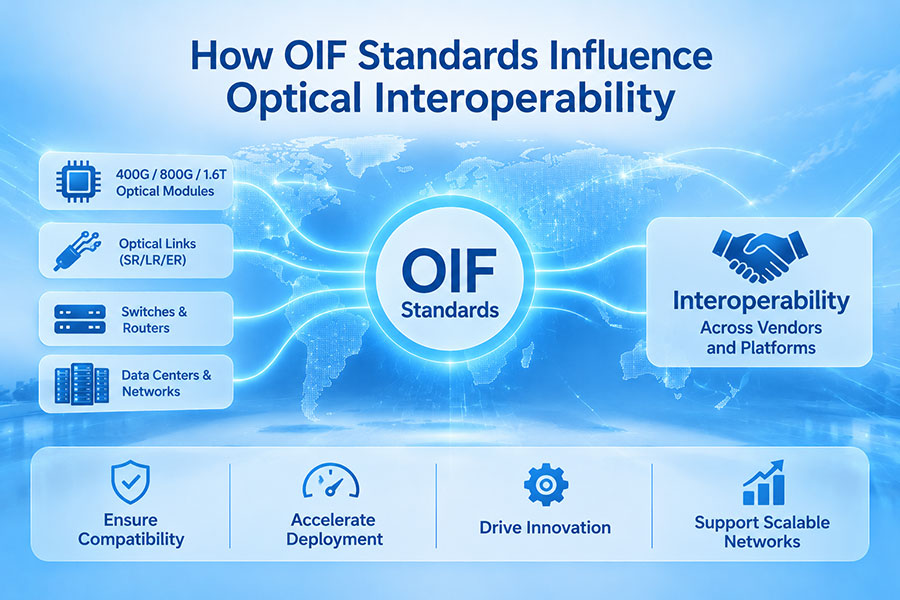
The Optical Internetworking Forum (OIF) has published agreements relevant to co-packaging and external laser interfaces, including:
OIF-Co-Packaging-FD-01.0: Co-Packaging Framework Document, published in February 2022.
OIF-Co-Packaging-3.2T-Module-01.0: Implementation Agreement for a 3.2 Tb/s co-packaged module, published in March 2023.
OIF-ELSFP-02.0: External Laser Small Form Factor Pluggable Implementation Agreement, published in January 2025.
These documents help define parts of the technical ecosystem, but they do not make all CPO products automatically interchangeable. Platform-level qualification and vendor-specific integration remain important.
Ecosystem maturity also affects procurement and long-term support. Data center operators need confidence in component availability, repair procedures, software and management support, spare parts and future upgrade paths before committing to a large-scale architecture.
11. CPO vs. Pluggable Optics: Different Operational Trade-Offs
CPO is designed to address electrical interconnect and bandwidth-density constraints, but it does not eliminate the advantages of pluggable optics. The two architectures have different strengths and operational requirements.
| Evaluation Factor | Pluggable Optical Transceivers | Co-Packaged Optics |
|---|---|---|
| Electrical connection | Longer PCB channel between ASIC and front-panel module | Short package-level connection between ASIC and optical engine |
| Optical engine location | Removable front-panel module | Integrated beside the ASIC |
| Bandwidth density | Constrained by front-panel space and module arrangement | Can provide high optical I/O density around the ASIC |
| Power optimization | Depends on module DSP, host SerDes and electrical channel | Can reduce electrical interconnect and retiming power |
| Maintenance | Individual modules are generally replaceable | Package-level failures can require more extensive replacement |
| Manufacturing | Optical modules can be tested independently | Requires coordinated photonic, electronic and package testing |
| Deployment flexibility | Mature module ecosystem and established replacement practices | More closely tied to the switch platform and package design |
Pluggable optics remain suitable where modularity, field replacement and flexible platform selection are priorities. CPO becomes more attractive when electrical channel limits, optical bandwidth density and system-level power are major constraints. The decision should consider the complete operating environment rather than a single performance metric.
12. What Must Improve Before CPO Can Scale Further?
Wider CPO adoption depends on progress across the complete manufacturing and operational ecosystem. Improvements in photonic devices alone will not be sufficient if package yield, optical testing or field maintenance remain difficult.
Several areas are particularly important:
Better thermal co-design: ASIC, PIC, EIC and laser thermal requirements need to be considered together from the earliest package-design stages.
More reliable optical coupling: Fiber attachment processes must maintain low loss and alignment stability across manufacturing and operating conditions.
Higher package yield: Known-good-die screening, assembly control and improved inspection can reduce integration-related failures.
Automated photonic testing: Wafer, package and system testing need to become faster, more repeatable and suitable for high-volume production.
Improved serviceability: Replaceable external lasers, accessible optical interfaces and better fault isolation can reduce maintenance complexity.
More consistent interfaces: Industry agreements and broader ecosystem participation can improve interoperability and supply-chain flexibility.
Lifecycle cost evaluation: Deployment decisions should include manufacturing, power, cooling, repair, downtime and upgrade costs.
These improvements are interconnected. For example, a more modular optical engine may simplify maintenance but increase package interfaces. A more integrated design may improve density but make repair and testing more difficult. CPO development therefore requires balancing performance, reliability, manufacturing efficiency and operational cost.
13. Conclusion
Co-Packaged Optics can address important scaling constraints in high-bandwidth data center networks, but its implementation introduces challenges that conventional pluggable optics do not face to the same extent. Thermal interaction between the switch ASIC and photonic components, precision fiber coupling, advanced packaging, manufacturing yield, optical testing and field serviceability are among the most important obstacles.
External laser sources can improve thermal separation and replacement flexibility, while advanced packaging and automated testing can help improve production consistency. However, these solutions must be evaluated together with optical loss, electrical performance, long-term reliability and total system cost.
CPO's long-term success will depend not only on achieving high bandwidth and low power consumption, but also on making the complete architecture manufacturable, testable, reliable and maintainable at scale. Pluggable optics will continue to offer advantages in flexibility and serviceability, while CPO is particularly relevant where electrical interconnect limits and optical bandwidth density become critical.
For data center projects evaluating different optical connectivity approaches, the appropriate solution should be selected according to transmission requirements, host platform, power budget and maintenance strategy. More information about available optical transceiver solutions can support high-speed network planning.
Discuss data rates, transmission distances, platform compatibility and optical interface requirements with the technical team.
Contact C-LIGHT >

 >
 >
 >
 >
 >
 >
 >