TEL:+86 132 6656 7067





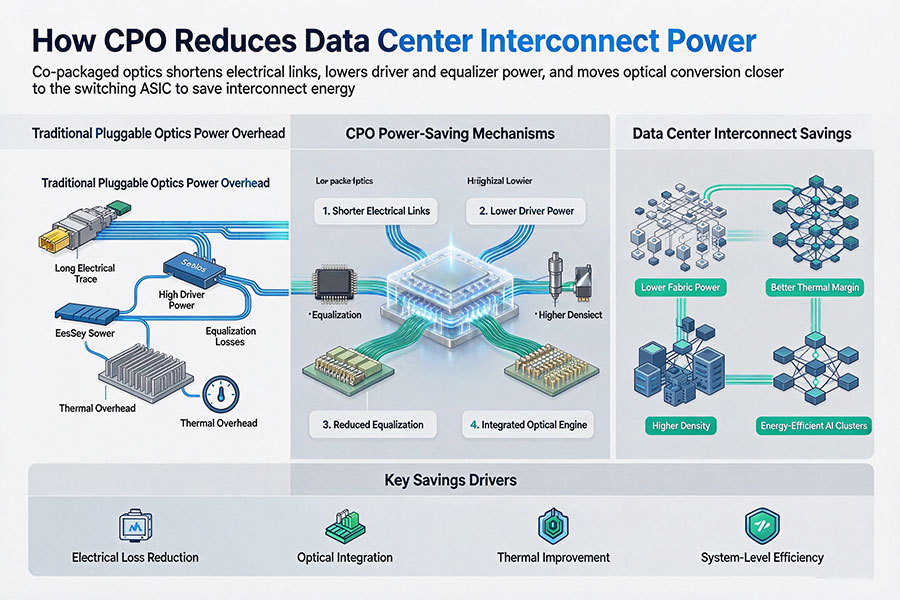
Power consumption is becoming a major design constraint in high-capacity data center networks. As switch ASICs support higher aggregate bandwidth and faster electrical lanes, the energy required to move data between the switching chip and optical interfaces becomes increasingly significant. Conventional pluggable architectures rely on high-speed electrical connections across the switch board, where signal loss and channel impairments can require additional equalization and signal conditioning.
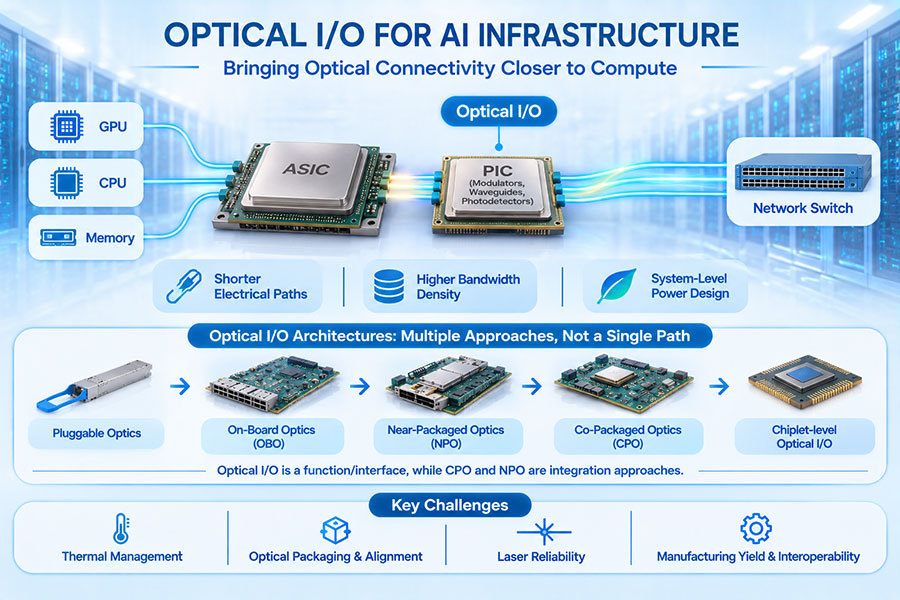
Co-Packaged Optics (CPO) addresses this challenge by placing optical engines directly beside the switch ASIC within a shared advanced package. This shortens the electrical path and moves electrical-to-optical conversion closer to the switching silicon. The result can be lower interconnect power, reduced signal-conditioning requirements and improved energy efficiency per transmitted bit.
However, CPO power savings involve more than removing a DSP or reducing optical module consumption. A meaningful evaluation must include the host SerDes, optical engines, laser source, package design and cooling system.
1. Why Data Center Interconnect Power Is Increasing
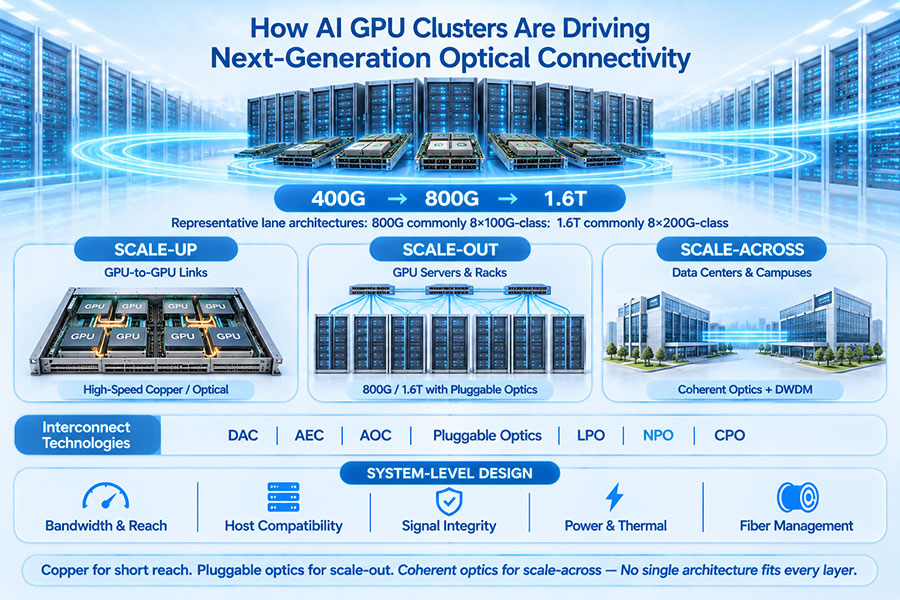
Data center networks carry large volumes of traffic between servers, switches, storage systems and accelerators. AI workloads add further pressure because distributed training and inference require frequent communication among GPUs and other computing devices.
As network bandwidth increases, the electrical interfaces connecting switch ASICs to optical transceivers become more demanding. In a conventional pluggable architecture, high-speed electrical signals travel from the ASIC through package connections, PCB traces and front-panel connectors before reaching the optical module.
These electrical channels introduce several sources of signal degradation:
Insertion loss: Electrical signal amplitude decreases as signals travel through PCB traces, connectors and package interconnects.
Return loss: Impedance discontinuities cause part of the signal energy to be reflected toward its source.
Crosstalk: Adjacent high-speed channels can interfere with one another.
Frequency-dependent attenuation: Higher-frequency signal components can experience greater loss, affecting waveform quality.
Timing uncertainty: Jitter and other impairments reduce the available signal margin at the receiver.
To maintain reliable communication, conventional systems may use retimers, DSP-based equalization and other signal-conditioning functions. These circuits improve link performance but consume additional power.
At high port counts, the power consumed by optical modules and their associated electrical interfaces can become a substantial part of switch-system power. CPO targets this interconnect energy rather than changing the fundamental packet-processing role of the switch ASIC.
2. How CPO Changes the Electrical-to-Optical Interface
In a conventional pluggable design, the optical transceiver is installed at the front panel, physically separated from the switch ASIC. The electrical signal must travel across the switch board before reaching the module's optical engine.
CPO moves the optical engine beside the ASIC on a shared package substrate or closely integrated package assembly. The electrical connection between the two becomes a short package-level interconnect rather than a longer board-level channel.
The outgoing signal path can be summarized as follows:
The switch ASIC processes packets and generates high-speed electrical data signals.
The signals travel through short electrical connections to the adjacent optical engine.
The optical engine's electronic circuitry drives the photonic components.
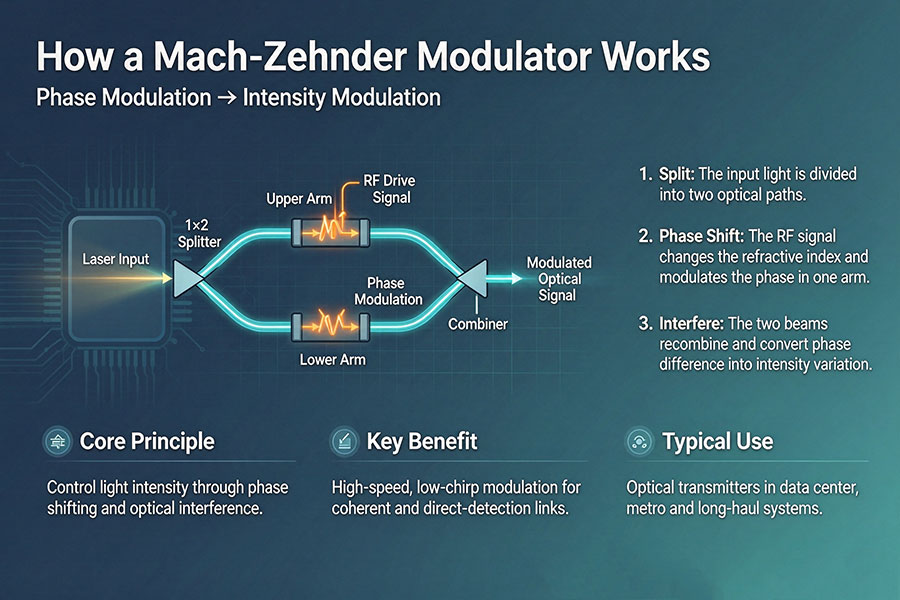
A modulator encodes the electrical data onto light supplied by a laser source.
The resulting optical signals travel through fiber connections to another network device.
The receive path operates in reverse. Photodetectors convert incoming optical signals into electrical currents, TIAs amplify those signals, and the recovered electrical data returns to the switch ASIC through short package-level connections.
3. Shorter Electrical Connections Reduce Signal-Conditioning Power
One of CPO's most important power advantages comes from reducing electrical channel loss between the switch ASIC and optical engine.
In a conventional architecture, the host SerDes must drive a signal through a relatively long electrical path. The receiver must recover that signal despite attenuation, reflections and crosstalk. Depending on the interface and channel characteristics, this may require substantial equalization and retiming.
When the optical engine is placed close to the ASIC, the electrical path becomes much shorter. A shorter channel generally has lower insertion loss and fewer opportunities for signal degradation. This can reduce the amount of electrical compensation required.
The potential benefits include:
Lower electrical drive requirements across the ASIC-to-optics connection.
Reduced equalization effort for the short-reach interface.
Less dependence on long-channel signal-conditioning functions.
Lower energy consumption in the electrical interface.
More favorable signal-integrity conditions at higher lane rates.
The exact reduction depends on the SerDes architecture and the package-level channel design. CPO does not eliminate all equalization, clock recovery or signal processing. The switch ASIC and optical engine still need to maintain the required signal quality for the intended interface.
4. CPO Can Reduce the Power Required by Host SerDes
SerDes circuits convert parallel data into high-speed serial signals for transmission and recover serial data at the receiving end. They are essential components of high-speed switch ASICs, network processors and optical interfaces.
In conventional pluggable architectures, long electrical channels can require SerDes modes designed to tolerate greater loss. These modes may use more power than very-short-reach interfaces because of their stronger equalization and signal-conditioning requirements.
CPO enables a much shorter connection between the ASIC and optical engine. This can allow the system to use a lower-power short-reach electrical interface, depending on the ASIC and package implementation.
It is important to distinguish two effects:
Reduced channel compensation: The shorter electrical path can reduce the signal-processing effort needed to overcome channel loss.
Different SerDes operating mode: The host may use a lower-power electrical interface designed for the short package-level connection.
These effects can contribute to lower host-interface power. However, the benefit is architecture-specific. It should be measured at the switch ASIC and system level rather than inferred solely from the optical engine's power consumption.
5. Lower Optical I/O Power Through Integration
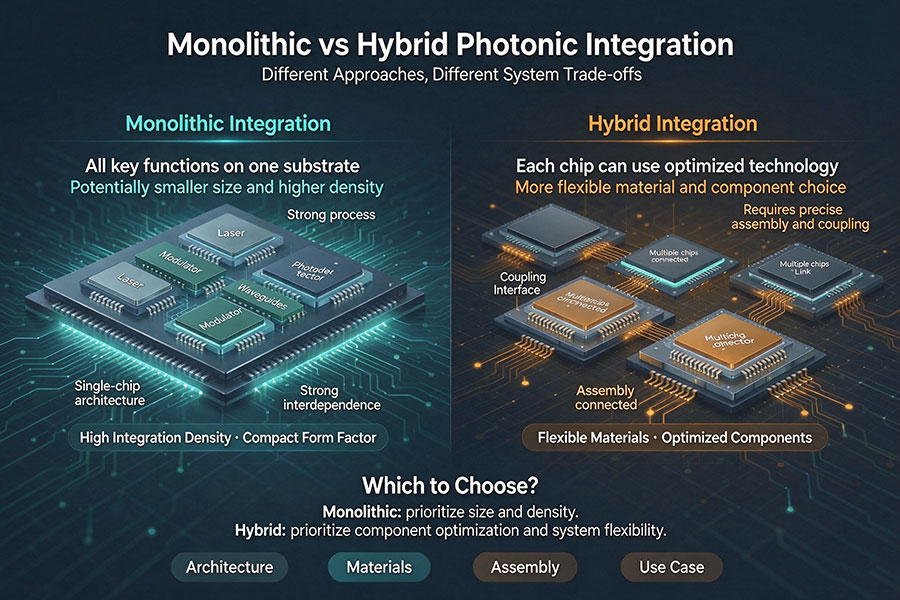
CPO also changes the optical I/O subsystem itself. The optical engine is designed as part of the switch package rather than as an independent front-panel transceiver. This allows electrical and photonic components to be co-designed around the required bandwidth and power targets.
Depending on the implementation, the optical engine may integrate:
Photonic integrated circuits containing modulators, waveguides and photodetectors.
Electronic integrated circuits with drivers and transimpedance amplifiers.
Optical coupling structures for fiber-array connections.
Monitoring and control functions for optical operation.
This integration can reduce duplicated interfaces and shorten the electrical connections within the optical subsystem. It can also allow designers to optimize the PIC, EIC and package together instead of treating the optical module as a separate component connected through a longer board channel.
Nevertheless, optical conversion still consumes energy. Laser generation, modulation, photodetection and amplification remain necessary. CPO improves the architecture around these functions; it does not make optical transmission power-free.
6. External Laser Sources and Their Effect on Power
Many CPO implementations use external laser sources (ELS) to supply continuous-wave optical power to the photonic engines. The laser can be placed away from the high-power switch ASIC, helping reduce thermal interaction and improving maintenance flexibility.
External lasers introduce an additional optical distribution path. Light travels through fibers and optical interfaces before reaching the modulators in the CPO engines. These connections introduce insertion loss, which means the source must provide sufficient optical power to meet the link requirements.
The power implications therefore involve a trade-off:
Thermal separation: Moving the laser away from the ASIC can simplify thermal management around the package.
Serviceability: A replaceable external laser can be maintained without replacing the complete switch package.
Optical distribution loss: Additional fiber connections and coupling interfaces can require more laser output power.
Laser efficiency: The electrical power required by the laser depends on its output requirement and wall-plug efficiency.
For this reason, the laser source must be included in any complete CPO power calculation. Measuring only the optical engine while excluding external laser consumption can overstate the system-level benefit.
7. How Much Power Can CPO Save?
CPO power savings depend on the comparison architecture, switch capacity, optical engine generation, SerDes implementation and system boundary. Published research shows that the difference can be significant, but the figures should be interpreted as specific technical estimates rather than universal product guarantees.
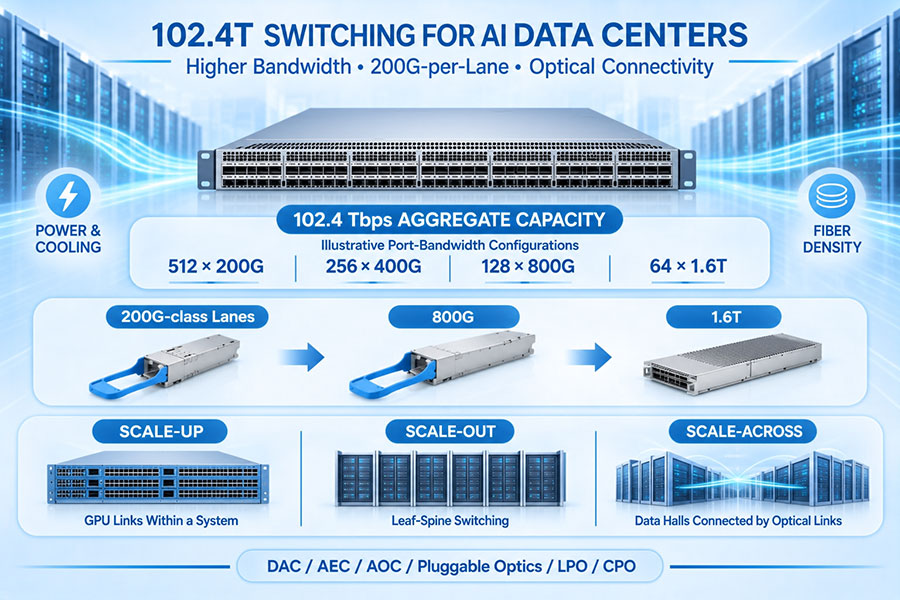
A 2026 Journal of Lightwave Technology study compared DSP-based pluggable optics, LPO and CPO architectures for a modeled 102.4 Tb/s switch. Its 128-port, 800G comparison reported the following system-power breakdown:
| Power Category | DSP-Based Switch | LPO-Based Switch | CPO-Based Switch |
|---|---|---|---|
| Switch and supervisor | 2,854 W | 2,854 W | 2,854 W |
| Optical transceivers / optics | 2,112 W | 922 W | 512 W |
| Switch SerDes | 410 W | 410 W | 72 W |
| Cooling | 640 W | 498 W | 409 W |
| Power supply | 384 W | 299 W | 246 W |
| Total | 6,400 W | 4,983 W | 4,093 W |
Under this study's assumptions, the CPO configuration used approximately 36% less total power than the DSP-based configuration and approximately 18% less than the LPO configuration.
The study also presented a modeled 64-port, 1.6T configuration for the same 102.4 Tb/s aggregate switch capacity. It estimated total power at 5,714 W for the DSP-based architecture, 4,648 W for LPO and 3,910 W for CPO. The corresponding CPO reductions were approximately 32% and 16% relative to those two alternatives.
These figures are from a particular research comparison and its assumptions. They are not universal measurements for all commercial switches. Different ASIC processes, optical engines, laser arrangements, cooling systems and measurement boundaries can produce different results.
8. Why System-Level Power Matters More Than Module Power Alone
A common mistake in comparing optical architectures is to focus only on the power consumed by the transceiver or optical engine. This can miss important changes elsewhere in the system.
For a fair comparison, at least five power categories should be considered:
| Power Category | What It Includes | Why It Matters |
|---|---|---|
| Optical engine | PIC, EIC, drivers, TIAs and associated circuitry | Measures the power of the optical conversion subsystem. |
| Laser source | Internal or external laser electrical consumption | Ensures optical source power is not excluded from the comparison. |
| Host SerDes | Electrical transmit and receive interface power | Captures changes in host-side signal conditioning and interface operation. |
| Cooling | Fans, pumps and other cooling-related power | Reflects the thermal consequences of the architecture. |
| Power conversion | Power-supply and voltage-regulation losses | Accounts for the energy required to deliver usable power to the system. |
For example, removing a DSP from an optical module may reduce module power, but some signal-processing responsibility may move to the host. Similarly, an external laser can improve thermal separation while adding power consumption and optical distribution losses.
The correct comparison is therefore the total energy required to deliver the same bandwidth with equivalent reach, reliability and operating conditions.
9. CPO Improves Energy Efficiency Per Bit
Energy per bit is a useful metric for comparing optical interconnect architectures. It expresses how much energy is required to transfer one bit of information.
When power is measured in watts and data rate in terabits per second, the numerical result is expressed in picojoules per bit.
For example, a link consuming 8 W while delivering 800 Gb/s has an energy consumption of:
8 W ÷ 800 Gb/s = 10 pJ/bit
If an alternative architecture delivers the same data rate using 5 W, its energy consumption becomes 6.25 pJ/bit. The lower value indicates better energy efficiency for that measurement boundary.
CPO can improve energy per bit by reducing electrical interconnect power and optimizing the optical engine and host interface together. However, the calculation must use a consistent boundary. A comparison that includes the laser and host SerDes for one architecture but excludes them for another is not meaningful.
10. CPO Power Efficiency Compared with Pluggable Optics and LPO
CPO, LPO and conventional DSP-based pluggable optics address different parts of the electrical and optical interface. Their power characteristics reflect how much signal processing takes place inside the module and how far electrical signals travel before optical conversion.
| Architecture | Optical Engine Location | Electrical Path | Power Consideration |
|---|---|---|---|
| DSP-Based Pluggable | Front-panel module | Longer board-level channel | Module DSP and host channel compensation contribute to power consumption. |
| LPO | Front-panel module | Longer board-level channel | Removes conventional module-side DSP retiming but relies more heavily on host SerDes. |
| NPO | Separate engine near the ASIC on the board | Shorter board-level channel | Reduces electrical distance while retaining a separate optical engine. |
| CPO | Integrated beside the ASIC on a shared package | Very short package-level channel | Can reduce interconnect and SerDes power through close electrical and optical integration. |
These architectures should not be ranked solely by their optical module power. A complete evaluation must consider the host electrical interface, laser source, optical reach, cooling requirements and the serviceability model.
Pluggable optics remain attractive for flexible deployment and field replacement. LPO can lower module power while preserving the pluggable form factor. CPO is more relevant where high aggregate bandwidth, electrical channel limitations and optical I/O density justify deeper package integration.
11. Thermal Efficiency and Cooling Power
Lower interconnect power can also reduce the heat generated by the optical I/O subsystem. This may help reduce thermal pressure in high-density switches and can influence cooling requirements.
However, CPO creates its own thermal challenges. Optical engines are positioned close to a high-power ASIC, and temperature changes can affect photonic component performance. The system may require dedicated thermal paths, heat spreaders, cold plates or other cooling arrangements.
External laser sources can separate laser heat from the ASIC package, but they introduce additional optical distribution requirements. The net cooling benefit depends on the complete system design.
Cooling savings should therefore be measured rather than assumed. A CPO switch may reduce the power needed for electrical interconnects while still requiring careful package cooling to protect the optical engines and ASIC.
12. Limitations That Can Affect CPO Power Savings
CPO does not guarantee a lower power figure in every implementation. Several design factors can reduce the expected benefit:
External laser overhead: Optical distribution loss may require additional laser output power.
Thermal management: Cooling requirements can offset part of the interconnect power reduction.
Optical engine efficiency: Modulator, driver and receiver designs influence total energy per bit.
Package-level electrical design: Poor interconnect design can still create signal-integrity problems despite short channel length.
Host SerDes architecture: The ASIC's electrical interface determines how much power can actually be saved.
System measurement boundary: Excluding laser, cooling or host power can produce misleading comparisons.
Serviceability and reliability also matter economically. A highly integrated package may reduce operating power but make some failures more expensive to repair. Total cost of ownership should include equipment replacement, maintenance and downtime alongside energy consumption.
13. How to Evaluate CPO Power Savings in a Data Center
Organizations evaluating CPO should compare it with alternative optical architectures under equivalent operating conditions. A practical assessment should include:
Define the bandwidth target: Use the same aggregate throughput and port configuration for each architecture.
Measure optical subsystem power: Include the optical engines and all required laser sources.
Measure host SerDes power: Identify changes in the electrical interface and signal-conditioning requirements.
Evaluate cooling consumption: Compare the actual cooling requirements under representative port populations and workloads.
Verify link performance: Test optical power, BER, signal integrity, reach and operating temperature.
Use a consistent measurement boundary: Include the same system components in every comparison.
Calculate energy per bit: Compare power consumption against delivered throughput.
Include lifecycle requirements: Consider maintenance, replacement, reliability and upgrade costs.
This process helps distinguish genuine system-level energy improvements from savings that occur only within one component of the architecture.
14. Conclusion
CPO reduces data center interconnect power primarily by shortening the high-speed electrical connection between the switch ASIC and optical engine. The shorter channel can reduce insertion loss, lower signal-conditioning requirements and enable more efficient host SerDes operation. Close integration of electronic and photonic components can further improve optical I/O energy efficiency and bandwidth density.
External laser sources, optical engines and package-level thermal design also influence the final result. CPO can deliver meaningful system-level power savings, but the actual benefit depends on the ASIC, optical engine, laser architecture, cooling system and measurement boundary.
For AI data centers and high-capacity switches, CPO is an important approach to managing the growing energy demands of network connectivity. Its value should be assessed through complete link and system measurements rather than module power alone. More information about available optical transceiver solutions can support the evaluation of different high-speed connectivity architectures.
Discuss data rates, host platforms, transmission distances and power requirements with the technical team.
Contact C-LIGHT >

 >
 >
 >
 >
 >
 >
 >