TEL:+86 132 6656 7067





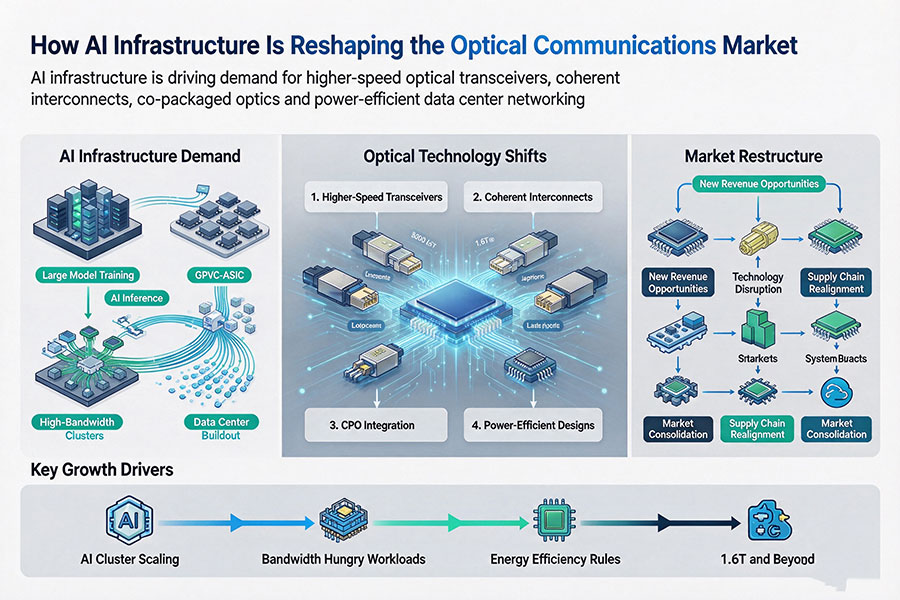
Artificial intelligence is changing the economics and technical direction of optical communications. As hyperscale operators expand GPU clusters, the industry is moving beyond conventional data center connectivity toward higher-speed transceivers, denser fiber infrastructure, advanced photonic integration and more sophisticated optical transport networks. The result is a broader market transformation involving component suppliers, module manufacturers, network equipment vendors and fiber infrastructure providers.
1. AI Infrastructure Is Creating a New Demand Cycle for Optical Communications
AI training and inference require large numbers of accelerators to exchange data across servers, racks and data center facilities. Distributed workloads generate substantial east-west traffic, placing increasing pressure on network bandwidth, latency, power consumption and connection density.
Optical communications are becoming more important because electrical interconnects face increasing signal-integrity and reach constraints as data rates rise. Copper remains attractive for short connections, particularly within tightly integrated server and accelerator systems, but fiber is increasingly important for connections across racks, rows and larger facilities.
This demand is expanding beyond optical transceivers alone. AI infrastructure requires optical fiber, high-density cabling, connectors, laser sources, photodetectors, optical engines, switching systems and manufacturing equipment. Each additional AI cluster creates demand across multiple layers of the optical communications supply chain.
The market is therefore experiencing both a speed upgrade and an expansion in the number and complexity of optical connections required by large-scale computing systems.
2. 800G and 1.6T Are Reshaping the Optical Transceiver Product Mix
One of the most visible changes is the migration toward higher-speed optical transceivers. Earlier data center deployments relied heavily on 100G and 400G connections. AI networking is accelerating demand for 800G products, while 1.6T modules are entering commercial production and broader qualification cycles.
TrendForce reported on April 20, 2026, that the AI-focused optical transceiver market was projected to grow from US$16.5 billion in 2025 to US$26 billion in 2026. The research firm attributed this growth to demand for 800G and higher-speed products, expanding AI server clusters and increased optical connectivity requirements.
The market transition is also visible in manufacturing results. In its November 6, 2026, third-quarter earnings call, Applied Optoelectronics reported that 800G revenue reached US$47.5 million, nearly quadrupling sequentially. The company also described strong demand for 1.6T products and a multiyear customer agreement covering 1.6T transceivers.
These developments indicate that the market is moving from product sampling and early qualification toward higher-volume production. However, 800G remains an important product generation rather than disappearing as 1.6T adoption expands.
| Product generation | Market role | Key application areas |
|---|---|---|
| 400G | Established high-speed connectivity generation | Data center switching, enterprise and cloud networks |
| 800G | Major deployment and capacity-expansion generation | AI scale-out networks, high-density data center fabrics |
| 1.6T | Next-generation high-bandwidth product entering volume deployment | Next-generation AI clusters and high-capacity switching platforms |
| 3.2T | Emerging development direction | Future high-density interconnect platforms and advanced optical architectures |
These generations will coexist for a period because network operators upgrade equipment in stages. Platform compatibility, cost per bit, power budgets and deployment schedules all influence how quickly individual customers move to a new data rate.
3. Optical Connectivity Is Expanding from Scale-Out to Scale-Up Networks
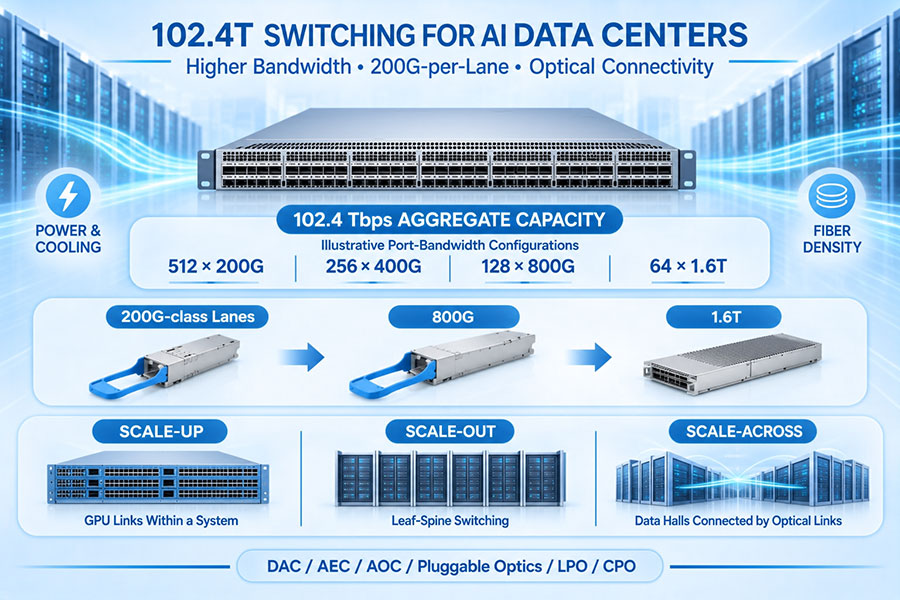
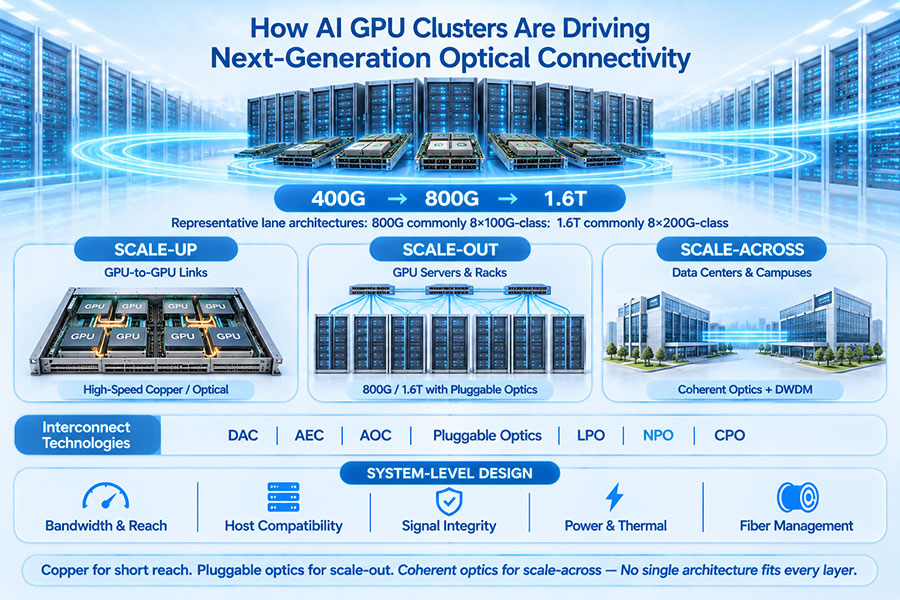
AI infrastructure is commonly divided into scale-up, scale-out and scale-across connectivity. Each layer has different distance, bandwidth and topology requirements, creating different opportunities for optical communications.
Scale-up connectivity
Scale-up networks connect accelerators within tightly coupled systems or racks. Copper remains widely used for short-reach connections because of its low cost, low latency and established ecosystem. However, increasing bandwidth per accelerator and more complex rack architectures are creating opportunities for optical interconnects closer to the compute package.
Scale-out connectivity
Scale-out networks connect servers and racks across an AI cluster. Ethernet and InfiniBand infrastructures use high-speed switches, network adapters and optical transceivers to move data between compute nodes. This is currently one of the most important demand areas for 400G, 800G and 1.6T pluggable optics.
Scale-across connectivity
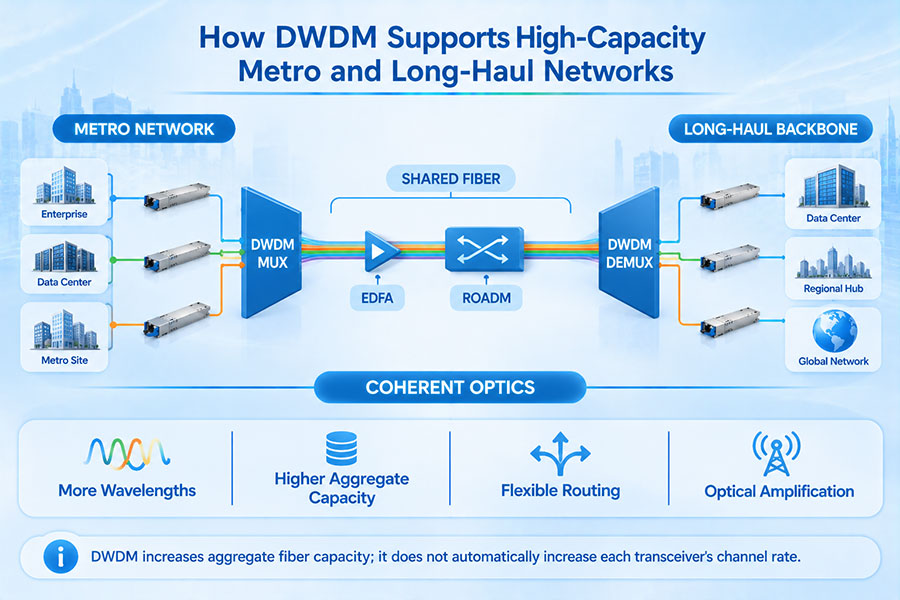
Scale-across connects AI resources across buildings, campuses or geographically separated data center facilities. It increases the importance of high-capacity optical transport, coherent transceivers, DWDM systems and data center interconnect (DCI) solutions.
The expansion of these three networking layers means optical suppliers are addressing a wider range of applications than conventional server-to-switch connectivity alone.
4. Silicon Photonics and Advanced Integration Are Changing the Technology Landscape
Higher data rates are increasing pressure on conventional optical component architectures. Manufacturers must improve bandwidth density, reduce power consumption and maintain reliable production at increasingly demanding tolerances.
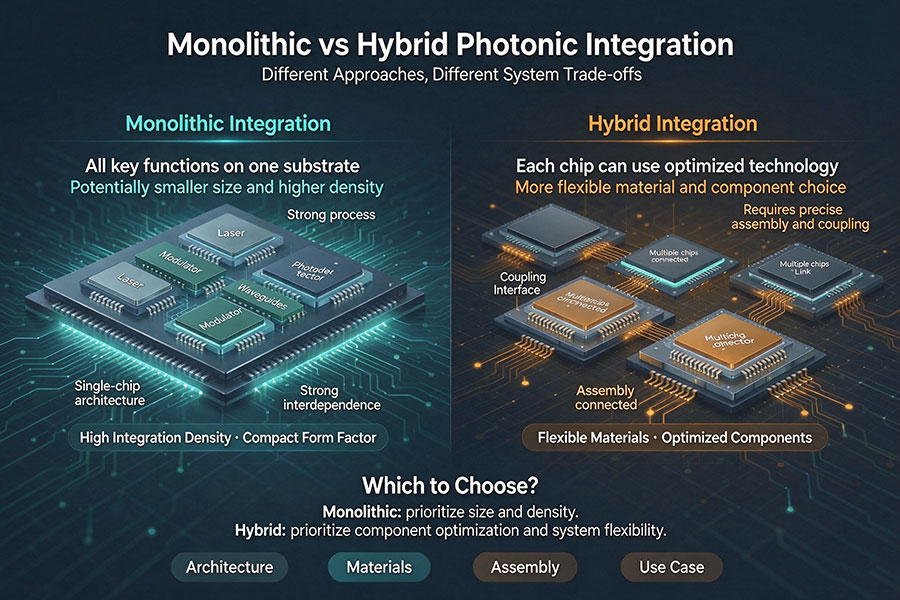
Silicon photonics (SiPh) is attracting investment because it enables multiple photonic functions to be integrated on a silicon platform. This can support compact optical engines, improve integration density and create opportunities for scalable manufacturing using semiconductor fabrication techniques.
Silicon photonics does not eliminate the need for other optical materials. Lasers, detectors and other components may still rely on compound semiconductor technologies such as indium phosphide. Hybrid integration and packaging remain important parts of the overall design.
The technology transition is also affecting the balance between EML-based and silicon-photonics-based transceiver architectures. Both approaches have roles in the market, depending on reach, optical performance, power consumption, cost and manufacturing maturity.
For suppliers, this creates opportunities in photonic integrated circuits, continuous-wave lasers, optical engines, precision alignment, packaging and test equipment.
5. LPO, NPO and CPO Are Creating New Optical Interconnect Business Models
The industry is not only increasing the speed of pluggable modules. It is also changing where optical conversion takes place in the network equipment.
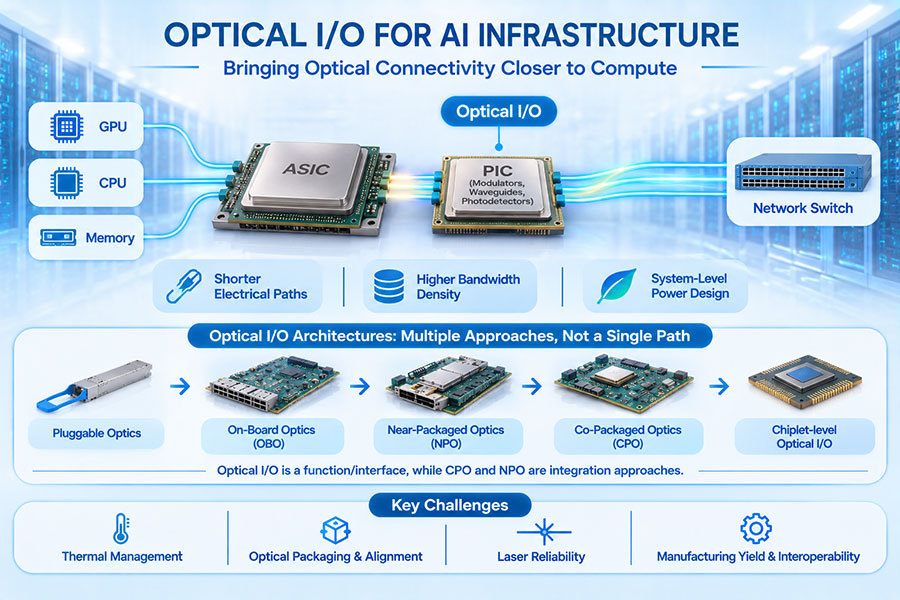
Linear pluggable optics (LPO): Reduces or removes conventional module DSP retiming in suitable designs. It can lower module power and latency, but places greater responsibility on host electrical signal quality and system-level design.
Near-packaged optics (NPO): Places optical engines closer to the switch ASIC while retaining a modular arrangement that can offer serviceability and integration flexibility.
Co-packaged optics (CPO): Integrates optical engines close to or within the switch ASIC package, shortening electrical paths and targeting higher bandwidth density and improved energy efficiency.
These architectures address different deployment requirements rather than representing a simple sequence in which one immediately replaces another. Pluggable modules retain advantages in serviceability, flexibility and established supply chains. NPO offers an intermediate integration approach, while CPO targets applications where electrical reach and power constraints become increasingly difficult to manage.
TrendForce reported on June 15, 2026, that CPO and NPO were attracting growing attention as AI data centers moved toward higher rack density and 200G-per-lane signaling. The report also highlighted manufacturing yield, serviceability, fiber-connector standardization and laser supply as challenges for wider CPO deployment.
For the optical communications market, these changes may redistribute component value. Some optical functions traditionally packaged inside pluggable transceivers may increasingly move into optical engines and integrated switching systems.
6. Optical Circuit Switching Is Gaining Attention in Large AI Clusters
As AI clusters grow, network operators are evaluating architectures that can connect large groups of accelerators while managing bandwidth utilization and power consumption. Optical circuit switching (OCS) is one technology receiving attention in this area.
Unlike conventional packet switches, an OCS establishes optical paths between selected ports. It can reconfigure network connectivity without converting every transmitted signal into an electrical packet-processing operation inside the optical switching stage.
Google's AI networking architecture has drawn attention to the use of optical circuit switching alongside high-speed optical transceivers. TrendForce's February 10, 2026, analysis of Google's TPU interconnect architecture highlighted the role of OCS in connecting large accelerator clusters and the associated demand for 800G and 1.6T optical modules.
OCS does not replace all packet switching. It serves different traffic-engineering requirements and introduces its own constraints, including path reconfiguration, connection scheduling, contention management and network control. Nevertheless, its adoption demonstrates that AI infrastructure is creating opportunities for optical technologies beyond conventional transceiver products.
7. Supply Chain Capacity Is Becoming a Strategic Competitive Factor
Rising demand does not automatically translate into unlimited production capacity. High-speed optical modules depend on a complex supply chain involving laser chips, photodetectors, optical components, DSPs, substrates, fiber, connectors and precision packaging processes.
TrendForce's April 2026 market analysis identified constrained supplies of EMLs and continuous-wave laser sources, together with high-precision optical alignment and manufacturing capacity, as bottlenecks affecting the expansion of AI optical transceiver production.
These constraints are encouraging suppliers to invest in manufacturing capacity and strengthen long-term customer relationships. Applied Optoelectronics' November 2026 earnings discussion, for example, described expansion plans for 800G and 1.6T production as well as additional indium phosphide laser manufacturing capacity.
Fiber infrastructure is also attracting strategic investment. On January 27, 2026, Corning and Meta announced a multiyear agreement valued at up to US$6 billion covering optical fiber, cable and connectivity products for data center expansion. The agreement included plans to expand manufacturing capacity in North Carolina.
These developments show that AI-related optical investment extends from semiconductor components to fiber and cable manufacturing. Capacity, production yield, qualification experience and delivery reliability are becoming important competitive factors alongside product specifications.
8. The Market Is Expanding Beyond Traditional Data Center Transceivers
AI infrastructure is broadening the application range of optical communications. Data center transceivers remain a major growth area, but other optical networking segments are also benefiting from higher traffic volumes and more geographically distributed computing resources.
| Market segment | AI-related demand driver | Relevant technologies |
|---|---|---|
| Data center transceivers | Higher bandwidth between switches, servers and racks | 400G, 800G, 1.6T, SR, DR, FR and coherent optics |
| Optical fiber and cabling | More connections, higher fiber density and larger facilities | Single-mode fiber, MPO/MTP, high-density trunk cables and connectors |
| Optical transport and DCI | Interconnection between data centers and campuses | DWDM, coherent optics, OTN and high-capacity transport systems |
| Photonic integration | Higher bandwidth density and lower interconnect power | Silicon photonics, optical engines, NPO and CPO |
| Optical switching | Dynamic connectivity in large accelerator clusters | OCS and optical network control systems |
| Testing and manufacturing | More complex devices and tighter production tolerances | Optical alignment, BER testing, automated inspection and qualification |
This diversification creates opportunities for companies at different positions in the value chain. Suppliers that focus only on one transceiver speed may face different competitive pressures from those offering broader optical components, cabling, testing or integrated connectivity solutions.
9. Market Growth Will Depend on More Than AI Spending
AI infrastructure investment is a major demand driver, but optical communications suppliers still face commercial and operational risks. Higher-speed products require customer qualification, reliable manufacturing yields and competitive power and cost performance.
Several factors will influence the pace and distribution of market growth:
Hyperscale capital expenditure: Changes in AI data center investment plans can affect order volumes and production schedules.
Deployment timing: Delays in GPU availability, switch platforms, power infrastructure or data center construction can postpone optical equipment demand.
Technology transitions: Faster migration to 1.6T, SiPh or CPO can benefit some suppliers while requiring others to redesign products and production lines.
Component availability: Laser, DSP, substrate and fiber capacity can limit the number of complete modules that manufacturers can deliver.
Pricing pressure: As production volumes increase, average selling prices may decline, making manufacturing efficiency and product differentiation more important.
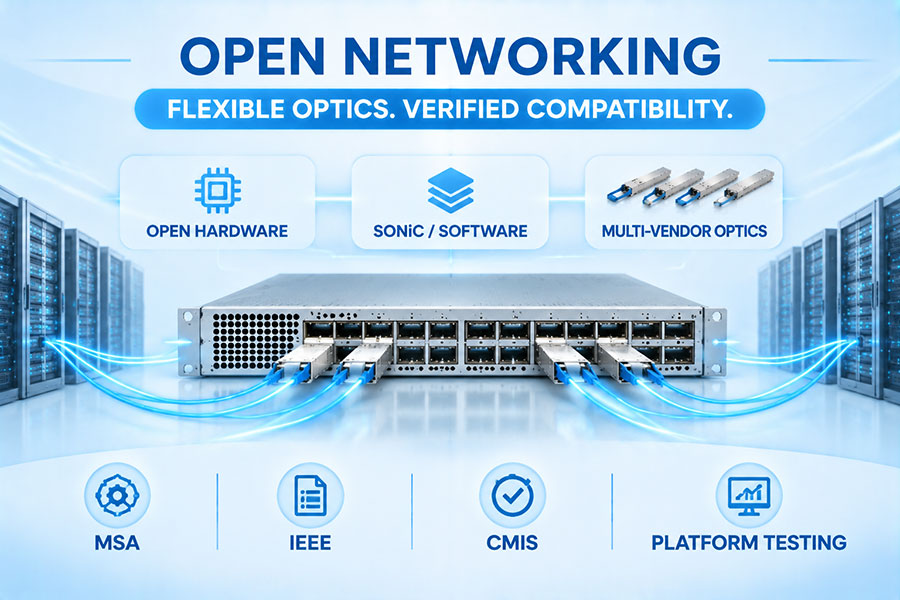
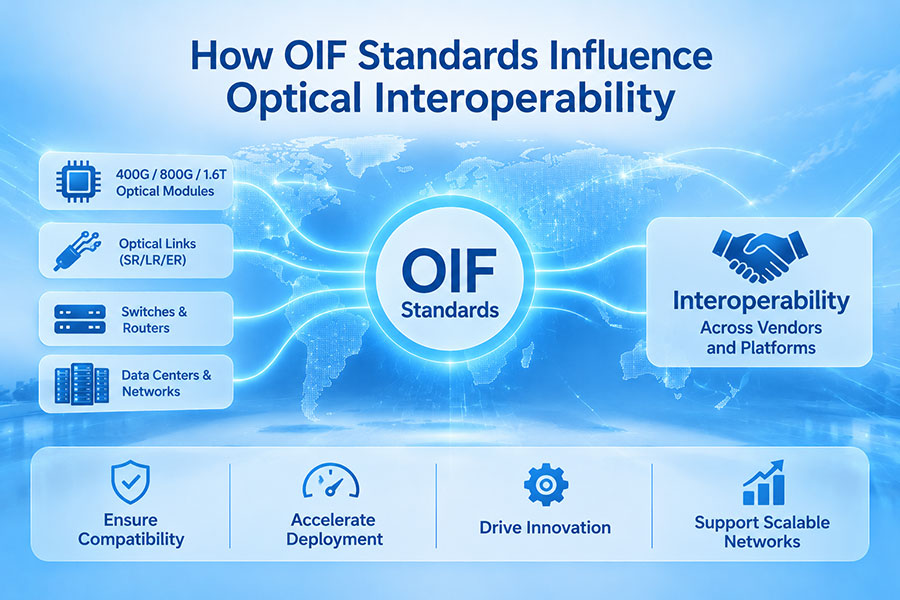
Interoperability: Compatibility across switches, modules, fiber infrastructure and management interfaces remains essential for large multi-vendor deployments.
Market forecasts should also be interpreted according to their definitions. Estimates for AI optical transceivers, all data center optical interconnects and the wider AI networking market measure different product categories and should not be treated as interchangeable.
10. What Optical Communications Suppliers Need to Prepare For
The next stage of market development will reward suppliers that can combine technical capability with reliable production and application support. Product roadmaps need to account for both current deployment demand and the changing architecture of future AI networks.
Important priorities include:
Build a multi-generation portfolio: Maintain relevant 400G and 800G offerings while preparing for 1.6T product requirements.
Strengthen manufacturing quality: Improve optical alignment, assembly consistency, automated testing and production yield.
Develop photonic integration capabilities: Track silicon photonics, optical engines, LPO, NPO and CPO as their applications mature.
Improve thermal and power performance: Address the increasing importance of power per bit, module temperature and host-system cooling.
Secure component supply: Build resilient sourcing arrangements for lasers, detectors, DSPs, connectors and other critical materials.
Support system compatibility: Validate products against relevant host platforms, optical standards and real deployment conditions.
For established optical manufacturers, the opportunity is not limited to producing faster modules. It also involves improving the complete product lifecycle, from design and component sourcing to testing, qualification and long-term supply.
11. Conclusion
AI infrastructure is reshaping the optical communications market through higher bandwidth requirements, expanding fiber deployments, new photonic integration architectures and increased investment across the supply chain. The transition from 400G to 800G and 1.6T is changing the product mix, while LPO, NPO, CPO and optical circuit switching are creating additional paths for network evolution.
The market's growth will not be distributed evenly. Component availability, manufacturing yield, customer qualification, power efficiency and technology maturity will influence which suppliers capture demand. Pluggable optics will remain important, while integrated optical architectures are expected to develop alongside them as AI network requirements evolve.
For optical communications companies, long-term competitiveness will depend on combining high-speed product development with dependable manufacturing, broad application knowledge and the ability to adapt to changing data center architectures.
For high-speed optical connectivity requirements across data center and telecom applications, visit the optical transceiver product range or Contact C-LIGHT.
 >

 >
 >
 >
 >
 >
 >
 >