TEL:+86 132 6656 7067





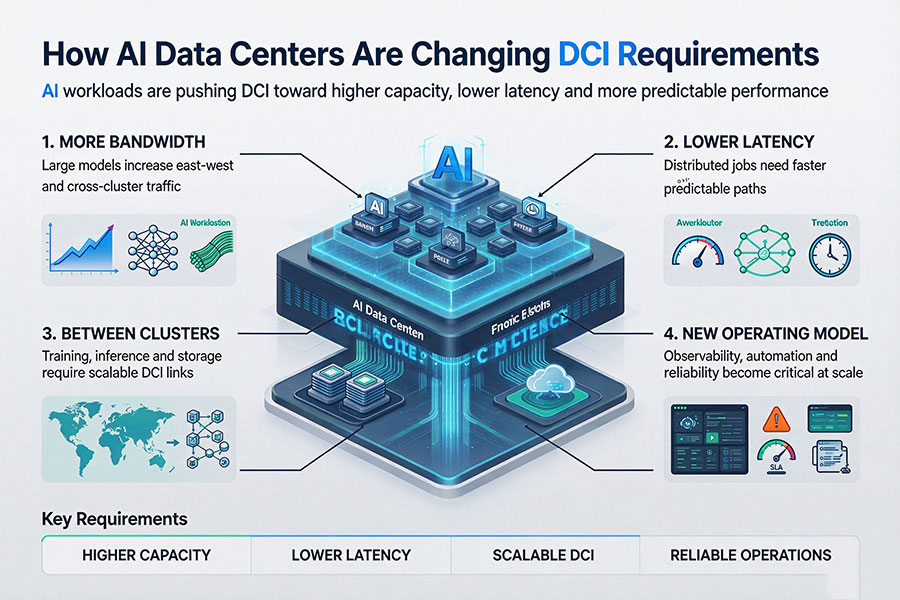
Artificial intelligence is changing how data centers are built, connected and operated. As GPU clusters expand across multiple buildings, campuses and metropolitan locations, the network connecting these facilities must support much larger data flows and more demanding service requirements. Data Center Interconnect (DCI), traditionally designed to connect geographically separated data centers and support workload mobility, backup and disaster recovery, is becoming an important part of distributed AI infrastructure. The shift is not simply toward higher link speeds. It also introduces new requirements for latency, packet loss, optical capacity, route diversity, traffic engineering and network resilience.
1. Why AI Data Centers Are Changing DCI Requirements
Traditional DCI networks primarily connect independent data center facilities. Common applications include data replication, storage synchronization, application access, cloud connectivity, backup and disaster recovery. These services require reliable bandwidth, predictable performance and sufficient capacity to handle normal traffic and recovery events.
AI infrastructure introduces additional traffic patterns. Large training systems exchange model parameters, gradients, datasets and checkpoint information. Distributed inference systems may synchronize model artifacts, cached data and serving resources across multiple locations. Some deployments also distribute accelerator workloads across geographically separated facilities.
These applications place different demands on interconnection networks. A connection used for periodic dataset replication may tolerate variable latency, while a connection supporting tightly coordinated distributed training can be much more sensitive to latency, jitter and packet loss.
Several changes are driving the evolution of DCI:
Larger traffic volumes: AI training and inference increase data exchange between computing facilities.
Distributed GPU resources: Computing capacity may be spread across multiple buildings, campuses or metropolitan sites.
Higher bandwidth requirements: More accelerator systems and larger models increase aggregate network demand.
Stricter performance expectations: Certain distributed workloads require predictable latency and low packet loss.
Greater infrastructure complexity: Multiple optical paths, service providers and cloud environments must work together.
Power and facility constraints: Limited electrical capacity and cooling resources can encourage operators to distribute computing workloads across sites.
The result is a broader role for DCI: it must support conventional data center services while providing transport capabilities for increasingly distributed AI workloads.
2. Understanding the Difference Between Traditional DCI and AI Scale-Across
Not every connection between AI data centers has the same performance requirements. A critical distinction exists between conventional DCI traffic and scale-across traffic that connects distributed parts of a tightly coordinated AI computing system.
Traditional DCI may carry asynchronous replication, backup, dataset transfers, model distribution and application traffic. These flows can often tolerate some delay variation or retransmission, provided that throughput and service availability meet the application requirements.
Scale-across networking is different. It attempts to connect computing resources in separate facilities as part of a coordinated accelerator cluster. Distributed training operations may repeatedly exchange data across the inter-site network. Communication performance can therefore influence the efficiency of the entire computing workload.
| Requirement | Traditional DCI | AI scale-across |
|---|---|---|
| Primary purpose | Connect independent data centers and support data movement | Connect distributed computing resources participating in coordinated workloads |
| Traffic patterns | Replication, backup, storage, application and cloud traffic | Distributed training, collective communication and synchronized accelerator traffic |
| Latency sensitivity | Depends on application; often tolerates higher delay | Can be highly sensitive to latency and jitter |
| Packet loss | Many applications can recover through retransmission | Loss can disrupt collective operations and reduce cluster efficiency |
| Bandwidth demand | High aggregate throughput with workload-dependent peaks | Potentially very high sustained throughput during coordinated operations |
| Network design | IP, Ethernet, coherent optical transport and traffic engineering | Requires closer coordination between transport, congestion control and compute architecture |
These are architectural tendencies, not universal rules. Some conventional DCI applications have strict latency and availability requirements, while some AI data transfers are asynchronous and can tolerate substantial delay. Network design should follow the actual workload rather than treating all AI traffic as equally sensitive.
3. Bandwidth Requirements Are Moving Toward 400G and 800G
AI data centers generate large volumes of traffic between compute clusters, storage systems and network infrastructure. As the number of accelerators increases, inter-site traffic can grow beyond the capacity of conventional data center links.
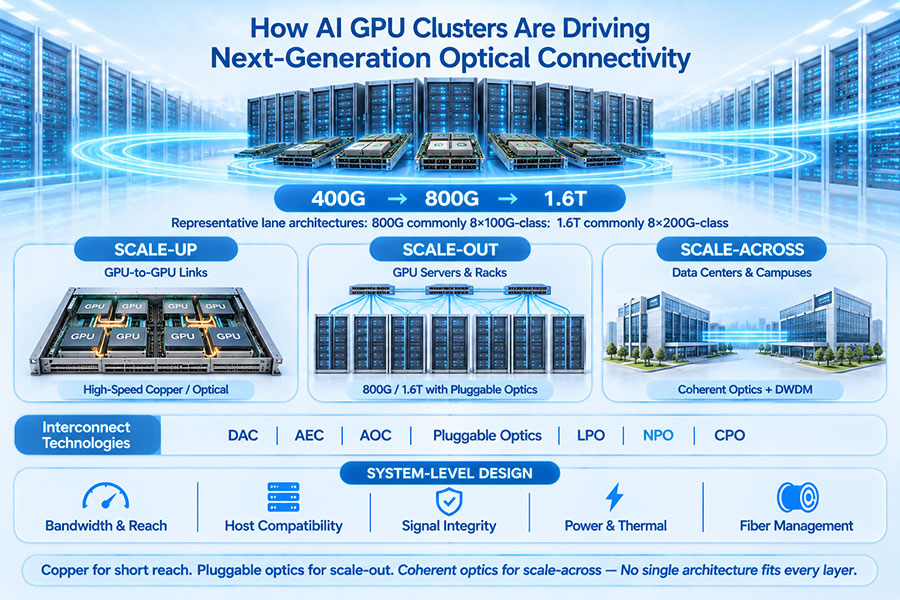
400G and 800G optical connectivity are becoming important options for high-capacity DCI. These interfaces allow operators to increase the capacity of individual links without requiring a proportional increase in the number of physical connections. Coherent optical technologies also enable high-speed signals to travel across metro and regional fiber infrastructure.
Bandwidth planning must consider more than the nominal speed of an optical module. The total capacity available to applications depends on the number of wavelengths, fiber pairs, line-system capabilities, router interfaces and the amount of traffic competing for network resources.
| Interface capacity | Typical role in DCI | Key considerations |
|---|---|---|
| 100G | Established DCI connections, smaller sites and lower-capacity services | Existing equipment, service cost and available fiber capacity |
| 400G | High-capacity metro and regional interconnection | Coherent optics, optical reach, line-system compatibility and port density |
| 800G | Higher-capacity AI and hyperscale interconnection | Optical signal quality, wavelength capacity, power and transport platform support |
| 1.6T-class systems | Emerging higher-capacity optical transport applications | Commercial maturity, supported reach, spectral efficiency and end-to-end compatibility |
These rates represent interface or optical-channel capabilities, not guaranteed application throughput. Protocol overhead, framing, FEC, routing, congestion and service allocation all affect usable capacity.
Operators should also plan for traffic growth over the service life of the optical infrastructure. Fiber routes, conduit capacity, optical amplification sites and equipment space may be harder to expand than the transceiver capacity itself.
4. Latency and Jitter Are Becoming More Important
Latency is one of the most important factors distinguishing ordinary data replication from tightly coordinated AI computing. When a distributed training workload exchanges information repeatedly between sites, network delay can affect how quickly each training step completes.
Fiber propagation introduces a physical latency floor. Light travels through standard optical fiber at roughly 200,000 kilometers per second, corresponding to approximately 5 microseconds of one-way propagation delay per kilometer. The round-trip propagation component is therefore approximately 10 microseconds per kilometer, before adding equipment, switching, routing and queuing delays.
This means geographical distance cannot be eliminated through faster transceivers or more powerful routers. A longer fiber route creates additional propagation delay regardless of the nominal bandwidth of the optical interface.
Factors affecting DCI latency
Physical distance: Fiber route length directly affects propagation delay.
Route selection: The shortest geographic route is not always the route with the lowest actual latency or best availability.
Optical transport equipment: Transponders, coherent DSPs and intermediate network elements contribute processing delay.
Packet switching: Router and switch processing can add latency depending on architecture and traffic conditions.
Congestion: Queuing and buffering can increase both latency and jitter during traffic bursts.
Network topology: Additional hops and indirect paths can increase end-to-end delay.
For conventional DCI, latency targets are often defined by application requirements and service-level agreements. For scale-across AI systems, latency and jitter must be considered as part of the distributed computing architecture, not simply as transport performance indicators.
5. Packet Loss and Network Reliability Have a Greater Impact on AI Workloads
AI training systems can generate substantial amounts of synchronized traffic. Collective communication operations often require multiple accelerators to exchange information before a computation stage can proceed. Packet loss can trigger retransmissions, delay synchronization and increase the time required to complete a training iteration.
Reliable DCI therefore requires more than redundant optical equipment. The complete path must maintain predictable forwarding behavior and recover effectively from link, device and fiber failures.
Important reliability mechanisms include:
Physical route diversity: Separate fiber routes reduce the risk that a single cable cut affects all available paths.
Equipment redundancy: Redundant routers, line systems, power supplies and optical interfaces improve service continuity.
Fast failure detection: Monitoring and protection mechanisms help identify failures and initiate recovery.
Traffic engineering: Alternative paths can be selected according to capacity, latency and availability requirements.
End-to-end performance monitoring: Packet loss, latency, jitter and throughput should be measured across the actual service path.
Protection mechanisms must also be evaluated carefully. Optical-layer protection, IP fast reroute and application-level recovery operate at different layers and have different restoration characteristics. A fast optical switch does not automatically guarantee that every transport and application session experiences hitless recovery.
6. Coherent Optics Is Becoming Central to High-Capacity DCI
Coherent optical technology is a major enabler of high-capacity data center interconnection. Unlike conventional intensity-modulated direct-detection links, coherent systems encode information in the amplitude and phase of optical signals and use a local oscillator and digital signal processing to recover the transmitted data.
This approach supports advanced modulation formats, high spectral efficiency and compensation for important fiber transmission impairments. It is therefore widely used in metro, regional and long-haul optical transport.
Why coherent technology fits AI DCI
Higher capacity per wavelength: Advanced modulation and high baud rates support high data rates over individual optical channels.
Longer transmission reach: Coherent DSP can compensate for chromatic dispersion and other transmission impairments.
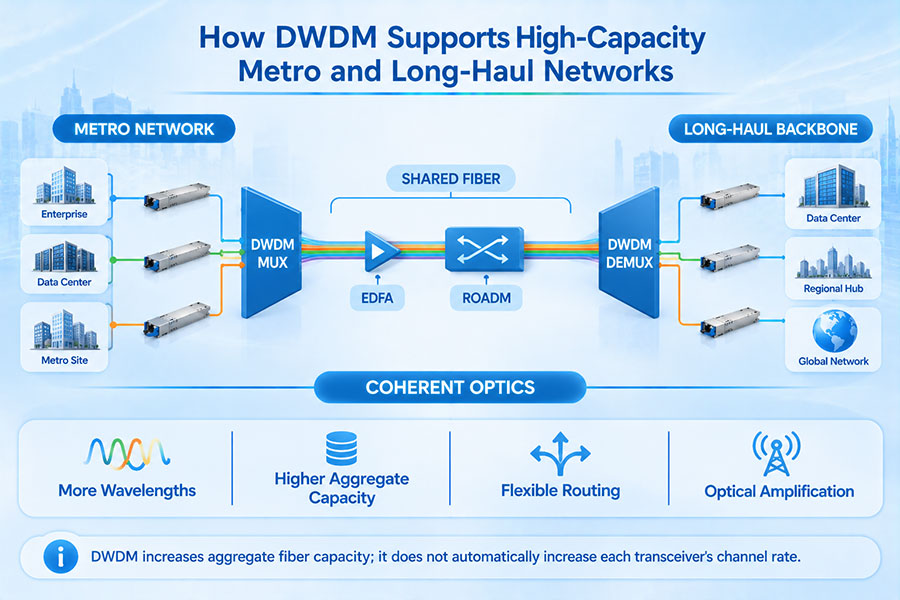
Efficient fiber utilization: DWDM systems can carry multiple coherent wavelengths over a shared fiber infrastructure.
Flexible deployment: Coherent pluggable modules can be installed directly in supported routers and switches.
Transport scalability: Optical line systems and ROADMs can support wavelength routing and capacity expansion across multiple sites.
Coherent pluggable modules such as 400ZR and ZR+ are relevant to different DCI deployment scenarios. Their reach and performance depend on the module specification, optical line system, fiber characteristics, amplification and engineering margins. A nominal reach value should not be treated as universal across all routes.
For some shorter campus connections, direct-detection optics or simplified coherent-lite technologies may provide suitable alternatives. The correct choice depends on distance, fiber availability, capacity, power consumption and the required optical infrastructure.
7. DWDM and Fiber Infrastructure Must Scale with AI Traffic
Increasing DCI capacity is not simply a matter of installing faster transceivers. The underlying fiber infrastructure must support the required wavelengths, optical power levels and transmission distances.
Dense wavelength-division multiplexing (DWDM) allows multiple optical channels to operate over the same fiber pair. Each channel uses a different wavelength, increasing total fiber capacity without requiring a separate fiber for every data stream.
For AI data centers, DWDM can support high-capacity connections between campuses and metropolitan facilities. ROADMs provide wavelength-level routing and reconfiguration, allowing operators to manage optical paths across more complex networks.
Several infrastructure factors require attention:
Fiber availability: Confirm the number of usable fiber pairs and their physical route diversity.
Fiber attenuation: Measure transmission loss and verify whether optical amplification is required.
Chromatic dispersion: Evaluate dispersion characteristics for the selected wavelength and transmission distance.
Optical signal-to-noise ratio: Ensure sufficient OSNR for the selected coherent modulation and FEC configuration.
Connector quality: Inspect and clean fiber connectors to prevent unnecessary insertion loss and reflection.
Wavelength planning: Confirm channel spacing, optical spectrum availability and compatibility with multiplexers and ROADMs.
Future capacity: Reserve sufficient fiber, conduit and equipment capacity for future expansion.
High-capacity AI DCI may also require dedicated fiber infrastructure rather than relying entirely on shared transport resources. This depends on the traffic volume, isolation requirements, service economics and the availability of suitable routes.
8. DCI Architecture Is Evolving Toward Routed Optical Networking
Traditional DCI deployments may use separate routers, transponders and optical transport equipment. This architecture offers flexibility and clear separation between IP and optical layers, but can increase equipment count, power consumption and operational complexity.
Routed optical networking combines IP routing with coherent pluggable optics, allowing supported routers to connect directly to optical transport infrastructure. This can reduce the need for separate transponder equipment in suitable deployments.
The architecture is particularly relevant when data center operators need to expand high-capacity connections across metro and regional networks while maintaining centralized routing and service management.
| Architecture | Basic structure | Potential advantages | Considerations |
|---|---|---|---|
| Traditional transponder-based DCI | Router connected to a separate optical transponder or muxponder | Established optical transport functions and flexible interface conversion | Additional equipment, power and operational layers |
| Coherent pluggable DCI | Coherent module installed directly in a supported router or switch | Fewer standalone transport devices and simplified deployment in suitable networks | Module reach, host support and optical line-system compatibility |
| Routed optical networking | IP routing and coherent optical transmission integrated into a coordinated architecture | Potentially simpler IP/optical operations and more direct capacity scaling | Requires coordinated routing, optical engineering and monitoring |
| ROADM-based optical transport | Wavelength channels routed through reconfigurable optical nodes | Flexible wavelength allocation and multi-site optical connectivity | Optical power management, spectrum planning and line-system design |
These architectures can coexist. The most appropriate choice depends on network scale, fiber ownership, optical reach, existing equipment and operational requirements.
9. AI Traffic Requires More Intelligent Bandwidth Allocation
AI traffic is not always continuous or uniform. Training jobs may generate intensive bursts during synchronization, checkpointing and data exchange. Inference systems may produce traffic patterns that change with user demand, model placement and resource availability.
A fixed-capacity network can support these workloads, but static allocation may leave some links underutilized while other paths experience congestion. More flexible bandwidth management can improve overall infrastructure utilization.
Modern DCI management can incorporate:
Traffic classification: Separate training, inference, replication, storage and general application traffic.
Bandwidth reservation: Allocate capacity for services with predictable throughput requirements.
Dynamic traffic engineering: Select paths based on link utilization, latency and available capacity.
Network slicing: Provide logically isolated services with different performance and security policies.
Optical resource provisioning: Establish or reconfigure wavelengths according to changing traffic demand.
Telemetry-driven optimization: Use real-time measurements to identify congestion and adjust network resources.
Automation and software-defined networking can coordinate these functions across IP and optical layers. However, dynamic optical reconfiguration has its own setup and switching times. It is generally more appropriate for planned capacity changes or sustained traffic patterns than for reacting to individual packets.
10. Security, Data Sovereignty and Multi-Site Operations
AI infrastructure increasingly spans enterprise facilities, colocation sites, cloud environments and specialized GPU data centers. This creates additional security and governance requirements for DCI.
Large AI datasets may contain confidential business information, customer data or regulated information. Moving these datasets between facilities requires clear policies for access control, encryption, data residency and operational accountability.
Key considerations include:
Encryption in transit: Apply suitable encryption at the optical, Ethernet or IP layer according to the security architecture.
Traffic isolation: Separate tenants, workloads and administrative domains through appropriate network segmentation.
Data sovereignty: Ensure that data movement complies with applicable geographic and regulatory requirements.
Access management: Control administrative access to routers, optical equipment and network management systems.
Monitoring and auditing: Maintain records of network changes, service access and security events.
Multi-provider coordination: Define responsibilities and service-level expectations across carriers, colocation operators and cloud providers.
Security should be designed into the DCI architecture rather than added after capacity has been deployed. High bandwidth does not remove the need for encryption, access control and service isolation.
11. How to Evaluate DCI for AI Data Center Deployment
Choosing a DCI solution requires a complete assessment of the workload, physical route and optical transport system. A high-speed transceiver alone cannot guarantee that the end-to-end connection will meet application requirements.
| Evaluation area | Questions to address |
|---|---|
| Workload requirements | Is the traffic for replication, inference, model distribution or synchronized distributed training? |
| Bandwidth planning | What are the sustained, peak and future aggregate throughput requirements? |
| Latency and jitter | What are the one-way and round-trip targets, and how much variation can the application tolerate? |
| Packet performance | What packet-loss and congestion levels can the workload tolerate? |
| Optical reach | What is the actual fiber route length, and does the selected coherent or direct-detection solution support it? |
| Fiber infrastructure | Are sufficient fiber pairs, diverse routes and suitable optical line systems available? |
| Platform compatibility | Are the selected modules supported by the routers, switches and optical transport equipment? |
| Reliability | Are redundant paths, power systems, equipment and recovery mechanisms available? |
| Security | Are encryption, tenant isolation, access control and data residency requirements satisfied? |
| Operations | Can the network provide end-to-end telemetry, automated provisioning and effective fault localization? |
Testing should cover the complete service path. Relevant checks include optical power, OSNR, BER where applicable, end-to-end throughput, packet loss, latency, jitter and failover behavior. Fiber inspection and characterization are also important before activating high-capacity optical channels.
For distributed AI training, validation should include representative traffic patterns rather than relying only on isolated link tests. The interaction between congestion control, routing, transport behavior and application synchronization can significantly influence real-world performance.
12. The Future of DCI in Distributed AI Infrastructure
DCI is evolving from a transport service that primarily connects separate data centers into a more flexible foundation for distributed computing. As AI workloads become larger and more geographically distributed, operators will need to coordinate compute placement, optical capacity and network performance more closely.
Several technology developments are likely to shape this evolution:
Higher-capacity coherent transmission
400G and 800G coherent solutions are expanding the capacity available across metro and regional fiber networks. Future generations will continue to improve optical bandwidth density, spectral efficiency and power consumption, although achievable reach will remain dependent on fiber conditions and line-system design.
Optical circuit switching
Optical circuit switching can establish dedicated optical paths between selected ports or clusters. It may complement packet switching where traffic patterns are predictable and sustained. Its reconfiguration characteristics make it more suitable for circuit-level resource allocation than ordinary packet-by-packet forwarding.
AI-aware network automation
Network controllers can increasingly use workload information, telemetry and service policies to allocate bandwidth and select transport paths. This can help align optical resources with changing AI workload requirements.
Closer integration between compute and transport
Future scale-across systems may coordinate accelerator placement, distributed training software, congestion management and optical transport as one operational environment. This requires cooperation between compute vendors, network equipment providers, optical suppliers and data center operators.
More resilient multi-site infrastructure
As organizations distribute AI capacity across multiple locations, DCI will need to support both workload continuity and infrastructure resilience. Diverse fiber routes, automated recovery, service isolation and continuous performance assurance will remain fundamental design priorities.
13. Conclusion
AI data centers are changing DCI requirements by increasing inter-site bandwidth demand and introducing workloads that can be sensitive to latency, jitter and packet loss. Traditional DCI remains essential for replication, backup, cloud connectivity and application access, while AI scale-across introduces more demanding requirements for tightly coordinated computing resources.
400G and 800G coherent optics, DWDM, routed optical networking, high-capacity fiber infrastructure and intelligent traffic engineering are becoming important tools for meeting these demands. However, link speed alone does not determine DCI performance. Physical distance, route diversity, optical signal quality, congestion, reliability and application behavior must all be considered.
The next generation of DCI will increasingly connect not just separate data centers, but distributed AI infrastructure operating across multiple locations. Networks designed around workload-aware capacity, predictable performance and end-to-end resilience will be better positioned to support this transition.
For high-speed optical connectivity requirements, visit the optical transceiver product range or Contact C-LIGHT.
 >

 >
 >
 >
 >
 >
 >
 >