TEL:+86 132 6656 7067





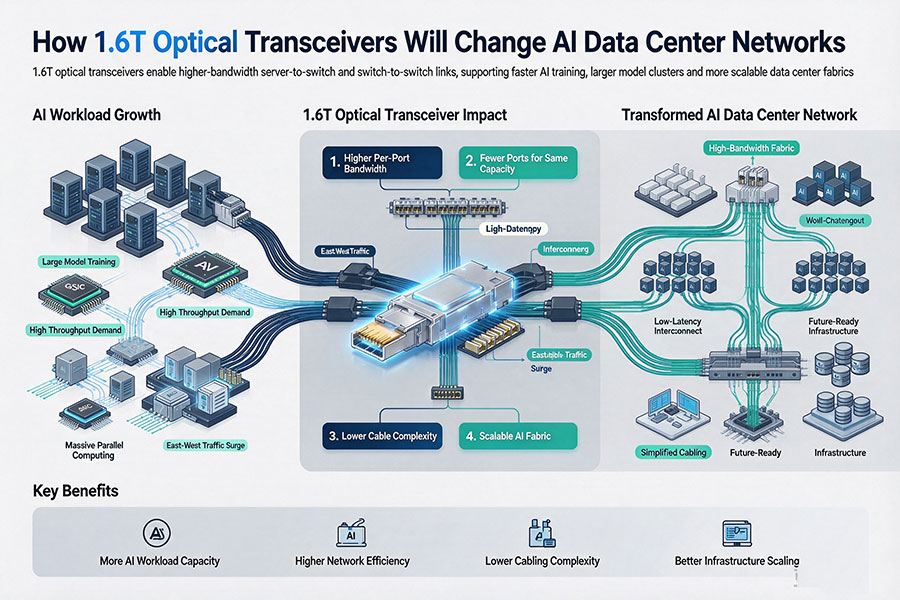
AI data center networks are approaching a bandwidth transition in which 800G links will increasingly be joined by 1.6T optical interfaces. The change is not simply a doubling of the port data rate. It affects switch architecture, electrical lane design, optical reach, fiber infrastructure, power delivery, cooling, and the way large accelerator clusters are interconnected.
As AI training and inference systems scale across more accelerators and racks, network fabrics must move increasingly large volumes of data with predictable latency and high utilization. Collective operations such as AllReduce, AllGather, and ReduceScatter can generate sustained east-west traffic across the cluster. At the same time, larger models and distributed workloads increase pressure on network capacity between switches, servers, and data center buildings.
1.6T optical transceivers provide a higher-capacity interface for these environments. Their impact will depend on more than the optical module itself: host SerDes capability, switch ASIC design, network topology, fiber plant, thermal limits, and interoperability all determine whether the additional bandwidth can be used effectively.
1. Why AI Data Center Networks Need 1.6T Connectivity
AI clusters place different demands on networking than many conventional enterprise and cloud workloads. Accelerator servers exchange model parameters, gradients, activations, and other intermediate data. During distributed training, communication can be frequent and highly synchronized, making network bottlenecks visible as idle accelerator time.
As cluster sizes increase, network capacity must grow at several levels:
Server-to-switch connectivity: Higher-speed network interfaces provide more bandwidth from each accelerator server or network adapter into the fabric.
Switch-to-switch connectivity: Higher-capacity uplinks help leaf and spine switches carry aggregate traffic without excessive oversubscription.
Rack-to-rack connectivity: Larger AI deployments require more bandwidth between groups of accelerator racks and network planes.
Data center interconnect: Multi-building or geographically separated facilities need high-capacity optical transport between sites.
Moving from 800G to 1.6T can increase the capacity of an individual optical interface by a factor of two. This can reduce the number of physical links required for a given aggregate bandwidth, or allow network designers to increase available capacity while retaining a similar port count.
However, a faster transceiver does not automatically improve application performance. If congestion control, routing, collective communication scheduling, or switch buffering is poorly configured, additional physical bandwidth may not translate into proportional gains for AI workloads.
2. What Changes Inside a 1.6T Optical Transceiver
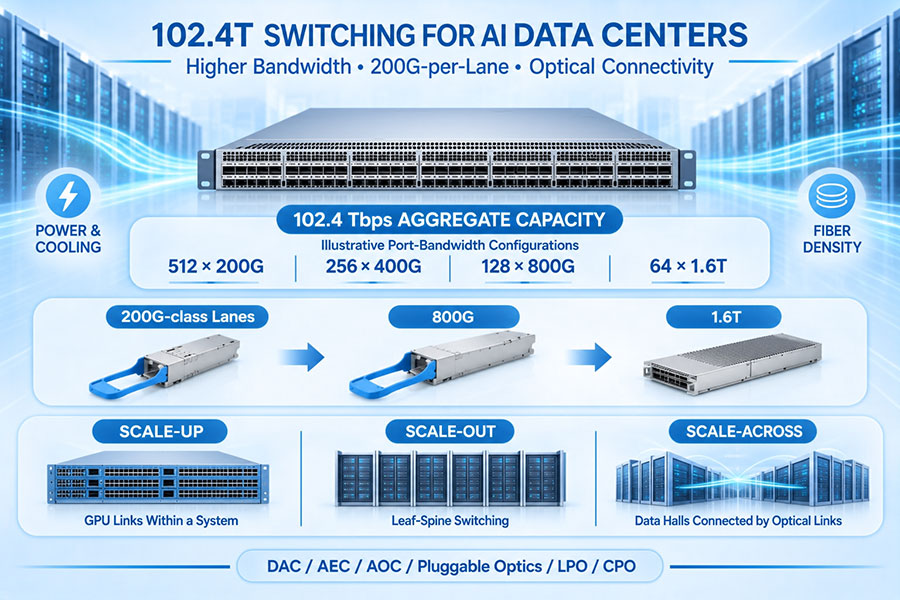
A major technical step in the 1.6T generation is the move toward 200G-class signaling per lane. A common architecture uses eight optical lanes operating at approximately 200 Gb/s each, producing an aggregate nominal rate of 1.6 Tb/s. The exact electrical and optical lane mapping depends on the module design and the applicable interface specification.
For PAM4 signaling, a lane operating near 106.25 GBd carries two bits per symbol before coding and framing overhead. The higher symbol rate places greater demands on the electrical channel, transmitter, receiver, clock recovery, equalization, and error correction. Some implementations may use gearbox functions to translate between host electrical lanes and optical lanes.
| Design area | 800G generation | 1.6T generation | Engineering implication |
|---|---|---|---|
| Aggregate interface rate | 800 Gb/s | 1.6 Tb/s | Twice the nominal interface capacity |
| Common lane approach | 8 × 100G-class lanes | 8 × 200G-class lanes | Higher per-lane electrical and optical performance |
| Modulation | PAM4 in common implementations | PAM4 in common implementations | More demanding signal integrity and receiver margin |
| Signal processing | DSP, equalization and FEC as specified | More demanding high-speed signal processing | Power, latency and thermal design become increasingly important |
| System integration | Pluggable optics and emerging near-package approaches | Pluggable optics and near-package integration options | Host architecture and cooling influence module selection |
The table describes common architectural directions rather than a universal specification for every 1.6T product. Lane count, baud rate, wavelength plan, fiber interface, reach, FEC behavior, and form factor must be verified against the relevant standard and product datasheet.
At these data rates, the electrical path between the switch ASIC and optical module becomes especially important. PCB traces, connectors, package transitions, and module electrical interfaces all contribute insertion loss, reflections, crosstalk, and jitter. A module rated for 1.6T therefore needs a compatible host platform and a validated end-to-end channel.
3. Higher Switch Port Capacity and New Network Architectures
One of the most direct effects of 1.6T optics is the ability to connect switch ports at a higher rate. A switch with compatible 1.6T interfaces can provide more bandwidth per physical port than a platform built around 800G interfaces. This creates opportunities to simplify some high-capacity links and reduce the number of connections required between network devices.
For example, a network designer may use fewer 1.6T links instead of a larger number of 800G links to reach a similar aggregate bandwidth. Alternatively, the designer can retain a similar link count and increase the available capacity between switch tiers. The preferred choice depends on the switch ASIC's total bandwidth, port configuration, oversubscription target, and the traffic pattern of the AI cluster.
More capacity can be carried through each physical interface, supporting high-radix switch designs and larger uplinks.
Consolidating capacity into faster interfaces can simplify some cable routes and reduce port consumption at both ends.
Higher-speed interfaces can help network platforms scale aggregate throughput within constrained rack and floor space.
Power, cooling, electrical reach, fiber management, and serviceability can become limiting factors as port rates rise.
It is important to distinguish port rate from total switch capacity. A 1.6T interface does not mean that every port on a switch can operate at that rate simultaneously. The actual system capacity depends on the ASIC, number of ports, internal switching fabric, power budget, and supported port configurations.
4. The Shift from 800G to 1.6T Will Be Gradual
800G will remain important as 1.6T platforms emerge. Network operators cannot replace every switch, optical module, cable, and fiber route at once. Existing 800G equipment may remain suitable for many server connections, leaf-spine links, and workloads whose bandwidth requirements do not justify an immediate upgrade.
A practical migration may begin with the highest-utilization links: spine uplinks, large aggregation points, or connections between major network blocks. Operators can then expand 1.6T deployment as compatible switches, host interfaces, optics, and operational processes become available.
| Deployment area | Potential role of 1.6T | Migration consideration |
|---|---|---|
| Leaf-to-spine links | Higher-capacity uplinks for heavily loaded network blocks | Confirm ASIC port modes, link budget, and oversubscription design |
| Spine-to-spine or fabric interconnect | More bandwidth between network planes or large switching domains | Check topology, routing behavior, and failure-domain design |
| Server-facing links | Support future high-bandwidth NIC and accelerator platforms | Host electrical interface and server I/O capability must match |
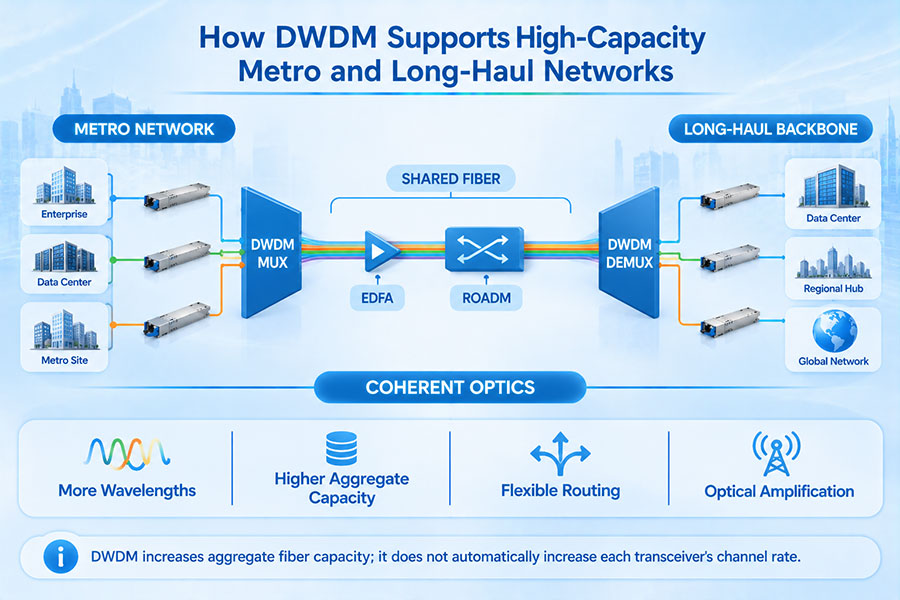
| Data center interconnect | Carry larger aggregate traffic between facilities | May require coherent optics and a suitable amplified DWDM line system |
Migration planning should also account for mixed-speed links. A network can contain 400G, 800G, and 1.6T interfaces at the same time, provided the switch platform supports the required port modes and the network is engineered around the resulting capacity differences.
5. Fiber Infrastructure and Optical Reach Will Matter More
Higher interface rates do not remove the need to select the correct fiber type and optical reach. A 1.6T module may use parallel single-mode fiber, wavelength-division multiplexing over duplex fiber, or a coherent optical interface for a different application. These approaches have different cabling, connector, and optical-budget requirements.
Parallel optics distribute data across multiple optical fibers. They can provide high aggregate capacity but require careful control of fiber count, polarity, connector type, and channel mapping. Wavelength-multiplexed designs can carry multiple optical channels over fewer fiber strands, which may be attractive where fiber availability or cable density is constrained.
For AI data center deployments, fiber planning should cover:
Fiber type: Confirm whether the interface requires OS2 single-mode fiber or a specified multimode fiber grade.
Connector system: Verify LC, MPO/MTP, or other specified interfaces, including connector gender, keying, and pinout.
Polarity and lane mapping: Ensure each transmit lane reaches the intended receive lane, especially in parallel-fiber systems and breakout assemblies.
Optical loss: Account for fiber length, connector pairs, splices, patch panels, and other passive components.
Physical routing: Check bend radius, cable fill, tray capacity, cable weight, and access for maintenance.
Cleanliness: Inspect and clean connector end faces before mating; contamination can significantly affect high-speed optical links.
Reach should never be inferred from the aggregate data rate alone. A 1.6T short-reach parallel optic, a 1.6T wavelength-multiplexed data center optic, and a 1.6T coherent DCI interface are different product categories with different optical architectures and link budgets.
6. Power Consumption and Cooling Become System-Level Issues
Higher-speed optical modules must process faster electrical and optical signals while operating within strict power and temperature limits. DSP complexity, driver and receiver performance, laser or modulator technology, optical output requirements, and packaging all influence module power.
Even if the power consumption of an individual module is controlled, the aggregate load can become substantial when a switch contains many high-speed optical ports. That heat must be removed from the module cages and surrounding switch assembly. Airflow restrictions, heatsink design, port spacing, inlet temperature, and chassis cooling capacity all influence real operating conditions.
Liquid cooling is increasingly relevant to high-density AI systems, but it does not automatically solve every optical thermal problem. A liquid-cooled accelerator or switch ASIC does not guarantee that the optical modules receive adequate cooling. The thermal path for the optical components must be designed and validated separately.
Power efficiency should also be evaluated at the network level. A faster port may reduce the number of links or switch ports needed for a target bandwidth, but the final result depends on module power, switch power, cooling overhead, cable infrastructure, and network utilization.
7. Pluggable Optics, LPO, NPO and CPO Will Coexist
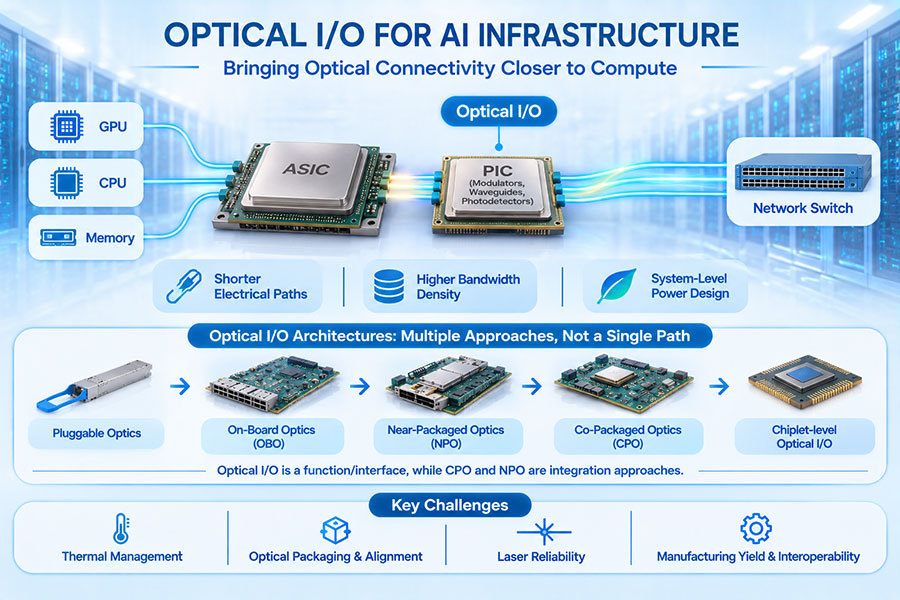
The 1.6T generation will not be defined by a single packaging approach. Conventional pluggable transceivers remain attractive because they are replaceable, independently testable, and compatible with established operational practices. However, as electrical lane rates and module power increase, alternative optical integration approaches are receiving more attention.
| Architecture | Optical placement and signal processing | Potential benefit | Key consideration |
|---|---|---|---|
| Pluggable optics | Optical module connects through a switch front-panel cage | Field replacement, modular upgrades, established servicing | Electrical reach, module power, front-panel density and cooling |
| LPO | Linear pluggable optics reduces or removes conventional module DSP retiming in suitable designs | Potential reduction in module power and latency | Greater dependence on host SerDes, channel quality and system tuning |
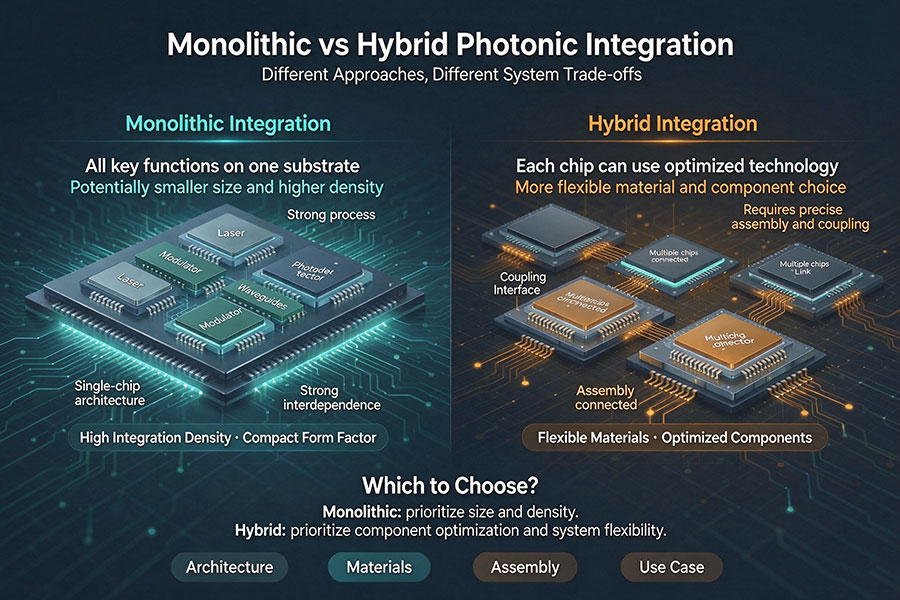
| NPO | Optical engines are placed near the switch ASIC but remain outside its package | Shorter high-speed electrical paths and higher integration density | Serviceability, optical connection, thermal design and platform integration |
| CPO | Optical engines are integrated close to or within the switch package assembly | Very short electrical connections and potential bandwidth-density gains | Manufacturing, laser supply, repair strategy and system-level reliability |
These approaches solve different engineering problems and should not be treated as interchangeable module types. LPO changes the distribution of signal-processing functions. NPO and CPO change where optical conversion occurs relative to the switch ASIC. A silicon-photonics engine may be used within different packaging architectures, so silicon photonics and pluggable form factor are not mutually exclusive categories.
For operators, the decision will depend on the required reach, power target, switch generation, maintenance model, optical engine reliability, and the ability to qualify the complete system. Pluggable optics are likely to remain relevant even as near-package and co-packaged designs expand into selected applications.
8. 1.6T Ethernet and 1.6T Coherent Optics Serve Different Network Roles
The term 1.6T can describe different interfaces. A 1.6T Ethernet optical transceiver used inside a data center is not the same as a 1.6T coherent module designed to transport an Ethernet client over a DWDM link.
For intra-data-center connections, the focus is typically on high-speed client-side optical lanes, short or medium reach, switch compatibility, and fiber connectivity. For DCI, coherent optics use advanced modulation and digital signal processing to transmit high-capacity signals over amplified optical links. They address line-system effects such as chromatic dispersion, polarization effects, and optical signal-to-noise ratio.
In September 2026, the OIF published its 1600ZR Implementation Agreement. It defines an interoperable 1.6T coherent line interface for amplified point-to-point DWDM links up to 120 km. This is a distinct development from 1.6T short-reach Ethernet optics and is relevant to high-capacity data center interconnect applications.
Network planners should therefore identify the application before selecting a 1.6T module: switch-to-switch within a facility, rack or row connectivity, campus interconnect, or longer DCI transport. The required optical architecture and supporting equipment can be very different.
9. Standards and Interoperability Will Shape Deployment
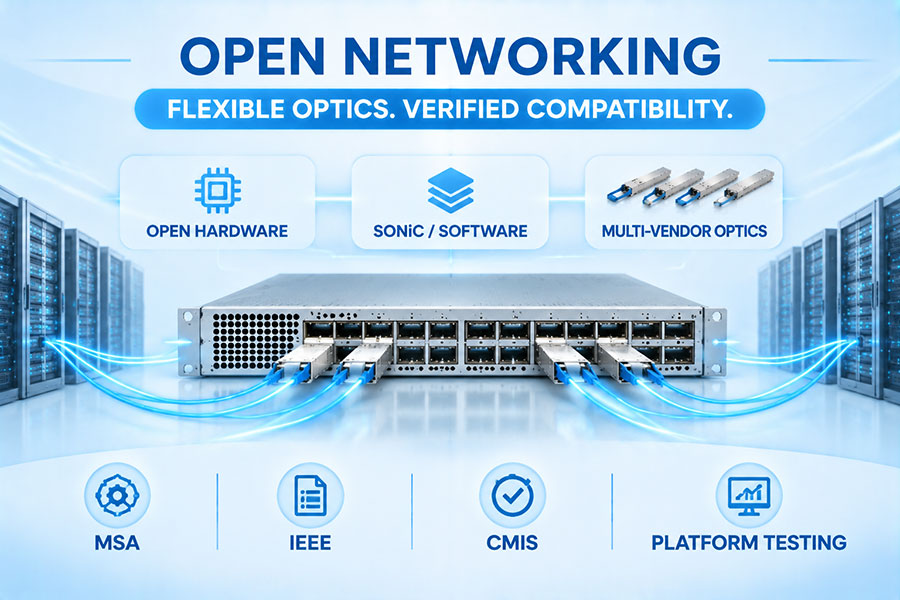
Interoperability is essential when high-speed modules are deployed across switches, optical vendors, and different generations of network equipment. IEEE Ethernet specifications define relevant MAC and physical-layer behavior, while industry agreements can address specific optical interfaces and interoperability requirements.
As of November 2026, IEEE P802.3dj has progressed through multiple Standards Association recirculation ballots. IEEE published the P802.3dj/D3.3 draft in September 2026, covering 1.6 Tb/s MAC parameters and physical-layer and management specifications for 200G, 400G, 800G, and 1.6T operation. The draft status and the exact interface clauses should be checked when qualifying products; a successful ballot is not the same as evidence that every commercial module implements every defined PMD.
Module qualification should include more than confirming the advertised data rate. Important checks include:
Supported host switch model, ASIC generation, port mode, and firmware requirements.
Electrical interface compliance and host channel requirements.
Optical wavelength, lane count, modulation, transmit power, and receiver sensitivity.
Fiber type, connector, polarity, reach, and end-to-end insertion-loss budget.
FEC mode, pre-FEC and post-FEC BER behavior, and host error-counter visibility.
Module power, case-temperature limits, airflow requirements, and thermal behavior.
Digital diagnostics, management interface behavior, alarms, and interoperability testing.
For multi-vendor networks, validation should include the actual switch, module, fiber assembly, and operating environment. A transceiver's nominal specification alone cannot guarantee link establishment or stable operation on every host platform.
10. How 1.6T Will Influence AI Network Design
The introduction of 1.6T interfaces will encourage network designers to reconsider how bandwidth is distributed across the fabric. Instead of upgrading every link uniformly, operators can prioritize connections where traffic concentration is highest and where additional capacity can reduce oversubscription.
Several design priorities will become more important:
Traffic-aware capacity planning: Size uplinks around measured and projected traffic, not only the theoretical bandwidth of connected servers.
Balanced network planes: Maintain predictable capacity and path diversity across parallel fabrics or network planes.
Congestion management: Tune queueing, load balancing, ECN, and transport behavior to the workload and network architecture.
Failure planning: Confirm that remaining links can carry critical traffic after a port, cable, module, or switch failure.
Operational observability: Monitor optical power, temperature, BER, FEC counters, link flaps, and interface utilization.
Lifecycle compatibility: Plan mixed 800G and 1.6T generations without creating unsupported port modes or uneven capacity bottlenecks.
These considerations are particularly important for distributed AI training. A network with higher nominal bandwidth can still perform poorly if a small number of oversubscribed links, uneven paths, or poorly managed congestion points limit collective communication.
11. Conclusion
1.6T optical transceivers will provide a new bandwidth tier for AI data center networks, enabling higher-capacity switch connections and creating options for denser network fabrics. Their arrival also pushes electrical signaling, optical integration, fiber infrastructure, power delivery, and cooling into a more demanding design environment.
The transition will be gradual. 800G will continue to serve many deployments, while 1.6T adoption will first make sense where switch capacity, traffic demand, and platform readiness justify the upgrade. Pluggable optics, LPO, NPO, CPO, and coherent DCI interfaces will each address different parts of the evolving network.
Successful deployment will depend on matching the optical interface to the host platform, reach, fiber plant, thermal envelope, and workload. The most effective AI networks will not simply use the fastest available transceivers; they will coordinate optics, switching, cabling, and traffic engineering as one system.
Planning high-speed optical connectivity for AI data center networks? Review the available optical transceiver solutions and contact the engineering team to discuss interface requirements, host compatibility, and deployment conditions.
 >

 >
 >
 >
 >
 >
 >
 >