TEL:+86 132 6656 7067





VOA attenuation range and dynamic range are closely related parameters in optical communication testing, but they describe different aspects of optical performance. The attenuation range of a variable optical attenuator (VOA) specifies how much adjustable optical loss the device can introduce. Dynamic range describes the span between the lowest and highest optical signal levels that a device or measurement system can handle or measure under specified conditions.
For example, a VOA with a 0–40 dB attenuation range can introduce up to 40 dB of adjustable loss. However, this does not automatically mean that the complete optical test system has a 40 dB dynamic range. The source power, receiver sensitivity, power meter measurement limits, noise floor, and other system characteristics also affect the usable dynamic range.
1. What Is the Attenuation Range of a VOA?
The attenuation range defines the adjustable optical loss that a VOA can introduce between its minimum and maximum settings. It is normally expressed in decibels (dB).
Common VOA specifications include:
0–10 dB: limited attenuation for small optical power adjustments.
0–20 dB: moderate attenuation for power control and component testing.
0–30 dB: a common range for optical testing and signal adjustment.
0–40 dB: extended attenuation for receiver sensitivity and link-loss simulation.
0–60 dB: a wider range for demanding low-power test conditions.
These are representative ranges rather than universal industry requirements. Actual minimum attenuation, maximum attenuation, and guaranteed performance depend on the device design and operating conditions.
1.1 How VOA Attenuation Is Calculated
Optical attenuation is calculated from the ratio of input power to output power:
Attenuation (dB) = 10 × log10(Pin / Pout)
When optical power is expressed in dBm, the relationship becomes:
Output Power (dBm) = Input Power (dBm) − Attenuation (dB)
For example, if the input power is +2 dBm and the VOA introduces 20 dB of attenuation, the output power is approximately -18 dBm, assuming the stated attenuation includes the relevant device loss.
1.2 What the Attenuation Range Tells Engineers
The attenuation range indicates the amount of optical loss that can be adjusted during a test. It helps engineers determine whether a VOA can reduce the signal to a required power level, simulate additional link loss, or reproduce different receiver input conditions.
It does not independently specify the minimum measurable optical power, the maximum measurable power, or the sensitivity of the complete measurement system.
2. What Is Dynamic Range in Optical Systems?
Dynamic range describes the span between the highest and lowest signal levels that a device or system can operate with or measure while meeting specified performance requirements. It is commonly expressed in decibels.
For an optical power measurement system, a simplified dynamic-range calculation is:
Dynamic Range (dB) = Maximum Measurable Optical Power (dBm) − Minimum Measurable Optical Power (dBm)
For example, if an optical power meter measures signals from -60 dBm to +10 dBm under a specified configuration, its measurement dynamic range is 70 dB.
Dynamic range is not limited to power meters. It can also describe the operating range of optical receivers, photodetectors, amplifiers, and complete optical test systems. The exact definition depends on the device and measurement context.
2.1 Dynamic Range of an Optical Receiver
For an optical receiver, the usable input-power range is generally bounded by its minimum required received power and maximum allowable input power. The lower boundary is related to receiver sensitivity, while the upper boundary is related to receiver overload.
A simplified receiver input-power range can be expressed as:
Receiver Input Range (dB) = Maximum Receiver Input Power − Receiver Sensitivity
For example, if a receiver has a sensitivity of -18 dBm and an overload limit of -3 dBm, the nominal input-power span is 15 dB.
This calculation is a simplified power-range description. Actual receiver performance also depends on the specified BER, modulation format, data rate, wavelength, and test conditions.
2.2 Dynamic Range of an Optical Power Meter
An optical power meter has a specified measurement range. Its upper limit is constrained by the maximum input power it can measure safely and accurately, while its lower limit is influenced by detector sensitivity, internal noise, resolution, and measurement uncertainty.
A wider measurement range allows the instrument to measure both relatively strong and weak optical signals. However, the stated range should be interpreted together with accuracy specifications across that range.
3. VOA Attenuation Range vs. Dynamic Range
The main difference is that attenuation range describes an adjustable loss capability, while dynamic range describes an operating or measurement span.
| Comparison | VOA Attenuation Range | Dynamic Range |
|---|---|---|
| Definition | Amount of adjustable optical loss | Span between upper and lower signal or measurement limits |
| Primary Function | Controls optical power by introducing attenuation | Describes the usable signal or measurement range |
| Typical Unit | dB | dB |
| Determined By | VOA optical design and attenuation mechanism | Device limits, sensitivity, noise, overload, and measurement conditions |
| Common Application | Receiver testing and controlled power reduction | Receiver characterization and optical power measurement |
| Key Question | How much optical loss can the VOA introduce? | Across what signal-level span can the device or system operate or measure? |
Although both parameters use decibels, they cannot be treated as interchangeable. A VOA may have a 40 dB attenuation range, while the receiver connected to it has a 15 dB usable input-power range. The VOA can create a broader range of test conditions than the receiver can operate within its specified performance limits.
4. How Are Attenuation Range and Dynamic Range Related?
A VOA can help engineers test a device across a wider span of optical input-power levels. By increasing attenuation in controlled steps, the VOA reduces the signal reaching the device under test (DUT).
However, the usable test range depends on the combined capabilities of the source, VOA, measurement instruments, and DUT.
4.1 The Role of the Optical Source
The source establishes the initial optical power available for the test. If the source output is too low, even a VOA with a wide attenuation range may not provide the required high-power test conditions. Source stability and wavelength accuracy also affect measurement reliability.
4.2 The Role of the VOA
The VOA determines how much additional optical loss can be introduced. Its attenuation range defines the adjustment span, while its resolution, accuracy, repeatability, and insertion loss determine how reliably each power level can be established.
4.3 The Role of the Receiver or Measurement Instrument
The receiver or measurement instrument determines which output levels can be detected or processed within the required performance limits. A receiver may stop meeting its BER requirement before the VOA reaches its maximum attenuation setting. Similarly, a power meter may not accurately measure very weak signals even when the VOA can reduce the optical power to that level.
5. Example: A 40 dB VOA Does Not Automatically Provide 40 dB of System Dynamic Range
Consider an optical test setup with the following illustrative specifications:
| Component | Specification |
|---|---|
| Optical source output | +3 dBm |
| VOA attenuation range | 0–40 dB |
| Receiver sensitivity | -18 dBm |
| Receiver overload limit | -3 dBm |
Ignoring additional path loss for this simplified example, the VOA can adjust the receiver input power from approximately +3 dBm down to -37 dBm.
However, the receiver's specified operating range is only from -18 dBm to -3 dBm. The receiver therefore has a 15 dB usable input-power span under the stated conditions.
The VOA can generate optical power levels outside that receiver range, but the receiver is not guaranteed to meet its performance requirements at those levels.
This example demonstrates the distinction:
VOA attenuation range: 40 dB of adjustable attenuation.
Receiver input-power range: 15 dB between sensitivity and overload.
Usable receiver test interval: Determined by the receiver limits and the test objective.
In a real setup, connector loss, VOA insertion loss, source stability, calibration uncertainty, and measurement-instrument limits must also be included.
6. How to Calculate the Usable Optical Test Range
To determine whether a VOA and test system can cover the required power levels, engineers should calculate the available output-power interval and compare it with the DUT and instrument limits.
6.1 Calculate the Available VOA Output Range
For a simplified setup:
Minimum Output Power = Source Power − Maximum VOA Attenuation − Additional Path Loss
Maximum Output Power = Source Power − Minimum VOA Attenuation − Additional Path Loss
For example, a +3 dBm source, a 0–40 dB VOA, and 1 dB of additional path loss provide an approximate output-power adjustment interval from -38 dBm to +2 dBm.
6.2 Identify the DUT Operating Limits
Next, determine the minimum and maximum input power at which the DUT must meet its specified performance. For an optical receiver, these limits commonly include sensitivity and overload power.
For transceiver validation, the relevant performance criteria may include BER, pre-FEC BER, FEC behavior, link stability, and error-free operation under the defined test conditions.
6.3 Check the Measurement Instrument Limits
The power meter or other measurement instrument must be capable of accurately measuring the optical power across the required interval. If the instrument's lower measurement limit is higher than the weakest test signal, the test setup may need a more sensitive measurement method or a different reference configuration.
6.4 Establish the Actual Usable Test Interval
The usable test interval is constrained by the overlap between the VOA's available output-power range, the DUT's operating range, and the measurement instrument's valid measurement range.
Usable Test Interval = Overlap of the Source/VOA Output Range, DUT Operating Range, and Instrument Measurement Range
This is a practical way to evaluate a test setup. It is not a universal standalone specification for a VOA.
7. Why VOA Resolution and Accuracy Matter for Dynamic-Range Testing
A wide attenuation range is useful only when the VOA can establish the required power levels with sufficient precision. Resolution and accuracy become especially important when testing close to receiver sensitivity or overload thresholds.
| Parameter | Effect on Testing |
|---|---|
| Attenuation Resolution | Determines the smallest adjustment step between test points |
| Attenuation Accuracy | Determines how closely the actual loss matches the programmed or displayed setting |
| Repeatability | Supports consistent results across repeated measurements |
| Insertion Loss | Affects the available output-power level and test calibration |
| Wavelength-Dependent Loss | Can affect power settings across different optical wavelengths |
| Polarization-Dependent Loss | Can introduce power variation depending on the signal's polarization state |
For example, a VOA with 0.01 dB resolution does not necessarily provide 0.01 dB accuracy. Resolution describes the smallest setting increment, while accuracy describes the difference between the actual attenuation and the specified value.
8. Applications in Optical Transceiver Testing
VOAs are widely used in optical component and transceiver validation because they provide controlled signal-power adjustment. Their attenuation range and the test system's dynamic range support different aspects of the same test process.
8.1 Receiver Sensitivity Characterization
During sensitivity testing, the VOA gradually reduces the optical input power while a BER tester or other monitoring equipment records receiver performance. The test identifies the lowest input-power level at which the receiver meets the required BER threshold.
8.2 Receiver Overload Characterization
The VOA can also adjust optical power around the receiver's upper operating limit. This helps identify the point at which excessive input power affects receiver performance.
8.3 BER and FEC Performance Evaluation
For high-speed optical transceivers, engineers may record pre-FEC BER, corrected error counts, uncorrectable errors, and link stability at different optical input levels. The VOA provides controlled attenuation steps, while the test equipment evaluates the resulting performance.
8.4 Multi-Wavelength Optical Testing
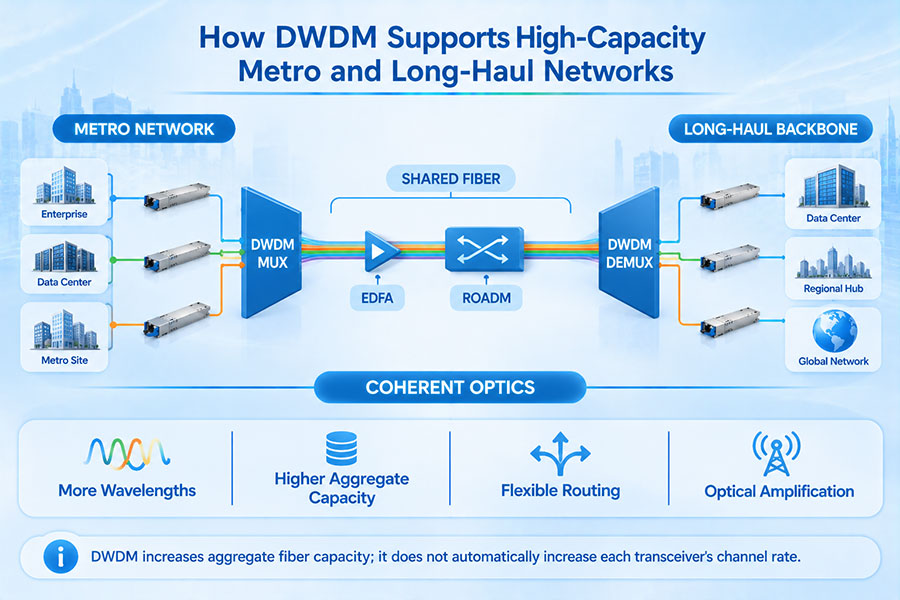
In DWDM and other wavelength-multiplexed systems, optical power levels may need to be adjusted across multiple channels. A suitable VOA can support channel-power control, but its wavelength-dependent loss and PDL should be considered when evaluating the complete system.
For optical transceiver validation, the VOA should be used together with suitable optical power meters, BER testers, and other measurement equipment. C-LIGHT's Optical Transceiver Testing and Validation Guide provides additional context on optical module testing and validation.
9. Common Mistakes When Comparing VOA Attenuation Range and Dynamic Range
Assuming both values mean the same thing: Attenuation range describes adjustable loss, while dynamic range describes a signal or measurement span.
Using maximum attenuation as the system dynamic range: The receiver and measurement instrument may have narrower operating limits.
Ignoring insertion loss: The minimum VOA setting may still introduce optical loss.
Confusing resolution with accuracy: A small adjustment step does not guarantee an equally small measurement error.
Ignoring wavelength dependence: Attenuation performance can vary across the specified wavelength band.
Overlooking receiver overload: A receiver must remain below its maximum input-power limit as well as above its sensitivity threshold.
Ignoring the measurement floor: A test instrument may not provide reliable readings at the lowest optical power levels generated by the VOA.
10. Conclusion
VOA attenuation range and dynamic range describe two different aspects of optical testing. Attenuation range specifies the adjustable optical loss that a VOA can introduce, while dynamic range describes the span of signal levels that a device or measurement system can handle or measure under defined conditions.
A VOA with a 0–40 dB range can provide up to 40 dB of adjustable attenuation, but the usable test range may be limited by the optical source, receiver sensitivity, receiver overload, power-meter measurement limits, and other components in the test path.
For reliable optical testing, engineers should evaluate attenuation range, resolution, accuracy, insertion loss, wavelength coverage, and maximum input power alongside the operating limits of the DUT and measurement instruments. This approach provides a more accurate assessment of whether a VOA can support receiver characterization, transceiver validation, and optical link-loss simulation.
Frequently Asked Questions
Q1: What is the main difference between VOA attenuation range and dynamic range?
Attenuation range describes adjustable optical loss, while dynamic range describes the span of signal levels a device or system can handle or measure.
Q2: Is a 40 dB VOA dynamic range equal to 40 dB?
No. A 40 dB VOA attenuation range does not automatically establish a 40 dB dynamic range for the complete test system.
Q3: Can a VOA increase receiver dynamic range?
No. A VOA adjusts the optical input power for testing, but it does not change the receiver's intrinsic sensitivity or overload limits.
Q4: How is VOA attenuation range calculated?
It is specified as the difference between the maximum and minimum adjustable attenuation settings, expressed in dB.
Q5: How is optical measurement dynamic range calculated?
It is generally calculated by subtracting the minimum measurable optical power from the maximum measurable optical power, with both values expressed in dBm.
Q6: What limits the dynamic range of an optical receiver?
Receiver sensitivity and overload power define the basic input-power boundaries, while BER requirements and operating conditions determine usable performance.
Q7: Does a wider VOA attenuation range improve testing accuracy?
No. A wider range provides more adjustment capacity, but accuracy depends on the VOA's calibration and performance specifications.
Q8: Can an optical power meter measure the full attenuation range of a VOA?
Only if its measurement range and accuracy cover the optical power levels produced by the VOA and source combination.
Q9: Why is insertion loss important when evaluating VOA range?
Insertion loss affects the actual optical power delivered to the DUT and must be accounted for when calibrating test conditions.
Q10: What is the relationship between receiver sensitivity and dynamic range?
Receiver sensitivity defines the lower input-power boundary, while overload power defines the upper boundary of the receiver's specified operating range.
Q11: Is attenuation range the same as optical power range?
No. Attenuation range measures adjustable loss in dB, while optical power range describes the signal levels a device can handle or measure, often in dBm.
Q12: Which VOA specifications are important for transceiver testing?
Attenuation range, resolution, accuracy, repeatability, insertion loss, wavelength range, PDL, return loss, and maximum input power should all be considered.
 >

 >
 >
 >
 >
 >
 >
 >