TEL:+86 132 6656 7067





Signal distortion in a high-speed optical channel is not attributable to a single mechanism. It arises from the combined action of linear fiber effects, intensity-dependent fiber nonlinearities, and non-ideal behavior in the transceiver's electrical and optical components. Each mechanism acts on the signal differently—spreading pulses in time, shifting optical phase, converting phase noise into intensity noise, or compressing amplitude levels—and each becomes more consequential as lane rates rise and modulation formats become more complex.
The transition from NRZ to PAM4 has made this problem more acute. PAM4 compresses four amplitude levels into the same optical power range that NRZ uses for two, reducing the separation between adjacent levels by roughly a factor of three. Distortions that NRZ could absorb within its link margin—a modest amount of residual dispersion, a slight nonlinear compression, a small reflection-induced ripple—can close a PAM4 eye. Understanding the root causes of distortion is therefore a prerequisite for designing and debugging 400G, 800G, and 1.6T optical links.
1. Linear Fiber Impairments: Dispersion and Pulse Spreading
1.1 Chromatic Dispersion
Chromatic dispersion (CD) arises because the propagation velocity of light in silica glass depends on wavelength. A modulated optical signal occupies a band of wavelengths, and different spectral components travel at slightly different speeds. The result is pulse broadening in the time domain: some parts of a pulse arrive earlier and others later, and if the broadening is severe enough, adjacent pulses overlap. This overlap is inter-symbol interference (ISI), and it directly reduces the eye opening available to the receiver[reference:0].
CD is a cumulative effect that increases linearly with transmission distance. It originates from both material dispersion—the wavelength dependence of silica's refractive index—and waveguide dispersion, which depends on how light is confined in the fiber core and cladding. In earlier 10 Gb/s systems, CD was a dominant bottleneck managed with dispersion-compensating fiber. In modern coherent receivers, it is largely compensated in the digital domain by DSP. In short-reach IM-DD PAM4 links, CD is typically less severe than in long-haul systems, but it still contributes to power fading and eye closure at high baud rates, particularly when combined with chirp from directly modulated lasers[reference:1].
1.2 Polarization Mode Dispersion
An ideal fiber has a perfectly circular core, so the two orthogonal polarization states of light propagate at identical speeds. Real fibers exhibit asymmetry—slightly elliptical cores, anisotropic stress—that breaks this symmetry and causes the two polarizations to travel at different velocities. The resulting differential group delay (DGD) between polarization components produces pulse spreading and ISI, just as chromatic dispersion does[reference:2].
What distinguishes PMD from CD is its stochastic nature. The fiber imperfections that cause PMD are randomly distributed along the fiber length, and they change over time with temperature and mechanical vibration. DGD is therefore a random, time-varying quantity rather than a deterministic impairment. This makes PMD more challenging to mitigate than CD, and it becomes a significant limiting factor for very high bit-rate systems above 40 Gb/s. Like CD, PMD is now effectively compensated by adaptive equalization in coherent DSP, but in IM-DD short-reach links with limited DSP, residual PMD can still degrade PAM4 eye quality[reference:3].
2. Fiber Nonlinearities: Intensity-Dependent Distortion
Linear impairments scale with distance and can be compensated once their magnitude is known. Nonlinear impairments behave differently: they appear only at high optical power levels, and their magnitude depends on the signal power density within the fiber core. In multi-channel DWDM systems, where many high-power signals are confined in a small glass core over long distances, nonlinear effects become the dominant performance-limiting factor[reference:4].
2.1 The Kerr Effect as the Root Mechanism
The primary source of fiber nonlinearity is the optical Kerr effect: the refractive index of silica changes in proportion to the intensity of the light passing through it. This intensity-dependent refractive index gives rise to three distinct impairments—self-phase modulation, cross-phase modulation, and four-wave mixing—each of which distorts the signal in a different way[reference:5].
2.2 Self-Phase Modulation
In self-phase modulation (SPM), the intensity variations of an optical pulse modulate its own phase. This phase modulation translates into a frequency shift, causing the spectrum of the pulse to broaden. The broadened spectrum then interacts more strongly with chromatic dispersion, magnifying the effective dispersion penalty. SPM is therefore not an isolated impairment; it couples to CD and makes dispersion compensation more difficult[reference:6].
2.3 Cross-Phase Modulation
In a multi-channel WDM system, the intensity variations of one channel modulate the phase of neighboring channels through the same Kerr mechanism. This cross-phase modulation (XPM) is a major source of inter-channel crosstalk and interference. Unlike SPM, which affects only the channel that generates it, XPM couples distortion across channels, making it dependent on the power and modulation characteristics of adjacent wavelengths[reference:7].
2.4 Four-Wave Mixing
When two or more optical signals at different frequencies propagate together, the Kerr nonlinearity causes them to mix and generate new optical signals at frequencies that were not present at the transmitter. If these newly generated products fall on top of existing data channels, they act as coherent interference, severely degrading performance. Four-wave mixing (FWM) is particularly problematic in DWDM systems with closely spaced channels and low dispersion, where the newly generated frequencies remain phase-matched to the original channels over long distances[reference:8].
3. Component-Level Non-Idealities in the Transmitter
A significant fraction of signal distortion in short-reach and medium-reach optical links originates inside the transceiver, not in the fiber. The laser, driver, and photodetector are not ideal linear transducers, and their deviations from linearity become more visible as the modulation format tightens level spacing.
3.1 Laser Level-Dependent Response
Semiconductor lasers do not respond identically to every drive level. Due to inherent nonlinear behavior, the laser's modulation speed depends on the drive current level. In a PAM4 signal, this means the response is fastest at the upper levels and slowest at the lower levels. The consequence is both a distortion in the optical eyes and a skew in the arrival time of different levels at the receiver—what is sometimes called level-dependent timing skew[reference:9].
The laser's L-I curve is also not perfectly linear. A nonlinear L-I characteristic produces modulation nonlinearity, which manifests as unequal eye heights across the three PAM4 eyes. The upper eye and lower eye may close differently depending on the bias point and the degree of compression at high drive currents[reference:10].
3.2 Level-Dependent Noise and Relative Intensity Noise
The noise introduced into a PAM4 signal is not uniform across levels. The voltage or optical power produced for the highest PAM4 level typically carries more noise than the lower levels. This level-dependent noise directly degrades the upper eye and can be a dominant contributor to transmitter eye closure[reference:11].
Relative intensity noise (RIN) is a related laser impairment. RIN represents the inherent intensity fluctuations of the laser output, and it persists under modulation. Peaks in the RIN spectrum can fall within the signal bandwidth and impact both noise performance and TDECQ, the standard PAM4 transmitter quality metric. This effect is particularly relevant for VCSELs and directly modulated lasers used in short-reach data center links[reference:12].
3.3 Driver and Modulator Nonlinearity
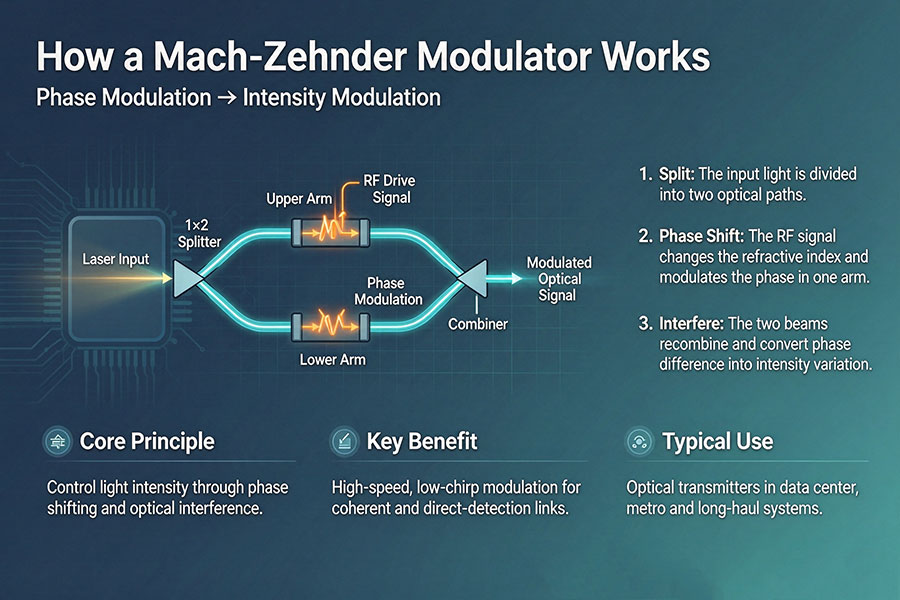
The laser driver's transfer characteristic—its output current versus input voltage—is not perfectly linear. Driver nonlinearity compresses or expands the PAM4 level spacing, producing unequal eye openings. In external modulation architectures, the modulator's transfer function introduces its own nonlinearity. A Mach-Zehnder modulator, for example, has a sinusoidal transfer characteristic, so the bias point and drive amplitude must be chosen carefully to maintain approximately equal spacing among the four PAM4 levels.
Photodetector and transimpedance amplifier (TIA) nonlinearity also contribute. A photodiode converts incident light to current linearly only within a limited optical power range; beyond that range, responsivity decreases and harmonic distortion increases sharply as the detector approaches saturation. In PAM4 receivers, this compression can distort the upper levels disproportionately[reference:13][reference:14].
4. Connector Reflections and Multipath Interference
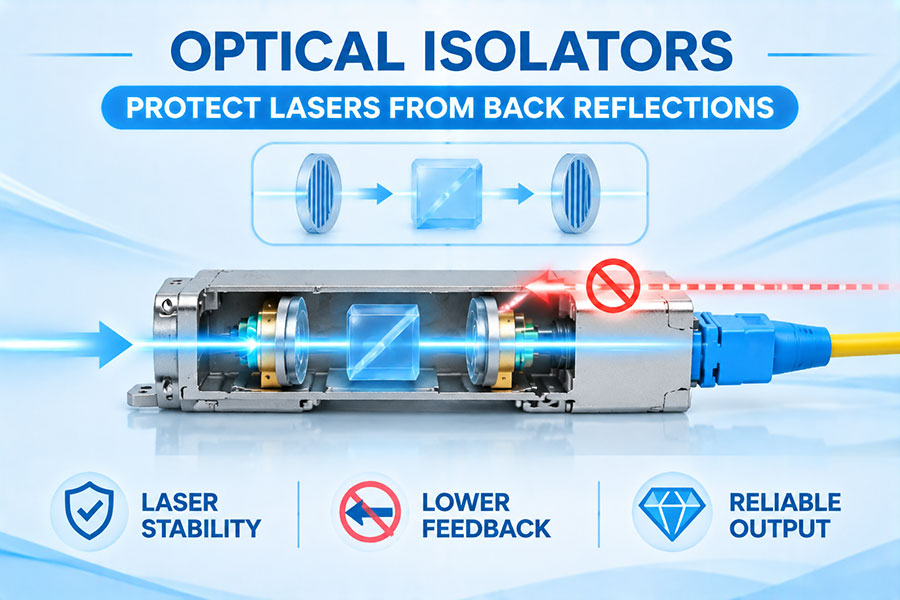
Optical connectors, splices, and pigtails are not perfectly impedance-matched to the fiber. Imperfect interfaces produce small reflections, and when multiple reflections are present, they interfere with the forward-propagating signal. This multipath interference (MPI) is a distinct and often underappreciated distortion mechanism in short-reach IM-DD links.
The mechanism is interferometric. A reflection at an imperfect connector interface creates a delayed replica of the signal. When this delayed replica recombines with the main signal, the two interfere. Because the laser has a finite linewidth, its phase noise is converted into intensity noise by this interference. Wider-linewidth lasers produce stronger MPI noise, which is why cost-sensitive IM/DD PAM4 links using broad-linewidth lasers are particularly vulnerable[reference:15].
MPI is more damaging to PAM4 than to NRZ because PAM4 is more sensitive to reflections. The interference creates irregular intensity fluctuations across the PAM4 levels, effectively reshaping the constellation and increasing bit error rate fluctuation. The severity depends on the number and return loss specifications of the connectors in the end-to-end link, as well as the reflection delay and the signal-to-interference ratio[reference:16]. Link budgets for 400GBASE and 800GBASE interfaces often allocate a specific MPI penalty—on the order of 0.1 to 0.5 dB—on top of other transmitter penalties, reflecting the practical reality that connector reflections cannot be eliminated entirely[reference:17].
5. Why PAM4 Amplifies Every Distortion Mechanism
The individual distortion mechanisms described above are not new. Chromatic dispersion, laser nonlinearity, and connector reflections have accompanied optical links since the NRZ era. What has changed with PAM4 is the margin available to tolerate them.
PAM4 reduces the spacing between adjacent levels to roughly one-third of the NRZ level spacing for the same peak-to-peak amplitude. This produces a theoretical signal-to-noise ratio penalty of approximately 9.5 dB. Residual distortion that consumed a small fraction of the NRZ eye opening can consume a much larger fraction of the PAM4 eye opening. The middle PAM4 eye is especially vulnerable because it is bounded by the two inner levels, where both level-dependent noise and level-dependent timing skew are most pronounced[reference:18].
The TDECQ metric captures this reality. TDECQ separates transmitter penalties into components that are equalizable by the reference receiver and components that are not. Low-pass filtering contributes mainly to the equalizable penalty, while amplitude noise, compression, and eye skew affect mainly the non-equalizable part. In a PAM4 transmitter, laser nonlinearity, level-dependent noise, and RIN fall largely into the non-equalizable category, meaning that equalization at the receiver cannot fully recover the eye closure they produce[reference:19].
| Distortion Mechanism | Origin | Primary Effect | PAM4 Sensitivity |
|---|---|---|---|
| Chromatic dispersion | Wavelength-dependent propagation velocity in fiber | Pulse broadening, ISI | Moderate; worse with chirp |
| Polarization mode dispersion | Fiber asymmetry and stress | Random pulse spreading, ISI | High; stochastic nature complicates compensation |
| SPM / XPM / FWM | Kerr effect (intensity-dependent refractive index) | Spectral broadening, crosstalk, coherent interference | High in DWDM; level-dependent for PAM4 |
| Laser level-dependent response | Drive-level-dependent modulation speed and L-I nonlinearity | Eye distortion, timing skew, unequal eye heights | Very high; directly degrades three-eye structure |
| RIN and level-dependent noise | Laser intensity fluctuations; upper-level noise dominance | Eye closure, TDECQ penalty | Very high; non-equalizable penalty |
| Multipath interference (MPI) | Reflections at connectors, splices, pigtails | Phase-to-intensity noise conversion, irregular level fluctuation | Very high; PAM4 more sensitive than NRZ |
6. Distinguishing Equalizable and Non-Equalizable Distortion
Not all distortion can be corrected by receiver equalization. This distinction is essential for root-cause analysis and for understanding why a link fails despite an apparently functional equalizer.
Linear, deterministic impairments—channel loss, chromatic dispersion in the electrical domain, and much of the ISI from bandwidth limitations—are largely equalizable by FFE, CTLE, and DFE. These mechanisms reshape the signal in ways that a linear filter can invert, subject to noise enhancement constraints.
Nonlinear and stochastic impairments resist equalization. Laser compression and level-dependent response produce distortion that depends on the instantaneous signal amplitude, not on a fixed linear filter response. RIN and MPI noise are stochastic processes that add variance rather than deterministic ISI. PMD is time-varying and random. These mechanisms degrade the non-equalizable component of TDECQ, and they must be addressed at the source—through laser linearization, bias optimization, connector quality, and, where available, digital pre-distortion at the transmitter[reference:20].
Conclusion
Signal distortion in high-speed optical channels originates from three broad categories of mechanism. Linear fiber impairments—chromatic dispersion and polarization mode dispersion—spread pulses in time and produce ISI. Kerr nonlinearities—SPM, XPM, and FWM—distort the optical spectrum and create inter-channel interference at high power levels. Component-level non-idealities—laser level-dependent response, RIN, driver and modulator nonlinearity, photodetector compression, and multipath interference from connector reflections—reshape the signal inside the transceiver and at its interfaces.
PAM4 does not introduce new physical mechanisms, but it reduces the margin available to tolerate them. The smaller level spacing of four-level modulation means that distortion which was previously benign can close an eye, and the non-equalizable components of that distortion cannot be fully recovered by receiver DSP. Root-cause analysis of a distorted PAM4 link therefore requires distinguishing between what equalization can correct and what must be corrected at the transmitter, in the optical path, or through connector and fiber quality.
Frequently Asked Questions
Note: The relative contribution of each distortion mechanism depends on reach, wavelength, modulation format, laser type, connector quality, and DSP architecture. Link debugging should identify which mechanisms dominate in the specific channel under test.
 >

 >
 >
 >
 >
 >
 >
 >