TEL:+86 132 6656 7067





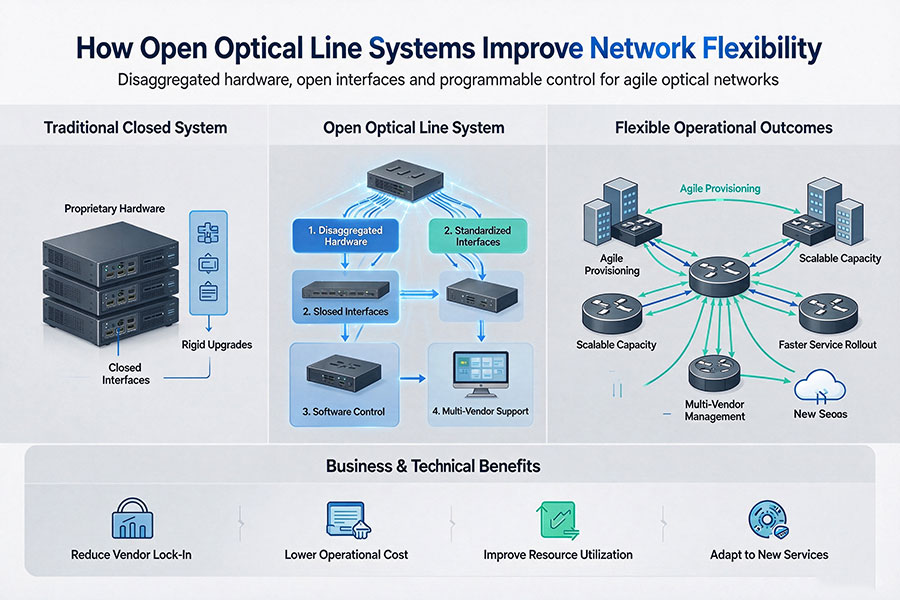
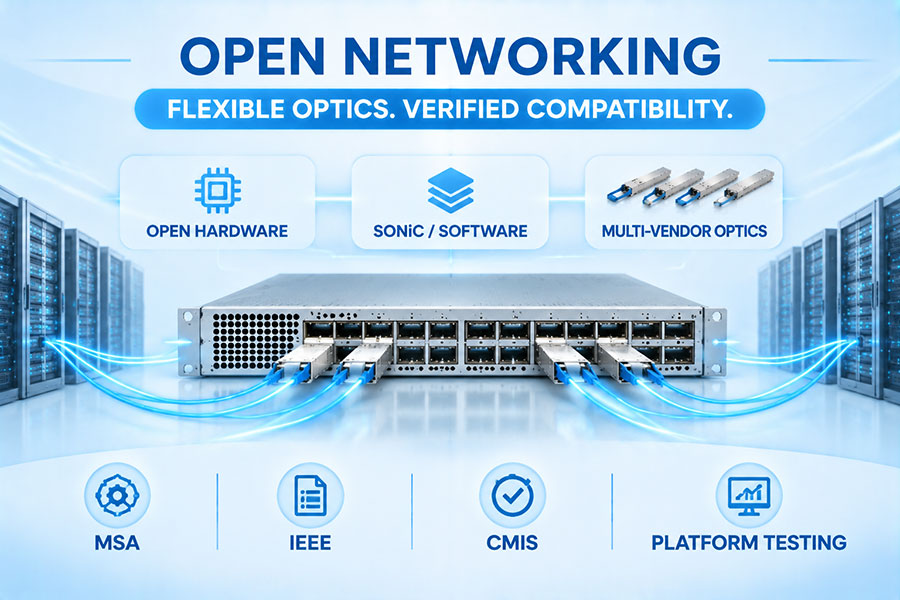
Traditional optical transport networks often combine transponders, optical amplifiers, wavelength multiplexers, ROADMs, and network management within a single vendor's integrated platform. An Open Optical Line System (Open OLS) changes this architecture by separating the optical transmission line from the terminal equipment that generates and receives data signals. This disaggregation allows network operators to introduce qualified third-party transponders, upgrade terminal technology independently, and manage optical resources through standardized interfaces. The result is a more adaptable DWDM infrastructure that can evolve without requiring every component to be replaced as one system.
1. What Is an Open Optical Line System?
An Open Optical Line System is an optical transport architecture in which the line infrastructure is designed to support compatible optical signals from independently selected terminal equipment. Instead of requiring the transponders and optical line equipment to come from the same vendor, an operator can deploy a shared optical line system and connect terminals supplied by different manufacturers.
The optical line system typically includes the equipment responsible for transporting and managing wavelengths across the fiber network. Depending on the architecture, this can include optical amplifiers, wavelength multiplexers and demultiplexers, ROADMs, optical channel monitors, and associated control and management functions.
Terminal equipment performs a different role. Transponders and muxponders convert client traffic into optical signals suitable for transmission over the line system, while receiving equipment recovers the data at the other end. In an open architecture, these terminal functions can be selected and upgraded independently, provided that their optical interfaces satisfy the line system's requirements.
Open OLS is often associated with optical disaggregation. It is important to distinguish partial disaggregation from full disaggregation: an operator may open the interface between terminals and the line while retaining a single supplier for the integrated line infrastructure itself.
2. Closed Optical Systems and Open OLS Architectures
In a traditional closed optical transport system, the vendor supplies a tightly integrated platform containing terminal equipment, optical line components, and management software. This arrangement can simplify initial deployment because the supplier validates the system as a complete solution. However, it may restrict the operator's ability to introduce terminal equipment from another manufacturer or adopt new transponder technology independently.
An Open OLS architecture separates the terminal layer from the optical line layer. The operator can retain an existing line system while introducing compatible transponders from another supplier. The line system remains responsible for its optical transmission environment, while the terminal equipment can evolve according to bandwidth, reach, and service requirements.
| Architecture | Equipment Selection | Upgrade Approach | Operational Characteristics |
|---|---|---|---|
| Closed optical system | Terminals and line equipment are generally selected as one integrated vendor solution. | Upgrades are commonly coordinated within the same platform ecosystem. | Integrated validation and support, with greater dependence on one supplier. |
| Partially disaggregated OLS | Line system and terminal equipment can come from different suppliers. | Terminal technology can be upgraded independently after compatibility validation. | One supplier may continue to integrate and manage the optical line. |
| More fully disaggregated optical network | Individual optical components and control functions may be sourced independently. | Different network layers and components can evolve separately. | Greater integration, interoperability, and lifecycle management responsibility. |
Disaggregation does not automatically mean that every component is interchangeable. The extent of openness depends on the optical interfaces, supported specifications, management APIs, and integration model adopted by the operator.
3. How Open OLS Supports Multi-Vendor Optical Connectivity
One of the main capabilities of an Open OLS is its ability to transport third-party optical signals, often described as alien wavelengths. An alien wavelength is an optical channel generated by terminal equipment that is independent of the supplier providing the underlying optical line system.
For example, a network operator may use a ROADM and amplifier infrastructure from one supplier while deploying coherent transponders from another. The third-party terminals generate optical channels that enter the shared line system, pass through its filters and amplifiers, and reach the receiving terminal at the opposite end.
To make this arrangement work, the terminal and line system must satisfy a defined set of optical conditions. These include operating wavelength or frequency, channel bandwidth, optical launch power, receiver input range, modulation characteristics, and transmission performance requirements.
Multi-vendor operation also requires attention to the complete optical path. A transponder that works over one fiber span may not perform identically over a different route with different amplifier characteristics, filter cascades, or accumulated optical noise.
4. The Role of DWDM and ROADM in Open Optical Networks
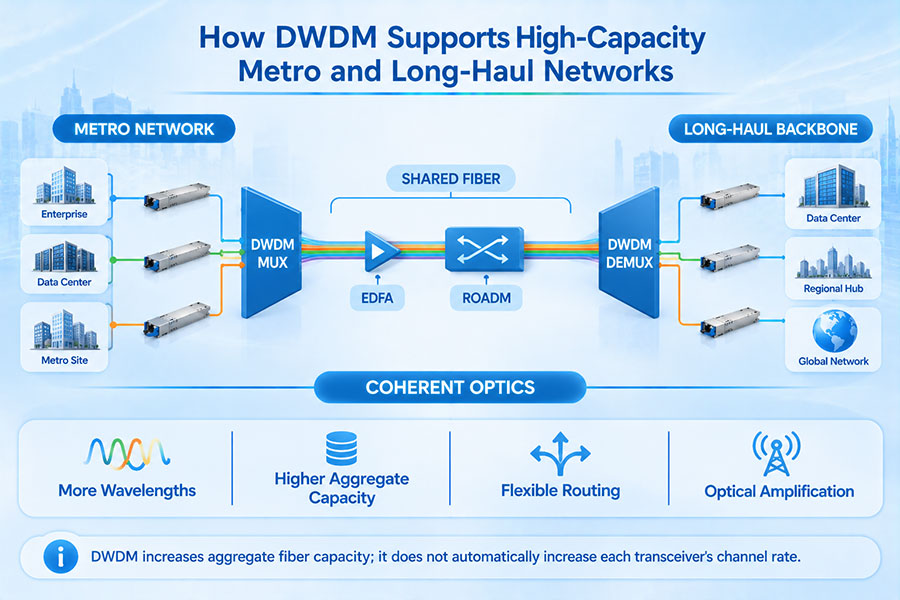
Dense Wavelength Division Multiplexing (DWDM) is fundamental to many Open OLS deployments. It allows multiple optical channels at different wavelengths or frequency slots to share a fiber pair. The line system combines these channels for transmission and separates them at the required network locations.
Reconfigurable Optical Add-Drop Multiplexers (ROADMs) add another level of flexibility. They allow selected wavelength channels to be added, dropped, or routed through optical nodes without requiring every channel to be converted into an electrical signal at each intermediate location.
When DWDM and ROADM infrastructure supports qualified third-party wavelengths, operators can introduce new terminal technologies while retaining much of the existing optical transport infrastructure. This is particularly useful in metro, regional, long-haul, and data center interconnection networks.
Flex-grid technology can further improve spectrum allocation. Rather than relying exclusively on fixed channel spacing, flexible-grid systems allow optical spectrum to be allocated in appropriately sized frequency slots. Higher-baud-rate signals may require wider spectrum, while narrower channels can be used where the signal characteristics permit.
| Technology | Function in an Open OLS | Flexibility Benefit |
|---|---|---|
| DWDM | Combines multiple wavelength channels on shared fiber infrastructure. | Supports capacity expansion through additional channels and terminal upgrades. |
| ROADM | Routes, adds, and drops optical channels at network nodes. | Enables flexible wavelength routing as traffic patterns change. |
| Flex-grid | Allocates optical spectrum using variable-width frequency slots. | Accommodates different baud rates and channel bandwidth requirements. |
| Optical channel monitor | Measures channel presence and optical power across the spectrum. | Supports monitoring, power balancing, and fault diagnosis. |
| Optical amplifiers | Compensate for transmission loss across fiber spans. | Allow multiple channels to share an amplified optical path. |
5. Independent Upgrades of Transponders and Line Infrastructure
Optical terminal equipment and passive or amplification-based line infrastructure do not necessarily follow the same technology lifecycle. Transponders may be upgraded as new modulation formats, baud rates, coherent DSP capabilities, and client interfaces become available. Fiber routes, amplifier sites, and some ROADM infrastructure may remain in service for substantially longer periods.
In a closed architecture, taking advantage of a new terminal generation may require a broader platform upgrade or continued reliance on the original vendor's product roadmap. An Open OLS makes it possible to evaluate new terminal equipment separately, reducing the need to replace functioning line infrastructure simply because a newer transponder becomes available.
For example, an operator may initially deploy 100G or 200G coherent wavelengths and later introduce higher-capacity terminals on selected routes. Whether the existing line can support the new signals depends on available spectrum, amplifier bandwidth, filter passbands, OSNR, fiber characteristics, and the terminal's operating mode.
This independent upgrade model helps operators plan investment around actual network demand. Capacity can be added where it is needed, while existing infrastructure continues to support services that do not yet require an upgrade.
6. Standardized Interfaces and Software-Defined Optical Control
Multi-vendor optical infrastructure creates a management challenge: equipment from different suppliers may expose different configuration methods, telemetry formats, and operational interfaces. Open OLS deployments therefore benefit from standardized data models and APIs that allow controllers and operations systems to manage network resources consistently.
Several industry initiatives contribute to this approach:
OpenROADM MSA: Defines specifications and YANG-based models for optical devices, network resources, services, and interoperable ROADM architectures.
OpenConfig: Provides vendor-neutral data models for network configuration and operational state across supported equipment.
ONF Transport API (T-API): Defines interfaces for exposing transport network topology, connectivity, and service-related information to higher-level systems.
NETCONF and RESTCONF: Provide standardized mechanisms for interacting with network configuration data and device models.
Software-defined networking (SDN) controllers can use these interfaces to discover network resources, calculate optical paths, coordinate provisioning, and collect operational information. The degree of automation depends on the capabilities exposed by each device and the integration between the controller and the underlying equipment.
Standardized APIs improve management consistency, but they do not eliminate the need for optical engineering. Controllers still need accurate information about wavelength availability, spectrum constraints, optical power, route loss, and signal quality before provisioning a new service.
7. Optical Power Management and Alien Wavelength Validation
Optical power management is one of the most important engineering requirements in an open multi-vendor environment. Every terminal transmitter has a specified launch-power range, while the line system has its own input-power, output-power, and amplifier operating limits.
If a channel enters the line with excessive power, it may contribute to nonlinear interference or exceed equipment limits. If its power is too low, the received signal may not maintain the required performance margin. Power balancing across multiple channels is therefore necessary for stable DWDM operation.
Before deploying a third-party wavelength, engineers should verify the following parameters:
| Validation Parameter | Why It Matters | Typical Engineering Check |
|---|---|---|
| Wavelength and frequency | Ensures the signal falls within the supported optical band and channel plan. | Check ITU grid compatibility, tuning range, and filter passband. |
| Channel bandwidth | Determines whether the signal fits within the available spectrum slot. | Evaluate baud rate, spectral width, and adjacent-channel spacing. |
| Launch power | Influences amplifier operation and nonlinear transmission effects. | Confirm transmitter output and line-system input limits. |
| OSNR | Indicates the optical signal quality relative to accumulated noise. | Verify route-specific OSNR margin and receiver requirements. |
| Chromatic dispersion | Affects signal propagation and receiver compensation requirements. | Check fiber route characteristics and terminal tolerance. |
| FEC and modulation | Influence receiver sensitivity and achievable transmission performance. | Validate supported operating modes and end-to-end error performance. |
| Amplifier and filter compatibility | Determines whether the complete line can transport the signal without unacceptable degradation. | Check gain profile, noise figure, filter narrowing, and passband restrictions. |
These checks should cover the entire route rather than only the transmitter and first optical amplifier. Cascaded ROADMs and filters can narrow the effective passband, while amplifier noise accumulates across successive spans. A channel that meets the specification at one node may still fail to meet its receiver performance target after traversing the full network.
8. How Open OLS Improves Network Scalability and Capacity Planning
Network traffic changes over time as data centers expand, cloud workloads move between regions, and enterprise services require additional bandwidth. Open OLS architectures help operators respond by separating capacity upgrades from the replacement of the entire optical platform.
Operators can introduce additional transponders, increase the capacity of selected wavelengths, or activate unused spectrum where the line system supports those changes. In ROADM networks, wavelength routing can also be adjusted to accommodate new traffic destinations and changing service paths.
For data center interconnection, this flexibility is particularly useful when traffic demand grows between specific facilities. Instead of rebuilding every part of the transport network, operators can evaluate new coherent terminal equipment and provision additional optical capacity over existing fiber routes when engineering conditions permit.
However, an open architecture does not create unlimited fiber capacity. The usable spectrum, fiber nonlinear threshold, amplifier capability, route length, and existing channel loading still define the practical limits of each optical path.
9. Cost, Vendor Choice, and Equipment Lifecycle Management
Open OLS can change how operators evaluate equipment procurement and network investment. By separating the terminal layer from the line infrastructure, operators gain more freedom to select suppliers based on performance, capacity, power consumption, cost, and product availability.
This flexibility can reduce dependence on a single supplier and make it easier to introduce terminal technology from a wider equipment ecosystem. It may also allow operators to preserve investments in existing fiber and line infrastructure while replacing only the equipment that needs additional capability.
However, lower equipment costs do not automatically translate into lower total network costs. Multi-vendor deployments require integration work, interoperability testing, optical planning, software adaptation, and operational procedures for equipment from different suppliers.
| Operational Area | Potential Benefit | Cost or Management Consideration |
|---|---|---|
| Vendor selection | More freedom to choose terminal and line-system suppliers independently. | Supplier coordination and responsibility boundaries must be defined. |
| Infrastructure lifecycle | Line equipment and transponders can be upgraded on different schedules. | Long-term compatibility and software support need to be maintained. |
| Capacity expansion | New terminal generations can be evaluated without replacing the complete line system. | Existing spectrum, amplifiers, and filters may limit the upgrade. |
| Operations | Standardized interfaces can improve integration with centralized management systems. | Multi-vendor fault isolation and testing can require additional expertise. |
| Procurement | Competition between suppliers may improve commercial flexibility. | Integration, validation, and support costs must be included in total cost of ownership. |
10. Challenges in Deploying Open Optical Line Systems
Open OLS offers architectural flexibility, but it also shifts some integration and validation responsibilities toward the network operator or its systems integrator. Optical transport is an analog physical-layer environment, so matching interface specifications alone does not guarantee that two devices will deliver the required performance over a real fiber route.
Interoperability testing: Third-party transponders must be validated against the line system and the intended route conditions.
Optical performance: OSNR, launch power, dispersion, filter narrowing, and nonlinear effects must remain within acceptable limits.
Management integration: Different vendors may implement data models, telemetry, alarms, and software functions with varying levels of support.
Fault ownership: Clear procedures are needed to identify whether a fault originates in terminal equipment, the optical line, or the control system.
Software compatibility: Device firmware, controller releases, and supported model versions need coordinated lifecycle management.
Service assurance: End-to-end performance monitoring must cover both the terminal and optical line layers.
A practical deployment often begins with a limited number of validated routes or terminal combinations. Operators can expand the architecture as they gain experience with optical performance, control integration, and operational support.
11. Open OLS and the Evolution of Optical Transport Networks
Open optical line systems are becoming increasingly relevant as transport networks support higher-capacity coherent wavelengths, expanding data center interconnection, and more dynamic bandwidth requirements. New terminal technologies can offer higher baud rates, improved spectral efficiency, and advanced digital signal processing, while the line infrastructure provides the optical path across the network.
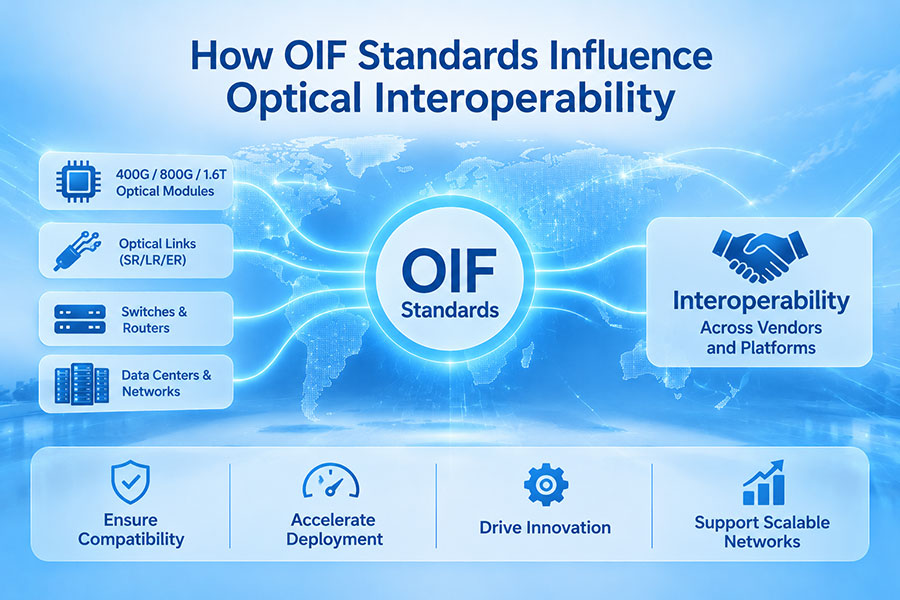
Industry initiatives such as OpenROADM and the Open Networking Foundation's Open Disaggregated Transport Network project demonstrate different approaches to open optical transport. Their work addresses equipment models, optical interfaces, controller integration, and multi-vendor network operation.
Open OLS also complements broader network automation. With suitable APIs and telemetry, optical resources can be exposed to higher-level orchestration systems, making it easier to coordinate transport capacity with IP routing, data center connectivity, and service provisioning.
As networks evolve, the most effective architecture will depend on the operator's requirements. Some may prefer partial disaggregation with an integrated line system and independent terminals, while others may pursue a broader multi-vendor model. In either case, interoperability, optical performance, and operational responsibility remain central design considerations.
12. Conclusion
Open Optical Line Systems improve network flexibility by separating optical terminals from the shared transmission infrastructure. This architecture enables qualified multi-vendor connectivity, independent equipment upgrades, more flexible capacity planning, and integration with standardized management and control interfaces.
DWDM, ROADM, flex-grid technology, optical monitoring, and SDN-based management provide the technical foundation for these capabilities. Successful deployment still requires careful validation of wavelength compatibility, optical power, OSNR, filtering, and end-to-end transmission performance.
For optical connectivity requirements in data center and transport networks, view C-LIGHT optical transceivers or Contact C-LIGHT.
 >

 >
 >
 >
 >
 >
 >
 >