TEL:+86 132 6656 7067




Driven by the exponential growth of AI training clusters scaling to hundreds of thousands of GPUs, the landscape of transmission distance, bandwidth, and power consumption within data centers has been fundamentally redefined. This article provides an in-depth analysis of the high-speed interconnect spectrum inside modern data centers. It systematically classifies optical solutions represented by pluggable transceivers and cable solutions represented by Direct Attach Copper (DAC), Active Optical Cable (AOC), and Active Electrical Cable (AEC). The paper analyzes the core principles, physical layer challenges, and application boundaries in the 800G/1.6T era. It also explores future technological directions, including Linear-drive Pluggable Optics (LPO), Co-Packaged Optics (CPO), and next-generation evolution based on 224G SerDes.
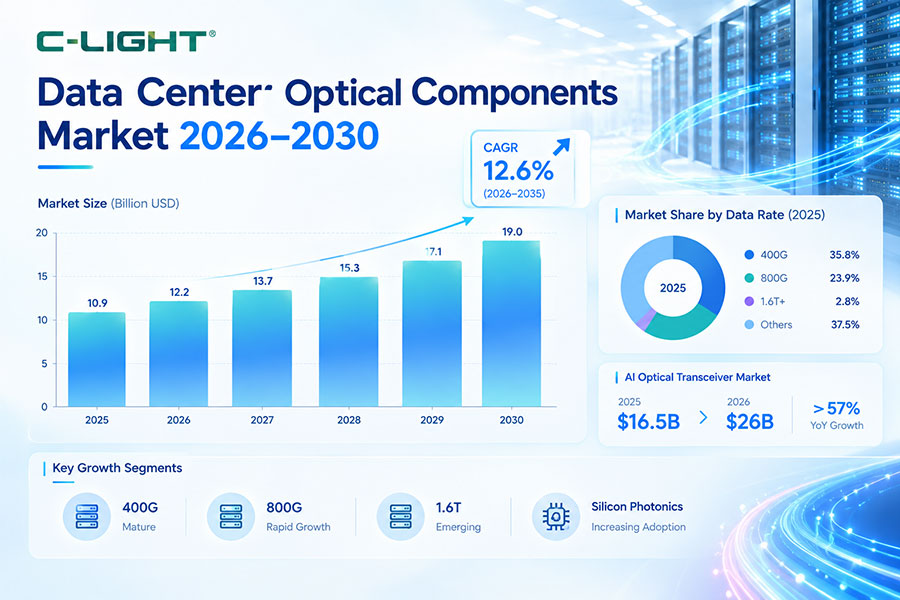
Driven by the surge in AI computing power, data center interconnect technology is undergoing a profound paradigm shift. The traditional linear "fiber-replaces-copper" mindset has been disrupted, replaced by a precision-layered architecture based on distance, power consumption, cost, and reliability. Today, designing an AI cluster network forces engineers to make trade-offs among intra-rack connections under 2 meters, cross-rack connections from 2 to 7 meters, and Data Center Interconnects (DCI) spanning dozens of meters or even kilometers . This balancing act has directly led to the clear differentiation of four major technology camps: DAC, AEC, AOC, and pluggable optical transceivers.
1. Core Technology Taxonomy
Based on the transmission medium and signal processing method, current high-speed interconnects can be divided into two main camps: copper-based electrical interconnects and fiber-optic interconnects.
1.1 Copper-Based Interconnects: DAC, ACC, and AEC
Copper solutions consistently dominate short-reach interconnects due to their core advantages in cost and power consumption. As signal rates increase, technological divergence has emerged within the copper family.
Passive Direct Attach Copper (DAC): As the baseline technology, DAC contains no active electronics, transmitting electrical signals directly. At 800G rates (112Gbps PAM4), due to "skin effect" and dielectric loss, its effective reach shrinks to only about 2 meters. However, its near-zero power consumption (<0.15w) and="" ultra-low="" latency="" make="" it="" the="" preferred="" choice="" for="" top-of-rack="">
Active Copper Cables (ACC/AEC): To combat signal degradation over copper at 112G PAM4, signal conditioning is introduced. While similar in appearance, ACC and AEC differ significantly in underlying technology:
ACC (Active Copper Cable): Integrates a linear equalizer within the connector housing to perform analog amplification of the attenuated signal. It features low power consumption (1.5-3W) but amplifies noise along with the signal, offering limited improvement in signal-to-noise ratio .
AEC (Active Electrical Cable): Represents a significant upgrade. It integrates a Retimer chip with Clock and Data Recovery (CDR) function inside the connector. This chip "re-times and reshapes" the received signal, fully restoring a clean digital signal. This allows AEC to extend transmission reach to 7 meters at 800G, with demonstrations reaching 9 meters, while also having a thinner diameter than DAC, aiding rack cooling . Due to their high reliability (Credo claims MTBF up to 100 million hours), AECs are rapidly becoming the de facto standard for GPU cluster interconnects spanning multiple racks .
1.2 Fiber Optic Interconnects: AOC and Pluggable Transceivers
Beyond 7-10 meters, copper loss and weight become prohibitive, making optical interconnects the inevitable choice.
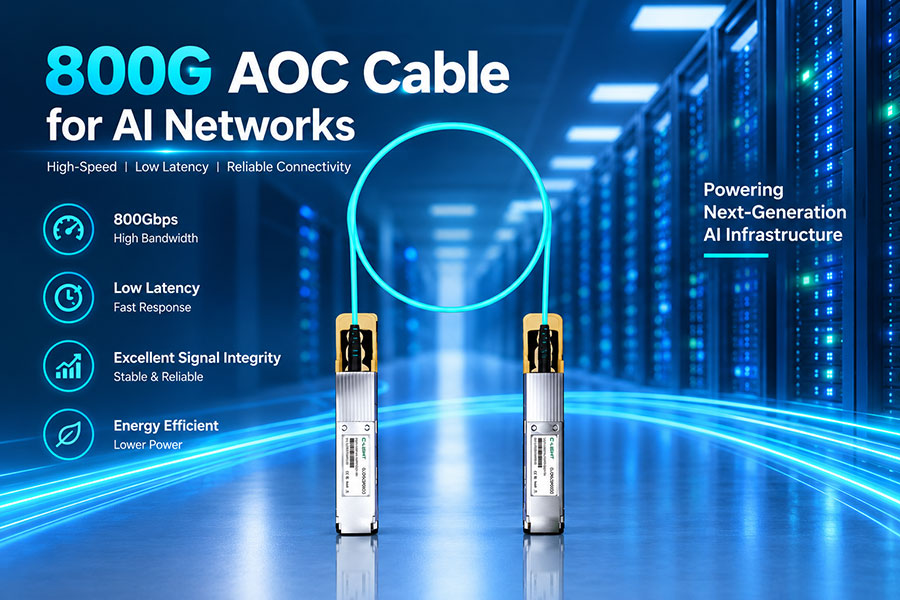
Active Optical Cable (AOC): AOC permanently attaches a pair of optical modules to the ends of a fiber cable. It performs electrical-to-optical and optical-to-electrical conversion within the connectors. AOCs are lightweight and immune to EMI, supporting distances of 30 to 100 meters at 800G, primarily used for cross-rack or even cross-row connections . However, power consumption is high at 12-17W, and failure requires replacing the entire cable assembly .
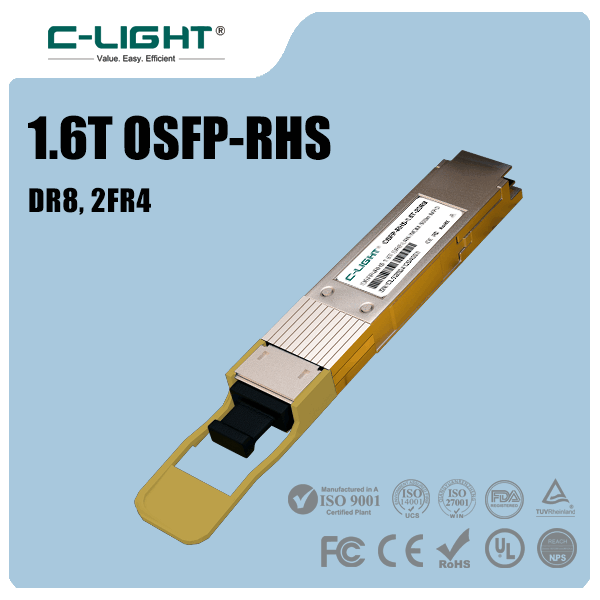
Pluggable Optical Transceivers: Unlike the fixed nature of AOCs, pluggable transceivers (e.g., QSFP-DD, OSFP) are separate from the fiber. This modular design greatly simplifies maintenance—modules can be swapped without re-cabling. Their application range is vast, from SR8 multimode modules for 100 meters, to FR4 single-mode modules for 2 km, and coherent modules for over 80 km used in DCI .
2. Core Drivers of Technology Evolution
2.1 The Trade-off Between Speed Upgrade and Signal Integrity
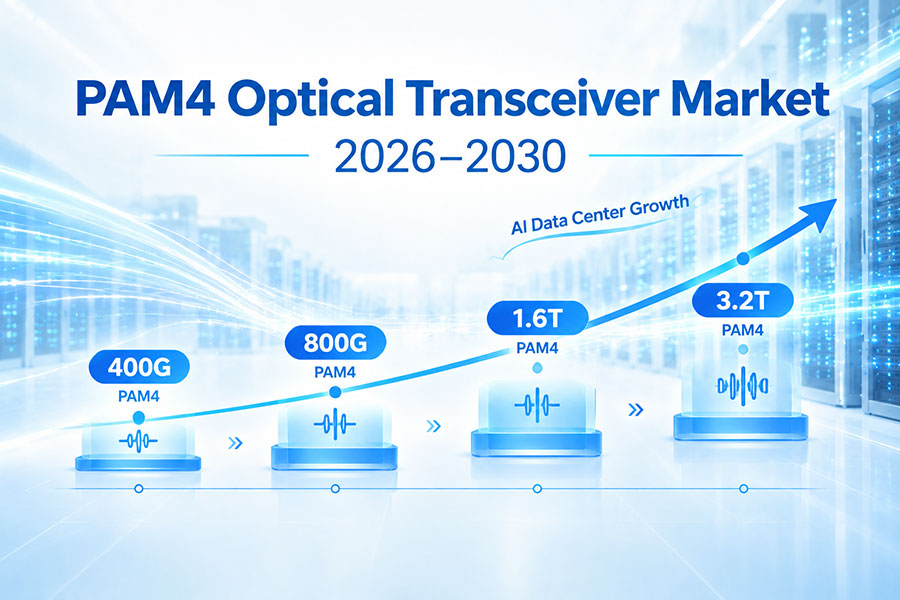
The fundamental change when upgrading from 400G to 800G/1.6T is the SerDes rate doubling from 56Gbps PAM4 to 112Gbps PAM4, heading towards 224Gbps. According to Shannon's law, doubling the rate causes channel loss to increase exponentially. This explains why "passive" copper reach shrank so dramatically in the 800G era, creating a market "dead zone" of 3-7 meters that fueled the rise of AEC . In this zone, traditional DAC falls short, while optical modules are too expensive and power-hungry. AEC perfectly fills this gap with its digital retiming technology.
2.2 The Power Wall: The Return of LPO and LRO
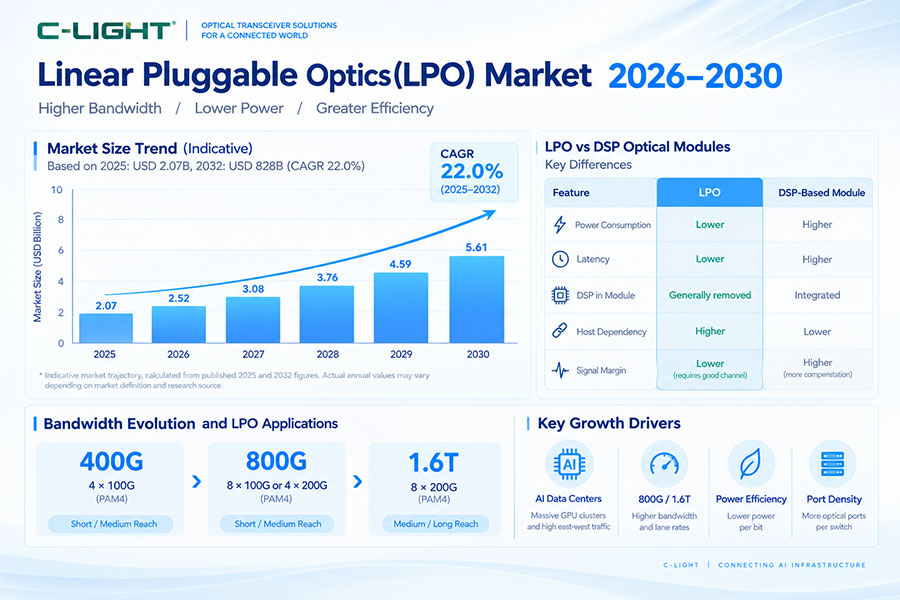
The power consumption of optical modules (~15W) is approaching the thermal limits of switch faceplates. This has led the industry to re-evaluate the necessity of DSPs. This gives rise to Linear-drive Pluggable Optics (LPO) . LPO removes the DSP chip from the module, allowing the switch ASIC's SerDes to drive the optical engine directly. This can reduce power consumption by approximately 50% (e.g., down to 8.5W for an 800G DR8 module) . However, LPO introduces new challenges: without the DSP's clock recovery and equalization, it imposes stringent requirements on motherboard trace routing and link budget, leading to testing and interoperability issues. As a compromise, Linear Receive Optics (LRO) retain some DSP functionality, attempting to balance power and reliability .
2.3 Architectural Shift: Diverging Needs of Scale-up and Scale-out
AI network architectures are evolving from a single focus on Scale-out to a coexistence of Scale-up and Scale-out .
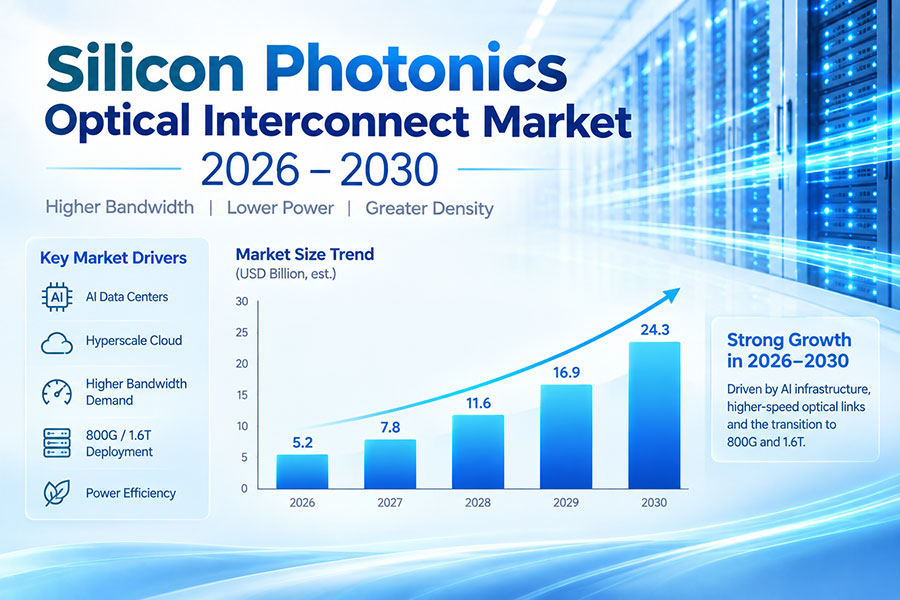
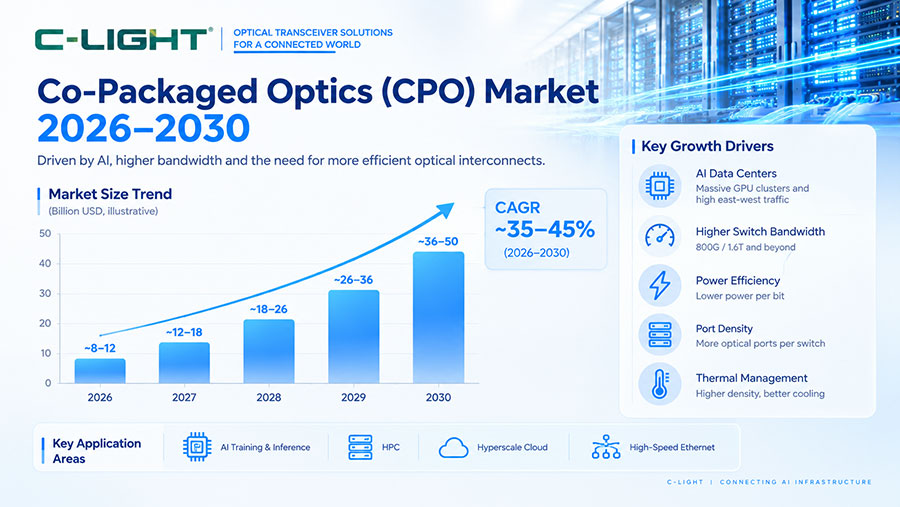
Scale-up Network (GPU-to-GPU): Demands ultra-low latency and ultra-high bandwidth. This drives the development of Co-Packaged Optics (CPO) . CPO integrates the optical engine onto the same substrate as the switch chip, reducing electrical trace length to mere millimeters. This drastically cuts power consumption and breaks through the bandwidth density limitations of the faceplate I/O .
Scale-out Network (GPU-to-Data Center): Prioritizes cost and reach. In this domain, pluggable optics remain strong, but AECs, with reliability comparable to copper and lower cost than optics, are actively penetrating short-reach links within leaf-spine networks .
3. Future Outlook
Looking ahead three to five years, data center interconnects will present a diversified landscape:
Copper Will Not Die: Advanced active copper cables, represented by AEC, will continue to dominate short-reach (<10m) connections.="" emphasis="" by="" major="" players="" like="" nvidia="" that="">
The Evolution of Optics: Between 10 meters and several kilometers, optical communication remains the absolute main force. However, its form will change: externally, LPO/LRO are poised to become power-efficient solutions for intermediate distances; internally, CPO will transition from labs to large-scale commercial deployment, particularly in custom switches for hyperscalers .
The Battle of Standards and Ecosystem: The 224Gbps per lane ecosystem is emerging . Both copper and fiber interconnects must comply with this new physical layer standard. Standards defined by organizations like OIF and IEEE (e.g., 800G-LR, 1600G-ZR) will dictate the compatibility and cost structure of the next generation of interconnect technologies .
Data center interconnection is no longer an either-or choice, but a complex prioritization problem based on physical layer constraints and Total Cost of Ownership (TCO) models. DAC holds the line in the last meter, AEC is conquering the main battlefield between racks, LPO seeks to redefine the energy efficiency of optical modules, and CPO represents the ultimate path toward future high-bandwidth-density computing. Understanding this layered evolution is key to architecting next-generation AI infrastructure.
 >
>

 >
>
 >
>
 >
>
 >
>
 >
>
 >
>
 >
>