TEL:+86 132 6656 7067





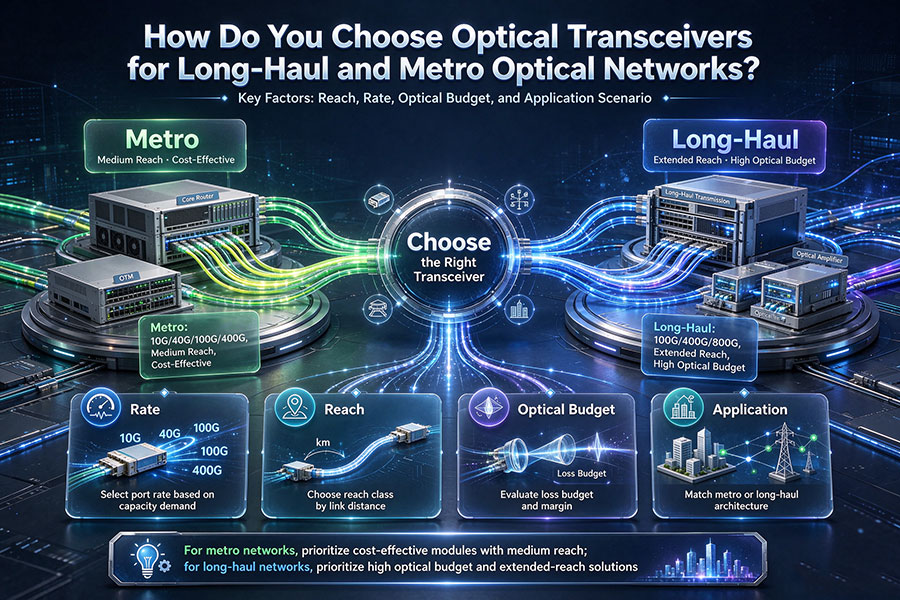
Optical transceiver selection for metro and long-haul networks is fundamentally a link-engineering decision. Transmission distance alone does not determine whether a module will operate reliably. Fiber attenuation, optical signal-to-noise ratio (OSNR), chromatic dispersion, modulation format, amplifier configuration, wavelength spacing and receiver performance all influence the achievable capacity and reach.
Metro networks generally prioritize high-capacity connectivity across metropolitan areas, while long-haul systems must maintain signal quality across multiple fiber spans and optical amplification stages. Selecting the appropriate transceiver requires matching its optical performance to the complete transmission path rather than relying only on a nominal distance specification.
1. Identify the Network Application and Transmission Distance
The first selection step is to establish the network's transmission requirements. Metro and long-haul networks have different physical characteristics, capacity requirements and optical infrastructure. A module designed for a short point-to-point link may not provide sufficient performance for a multi-span DWDM system.
| Network Type | Typical Application | Transmission Characteristics | Common Optical Solution |
|---|---|---|---|
| Metro Access | Enterprise aggregation, access networks and regional service connections | Shorter fiber routes, often with relatively straightforward optical paths | 10G–100G direct-detect or coherent optics, depending on capacity and architecture |
| Metro Core | Interconnection between metropolitan core nodes and data centers | Higher capacity, wavelength multiplexing and possible optical amplification | 100G–400G coherent DWDM transceivers |
| Regional Transport | Intercity connectivity and regional backbone links | Longer fiber paths, multiple spans and increased OSNR requirements | Coherent DCO, transponders and amplified DWDM systems |
| Long-Haul | National and cross-country backbone networks | Multiple amplified spans, ROADM nodes and accumulated optical impairments | High-performance coherent optics and engineered DWDM line systems |
These categories describe common deployment patterns rather than fixed distance boundaries. Actual reach depends on the optical interface, fiber route, line-system design and operating conditions.
2. Select Between Direct-Detect and Coherent Optical Transceivers
Direct-detect and coherent transmission technologies serve different network requirements. The appropriate choice depends on channel capacity, spectral efficiency, transmission distance and the optical infrastructure already deployed.
Direct-Detect Optical Transceivers
Direct-detect modules recover information primarily from the received optical intensity. They are widely used in Ethernet access, enterprise networks, data center interconnections and shorter optical transport links.
Suitable for many 10G, 25G, 100G and selected higher-rate short- or medium-reach applications.
Common interfaces include SFP+, SFP28, QSFP28 and other high-speed form factors.
Often provide a simpler deployment model for dedicated fiber connections.
Generally do not provide the same spectral efficiency and long-distance performance capabilities as coherent DWDM systems.
Coherent Optical Transceivers
Coherent optics use the amplitude and phase information of the received optical field. A local oscillator, coherent receiver and digital signal processor recover the transmitted data while compensating for important transmission impairments.
Support high-capacity wavelength transmission over metro, regional and long-haul fiber infrastructure.
Use modulation formats such as DP-QPSK and DP-16QAM, depending on the target capacity and optical reach.
Provide digital compensation for chromatic dispersion and polarization-related impairments within supported operating limits.
Can integrate directly into compatible switches, routers or dedicated transport platforms through coherent pluggable interfaces.
| Parameter | Direct-Detect | Coherent |
|---|---|---|
| Detection Method | Optical intensity detection | Amplitude and phase detection |
| Modulation | Commonly NRZ or PAM4 | DP-QPSK, DP-8QAM, DP-16QAM and other supported formats |
| Signal Processing | Depends on module architecture and data rate | Coherent DSP with dispersion and polarization compensation |
| Typical Deployment | Access, enterprise, data center and selected metro links | Metro DWDM, regional and long-haul transport |
| Wavelength Multiplexing | Possible with appropriate optical interfaces and line systems | Commonly deployed in tunable DWDM systems |
3. Match the Transceiver to the Required Optical Reach
Optical reach should be evaluated using the complete link budget and transmission performance, not simply the distance printed on a product specification sheet.
For a basic optical power budget, the available margin can be expressed as:
Available Power Margin = Transmitter Output Power − Receiver Sensitivity − Total Link Loss
Total link loss includes fiber attenuation, connector loss, splice loss and other passive component losses. Engineering margin must also account for aging, repair conditions and operational variation.
This calculation is useful for evaluating optical power, but it is not sufficient for coherent DWDM links. A coherent signal may have adequate received power while still failing because of insufficient OSNR, excessive filtering or nonlinear transmission effects.
| Reach Category | Selection Consideration | Relevant Optical Technology |
|---|---|---|
| Short Metro | Fiber loss, connector quality and host interface compatibility | Direct-detect or 400ZR, depending on architecture |
| Extended Metro | OSNR, wavelength filtering, launch power and amplification | 400ZR+, OpenZR+ or other qualified coherent interfaces |
| Regional | Span loss, amplifier noise, dispersion and ROADM filtering | Coherent DCO and transport transponders |
| Long-Haul | End-to-end OSNR, nonlinear effects, amplifier spacing and modulation selection | High-performance coherent transmission systems |
These are technology-selection categories, not guaranteed reach ratings. A 400ZR interface is commonly associated with shorter coherent DCI links, while OpenZR+ supports additional operating modes intended for metro and regional transport. The actual achievable distance depends on the selected line rate, modulation, FEC and optical line system.
4. Evaluate OSNR and Optical Amplification
OSNR is one of the most important parameters in coherent optical network engineering. It describes the relationship between the optical signal power and noise power within a specified reference bandwidth. As a wavelength travels through fiber spans and optical amplifiers, amplified spontaneous emission (ASE) noise accumulates and reduces the available OSNR.
The receiver requires sufficient OSNR to recover the transmitted signal at the selected modulation format, baud rate and FEC operating point.
Key OSNR Considerations
Modulation format: Higher-order modulation can increase spectral efficiency, but generally requires a stronger signal quality at the receiver.
FEC performance: Soft-decision FEC can provide additional coding gain, although its performance and overhead depend on the implementation.
Amplifier noise: EDFA noise contributes to OSNR degradation across amplified spans.
Channel loading: The number of active wavelengths and their launch powers affect the operating conditions of a DWDM line system.
ROADM filtering: Repeated wavelength-selective filtering can reduce the available optical bandwidth and introduce penalties.
Optical Amplification Options
Long-distance DWDM networks commonly use optical amplifiers to compensate for span loss without converting every wavelength into an electrical signal.
| Amplifier Type | Primary Function | Typical Deployment |
|---|---|---|
| EDFA | Amplifies optical signals in the erbium gain band, commonly used across the C-band | Booster, inline and pre-amplifier positions |
| Raman Amplifier | Provides distributed or lumped Raman gain through the transmission fiber | Long-haul and extended-reach systems requiring OSNR optimization |
| SOA | Provides semiconductor-based optical amplification | Selected optical access, switching and specialized amplification applications |
Amplifier selection must consider gain, noise figure, output power, gain flatness, channel loading and the required operating wavelength range. Adding an amplifier does not automatically solve every reach limitation because OSNR, nonlinear effects and filtering penalties remain important.
5. Choose the Appropriate Coherent Standard and Modulation Mode
Coherent transceiver standards define different performance targets and interoperability requirements. Choosing between 400ZR, OpenZR+ and other coherent interfaces requires attention to both the host-side electrical interface and the line-side optical characteristics.
| Coherent Interface | Typical Application | Key Characteristics | Selection Consideration |
|---|---|---|---|
| 400ZR | Point-to-point coherent DCI and selected metro links | 400GbE-oriented coherent interface, commonly QSFP-DD or OSFP | Designed around a defined optical performance envelope; verify the line-system requirements |
| OpenZR+ | Metro, regional and selected long-haul applications | Multiple line-rate and modulation options with enhanced FEC capabilities | Match the selected mode to available OSNR and optical infrastructure |
| OpenROADM-Compatible Coherent | Service provider metro and ROADM networks | Designed for interoperable optical transport applications | Check supported profiles, channel plans and ROADM interoperability |
| Proprietary or Platform-Specific DCO | Specialized transport systems | Performance and operating modes depend on the vendor implementation | Confirm platform support, licensing and cross-vendor compatibility |
Modulation selection creates a trade-off between capacity and reach. DP-16QAM can provide higher spectral efficiency than DP-QPSK under suitable optical conditions, while DP-QPSK is often preferred when greater tolerance to transmission impairments is required.
OpenZR+ implementations can support multiple line rates and modulation modes, allowing network operators to adjust capacity according to the available optical margin. However, the supported modes and achievable reach are product- and line-system-dependent.
6. Check Fiber Characteristics and DWDM Line-System Compatibility
Even a high-performance coherent transceiver cannot compensate for an incompatible optical line system. Before selecting a module, network engineers should evaluate the installed fiber route, wavelength plan and passive optical components.
Fiber and Optical Path Parameters
Fiber type: Confirm whether the route uses G.652, G.655 or another fiber category, and obtain its relevant attenuation and dispersion characteristics.
Chromatic dispersion: Verify the accumulated dispersion against the transceiver's compensation range.
Polarization mode dispersion: Evaluate PMD, particularly on older or longer fiber routes.
Connector and splice loss: Include all patch panels, intermediate connections and splices in the link model.
Wavelength plan: Confirm that the tunable range and channel spacing are supported by the MUX, DEMUX and ROADM.
Optical filtering: Check the passband width and insertion loss of wavelength-selective components.
The diagram represents a simplified amplified DWDM path. Actual networks may contain multiple amplifier spans, ROADMs, add/drop filters, monitoring points and protection routes. Some coherent pluggables connect directly to an open optical line system, while other deployments use dedicated transponder or muxponder equipment.
7. Select the Right Form Factor, Power and Host Platform
Optical performance is only one part of transceiver selection. The module must also operate correctly within the host platform's electrical, mechanical and thermal constraints.
| Form Factor | Common Application | Important Considerations |
|---|---|---|
| QSFP28 | 100G Ethernet and selected transport interfaces | Host electrical interface, power class and optical specification |
| QSFP-DD | 400G Ethernet and coherent pluggable applications | Module power, cooling, firmware and coherent mode support |
| OSFP | High-density 400G, 800G and selected coherent applications | Host cage, thermal design, electrical interface and supported module type |
| CFP2-DCO | Coherent transport and carrier optical systems | Platform compatibility, power consumption and optical performance requirements |
Coherent modules can have significantly different power and thermal requirements from conventional Ethernet optics. High-power modules may require dedicated airflow, suitable heat sinks and host platforms designed for their operating conditions.
Compatibility verification should include:
Supported form factor and electrical lane configuration.
Host firmware, transceiver identification and management interface support.
Supported line rates, modulation modes and FEC configurations.
Maximum module power consumption and chassis cooling capability.
Optical wavelength tuning and DWDM channel configuration.
Vendor interoperability and any required platform licenses.
8. Consider Capacity Growth and Network Expansion
Metro and long-haul optical networks are long-term infrastructure investments. Transceiver selection should account for expected traffic growth, wavelength availability, fiber utilization and the ability to increase capacity without replacing the entire optical transport system.
Several engineering approaches can support network expansion:
Higher-capacity wavelengths: Deploy higher-rate coherent interfaces where the optical path provides sufficient OSNR and bandwidth.
Flexible modulation: Use supported modulation and line-rate options to balance spectral efficiency and reach.
DWDM channel expansion: Increase the number of active wavelengths within the supported optical spectrum.
ROADM deployment: Enable wavelength routing and add/drop flexibility across multi-node transport networks.
Open line systems: Separate optical line infrastructure from transceiver platforms where interoperability requirements can be met.
Higher data rates do not automatically increase total network capacity if the existing fiber, amplifier chain or ROADM filtering cannot support the additional optical bandwidth. Capacity planning must consider the complete wavelength system.
9. C-LIGHT Optical Transceiver and DWDM Solutions
C-LIGHT provides optical transceivers and WDM-related products for high-speed data transmission, data center interconnection and optical transport applications. Product selection can be aligned with the required data rate, form factor, transmission distance and network architecture.
DWDM Digital Coherent Optics (DCO)
Coherent DCO solutions are relevant to high-capacity metro and long-distance DWDM deployments. C-LIGHT's DCO portfolio covers 100G–800G configurations across form factors including QSFP28, CFP2, QSFP-DD and OSFP, with tunable C-band options. Supported reach and operating modes depend on the selected product configuration and optical line system.
WDM and OTN Transport Equipment
For networks requiring wavelength multiplexing, optical amplification and transport-layer integration, C-LIGHT offers WDM and OTN-related equipment, including DWDM MUX/DEMUX, EDFA, SOA, OADM/FWDM and other optical transport components.
High-Speed Optical Transceivers
For metro aggregation, data center connectivity and high-bandwidth network infrastructure, C-LIGHT also provides optical transceiver solutions across multiple data rates and form factors.
For a specific long-haul or metro project, product selection should be based on the actual fiber route, target capacity, optical line-system specifications, host platform and required interoperability profile. These details are necessary to determine whether a standard coherent pluggable or a dedicated transport solution is more appropriate.
10. Practical Selection Checklist for Network Engineers
Before finalizing a transceiver specification, verify the following parameters against the network design and equipment documentation.
Required client data rate and line-side capacity.
Actual fiber route length and number of optical spans.
Fiber type, attenuation, chromatic dispersion and PMD.
Available optical power budget and engineering margin.
Required OSNR and expected OSNR at the receiver.
Supported modulation formats, baud rates and FEC modes.
DWDM wavelength range and channel spacing.
Amplifier gain, noise figure and output power.
ROADM filtering, insertion loss and passband characteristics.
Host compatibility, firmware, power and thermal requirements.
Multi-vendor interoperability and operating-mode validation.
Future capacity requirements and network expansion plans.
11. Conclusion
Choosing optical transceivers for metro and long-haul networks requires a balance between transmission capacity, optical reach, OSNR performance, modulation efficiency and infrastructure compatibility. Direct-detect optics remain suitable for many access and shorter-distance applications, while coherent DCO and transponder solutions provide the performance flexibility required by high-capacity DWDM transport networks.
The most reliable selection process starts with the actual fiber route and optical line-system characteristics. A transceiver's nominal reach is only one specification; its operating mode, receiver OSNR requirement, FEC capability, wavelength compatibility and host-platform support determine whether it can deliver stable performance in the deployed network.
Planning a Metro or Long-Haul Optical Network?
Contact C-LIGHT for optical transceiver, coherent DCO and WDM product information based on your network capacity and transmission requirements.
Contact C-LIGHT >

 >
 >
 >
 >
 >
 >
 >