TEL:+86 132 6656 7067





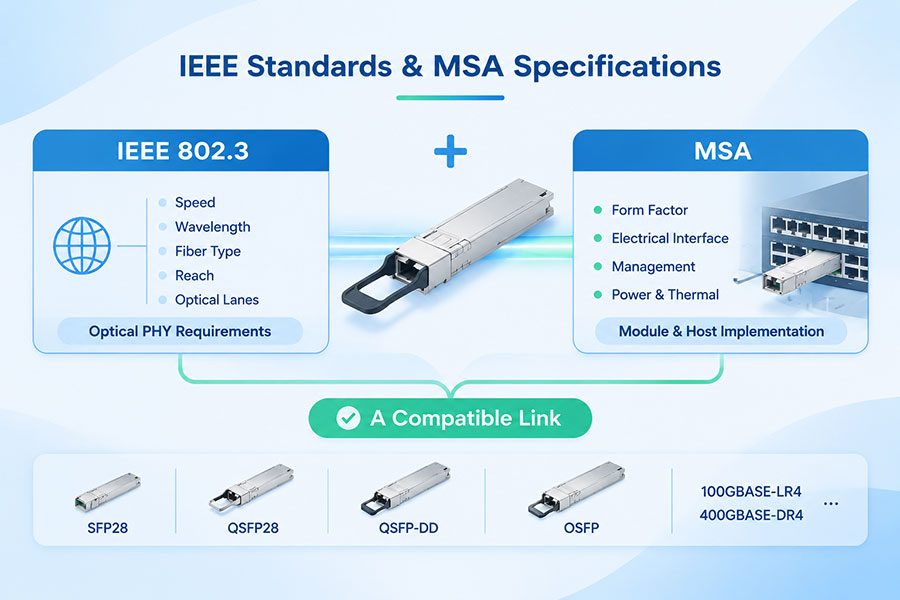
Optical networking equipment is designed to support interchangeable pluggable modules rather than relying exclusively on transceivers from a single manufacturer. This flexibility is made possible in part by Multi-Source Agreements (MSAs), which define common module and host-interface requirements for products developed by different suppliers.
As a result, optical transceivers from different vendors can share the same MSA form factor. A compatible SFP+, QSFP28, QSFP-DD, or OSFP module may follow the same mechanical and interface specifications regardless of its manufacturer. However, sharing a form factor does not automatically guarantee that every module will operate in every switch or establish an interoperable optical link.
1. What Is an Optical Transceiver MSA?
MSA stands for Multi-Source Agreement. It is an industry agreement developed by multiple companies to define common specifications for a particular optical transceiver form factor or interface.
Rather than allowing every manufacturer to develop a completely different module design, an MSA provides a shared technical framework. Participating and independent suppliers can use the published requirements to develop modules intended to fit compatible host equipment.
Depending on the MSA, its specifications may cover:
Module dimensions and mechanical tolerances.
Host cage and connector arrangements.
Electrical interface characteristics.
Power supply and power consumption requirements.
Thermal operating conditions.
Management interface and identification information.
Hot-plug behavior and module control functions.
MSAs are particularly important in data centers and telecommunications networks, where equipment manufacturers need consistent module interfaces across different generations of networking hardware.
2. Can Different Vendors Manufacture the Same MSA Form Factor?
Yes. Multiple manufacturers can design optical transceivers around the same MSA form factor. This is the central purpose of a multi-source agreement: to enable products from different sources to follow a common interface specification.
For example, several suppliers can manufacture 100G QSFP28 transceivers. Their modules may share the same general QSFP28 mechanical interface and supported host electrical requirements while using different optical components, firmware implementations, manufacturing processes, and product identification information.
| Module family | Typical application range | Multi-vendor design purpose |
|---|---|---|
| SFP / SFP+ | 1G and 10G applications | Common compact pluggable interface for access and aggregation networks. |
| SFP28 | 25G applications | Higher-speed SFP-family interface for Ethernet and related systems. |
| QSFP28 | 100G applications | Four-lane pluggable interface used in switches and data center equipment. |
| QSFP-DD | 200G, 400G, and 800G product generations | Double-density QSFP architecture for higher-bandwidth systems. |
| OSFP | High-speed applications including 400G and 800G | High-density module architecture with its own mechanical and thermal requirements. |
The exact supported data rates and applications depend on the particular MSA revision and optical interface implemented by the module. A form factor alone does not identify the optical standard or transmission distance.
3. What Does an MSA Actually Standardize?
An MSA is more than a definition of module size. It provides a set of interface requirements that help module manufacturers and equipment developers build products that can work together.
Four areas are especially important when evaluating multi-vendor transceivers.
Mechanical compatibility: The module must fit the intended cage and meet the specified dimensions, connector position, and insertion requirements.
Electrical compatibility: The module must support the host electrical interface, signaling characteristics, lane arrangement, and relevant operating requirements.
Management compatibility: The module and host must communicate through compatible management interfaces. Identification, monitoring, control, and application configuration depend on the applicable specification.
Thermal and power compatibility: The module must operate within the host's supported power and thermal envelope. This is especially important for high-speed, high-density modules.
| MSA area | What it defines | What engineers should verify |
|---|---|---|
| Mechanical | Module dimensions, cage, connector, and tolerances | Correct form factor and physical fit. |
| Electrical | Host electrical interface and signaling requirements | Lane rate, electrical interface, and port support. |
| Management | Identification and management communication | EEPROM or CMIS support and host interpretation. |
| Power | Power supply and operating requirements | Host power capability and module consumption. |
| Thermal | Operating conditions and thermal requirements | Case temperature limits and cooling capability. |
4. Does the Same MSA Form Factor Guarantee Interoperability?
No. MSA compliance provides a common foundation, but it does not mean that every module with the same form factor can be used in every host or connected directly to every other optical module.
There are several separate compatibility layers:
Physical compatibility: The module must fit the host cage and use the correct connector arrangement.
Host electrical compatibility: The switch or network adapter must support the module's electrical interface, lane configuration, and data rate.
Host recognition: The equipment must accept the module's identification information and compatibility profile.
Optical interoperability: Both ends must use compatible optical standards, wavelengths, fiber types, lane arrangements, and link budgets.
Software compatibility: The host firmware and operating system must support the module and its management behavior.
For example, two 100G QSFP28 modules may share the same form factor but implement different optical interfaces. A 100GBASE-SR4 module designed for multimode fiber is not interchangeable with a 100GBASE-LR4 module designed for single-mode fiber simply because both use QSFP28 packaging.
5. Why Can Two MSA-Compatible Modules Behave Differently?
Even when two products follow the same form factor specification, their internal designs and host compatibility characteristics may differ.
Common differences include:
| Difference | Possible impact |
|---|---|
| EEPROM vendor information | The host may identify the modules differently or apply different compatibility policies. |
| Firmware implementation | Management behavior and supported functions may vary. |
| Optical components | Transmit power, receiver sensitivity, and other optical characteristics may differ within the relevant product specifications. |
| Power consumption | Some modules may exceed the power capability of a particular host port. |
| Thermal performance | Different designs may produce different heat loads and operating temperatures. |
| Diagnostic support | DOM/DDM or CMIS monitoring information may differ in availability and presentation. |
| Optical application | Modules may use different wavelengths, fiber types, lane arrangements, or reach classes. |
These differences do not necessarily indicate that a module violates its MSA. They may reflect different optical applications, component selections, product features, or host-specific requirements.
6. MSA Compatibility Versus Vendor-Specific Coding
One of the most common sources of confusion is the difference between MSA compliance and vendor-specific transceiver coding.
An MSA-compatible module follows the applicable common interface requirements. Vendor-specific coding, by contrast, concerns the identification profile presented to the host device and the way that equipment evaluates the module.
Some switches and routers check vendor identification, product information, or other module attributes before accepting a transceiver. Consequently, a module can follow the relevant MSA interface specification but still trigger an unsupported-transceiver warning on a particular platform.
| Feature | MSA compliance | Vendor-specific coding |
|---|---|---|
| Main purpose | Defines common module and host-interface requirements. | Provides identification information intended for a particular equipment environment. |
| Physical fit | Addresses the relevant mechanical interface. | Does not change the physical module dimensions. |
| Electrical interface | Defines applicable electrical requirements. | Does not convert an incompatible electrical interface. |
| Host recognition | Provides a common technical foundation. | May affect how a host identifies or accepts a module. |
| Optical performance | Depends on the applicable optical standard and product design. | Does not change the physical optical capabilities. |
For multi-vendor deployments, both aspects should be checked. A module may be mechanically and electrically suitable but still require a compatible identification profile for the target switch.
7. Can You Mix Optical Transceivers from Different Vendors on the Same Link?
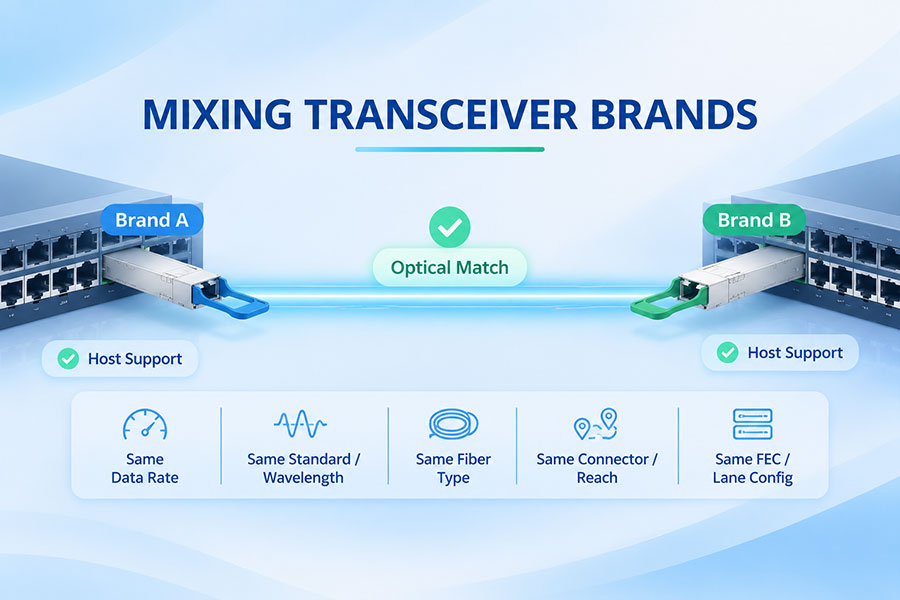
Yes, different vendors' optical transceivers can often operate at opposite ends of the same fiber link when they implement compatible optical interfaces and meet the required link specifications.
The manufacturer's name is generally less important for optical interoperability than the actual transmission characteristics.
Before connecting two modules, verify:
Matching data rate and supported Ethernet or transport standard.
Compatible optical wavelength or wavelength arrangement.
Matching single-mode or multimode fiber requirements.
Compatible connector type and fiber polarity.
Compatible lane count and optical mapping.
Transmit power and receiver sensitivity within the link budget.
Compatible FEC and host-side operating requirements.
For example, two 10GBASE-LR SFP+ modules from different suppliers can generally interoperate over a suitable single-mode fiber link when both meet the relevant interface requirements. A 10GBASE-SR module and a 10GBASE-LR module, however, are not a standard interchangeable pair because they use different optical applications.
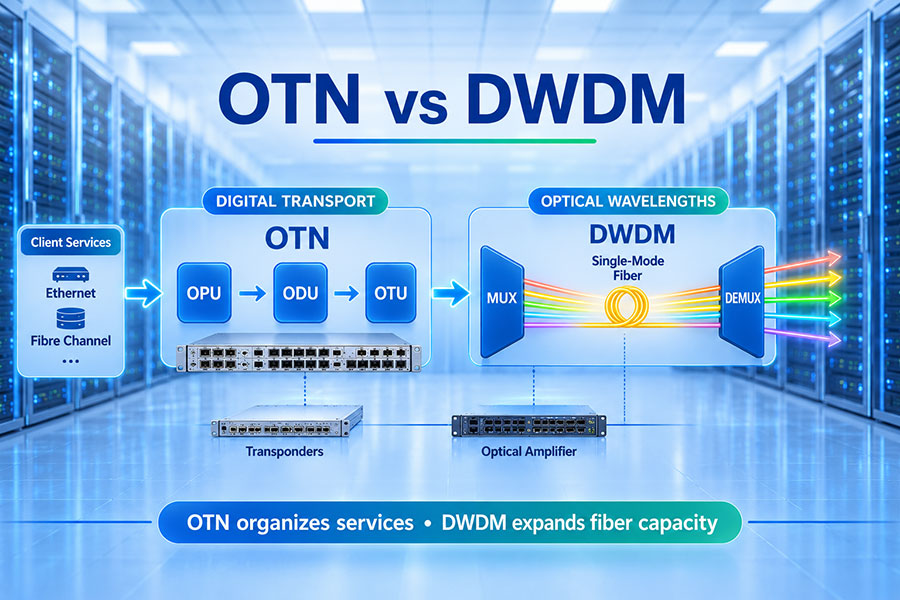
Special interfaces such as BiDi, CWDM, DWDM, and coherent optics require additional attention to wavelength pairing, channel plans, modulation, and interoperability specifications.
8. How to Evaluate Multi-Vendor MSA Compatibility
For network operators and system integrators, a structured evaluation helps prevent problems when selecting optical modules from multiple suppliers.
Identify the form factor: Confirm whether the host requires SFP+, SFP28, QSFP28, QSFP-DD, OSFP, or another module type.
Confirm the applicable MSA: Check the relevant mechanical, electrical, and management specifications.
Verify the optical standard: Confirm SR, LR, DR, FR4, ER, or another required interface.
Check host compatibility: Verify the switch model, port configuration, firmware, and module recognition requirements.
Review power and thermal limits: Ensure the module operates within the host's supported conditions.
Validate both link endpoints: Confirm that the optical characteristics and lane mapping are compatible.
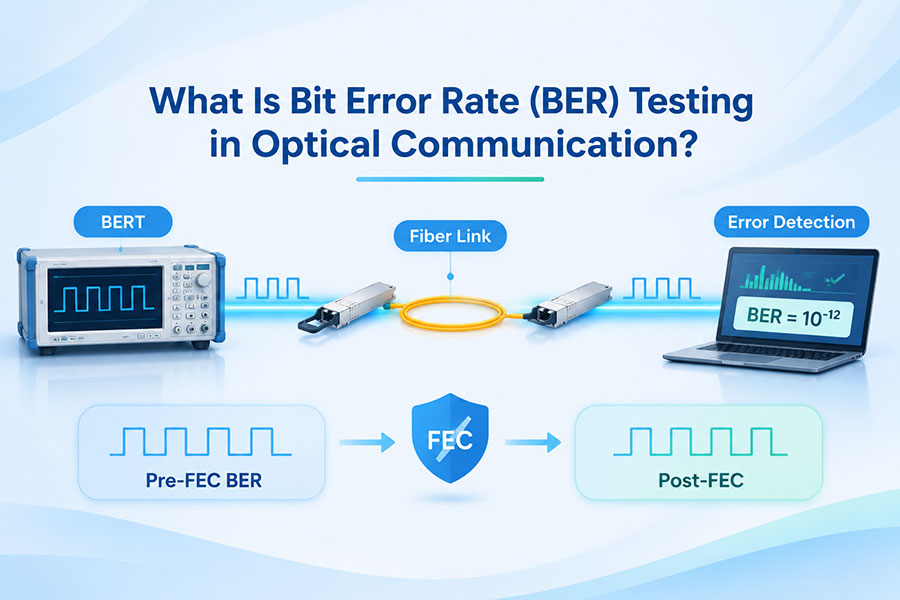
Test representative samples: Check recognition, link establishment, diagnostic readings, and error performance before wider deployment.
For large networks, it is useful to maintain a compatibility matrix that records the equipment model, port type, module part number, optical standard, firmware version, and test result. This makes multi-vendor procurement and future replacement easier to manage.
9. MSA Form Factors in 400G and 800G Networks
As network speeds increase, MSA-based module architectures continue to support multiple suppliers and different optical implementations.
In 400G and 800G networks, QSFP-DD and OSFP are two important high-speed pluggable form factors. They have different mechanical designs and host requirements, so they should not be treated as physically interchangeable.
| Form factor | Common high-speed applications | Deployment considerations |
|---|---|---|
| QSFP-DD | 400G and 800G optical modules | Check host port generation, electrical lane configuration, power, and cooling. |
| OSFP | 400G and 800G optical modules | Check OSFP cage design, thermal interface, power capability, and host support. |
Within each form factor, products may implement different optical interfaces. For example, 800G SR8, DR8, and 2FR4 are not equivalent optical designs. They have different fiber, connector, lane, and reach requirements even when installed in compatible 800G module cages.
High-speed module selection should therefore consider the MSA form factor and the actual optical application together.
10. C-LIGHT Multi-Rate Optical Transceiver Solutions
C-LIGHT provides optical transceiver product families for data center, enterprise, and high-speed networking applications. These product categories cover several widely used pluggable form factors and optical interfaces.
400G QSFP-DD Optical Transceivers
For supported 400G QSFP-DD platforms, with optical options selected according to the required transmission distance, fiber infrastructure, and host interface.
400G OSFP Optical Transceivers
For compatible 400G OSFP equipment. Verify the specific optical configuration, port support, power consumption, and thermal requirements for the target system.
800G QSFP-DD Optical Transceivers
Designed for supported 800G QSFP-DD applications. Selection should account for the host's electrical interface, optical lane architecture, and cooling capability.
800G OSFP Optical Transceivers
For compatible 800G OSFP platforms, with options including SR8, DR8, and 2FR4 configurations for different network architectures and fiber environments.
When evaluating products from different suppliers, customers should provide the target equipment model, port specification, optical standard, transmission distance, and required compatibility profile. These details help establish whether a proposed module is suitable for the intended deployment.
11. Conclusion
Different optical transceiver vendors can manufacture modules using the same MSA form factor. Shared specifications establish common mechanical, electrical, management, power, and thermal requirements, making multi-source module development possible.
However, the same form factor does not guarantee complete compatibility. Host recognition, firmware support, optical standards, lane mapping, power consumption, and link budgets must also be considered.
For reliable multi-vendor networks, engineers should evaluate the MSA form factor and the optical application separately, then verify host compatibility and test representative modules before deployment. This approach provides greater flexibility in optical module sourcing while maintaining predictable network operation.
Looking for MSA-compatible optical transceivers for your network?
Share your equipment model, required form factor, data rate, and optical specifications for a suitable product assessment.
Contact C-LIGHT >

 >
 >
 >
 >
 >
 >
 >