TEL:+86 132 6656 7067





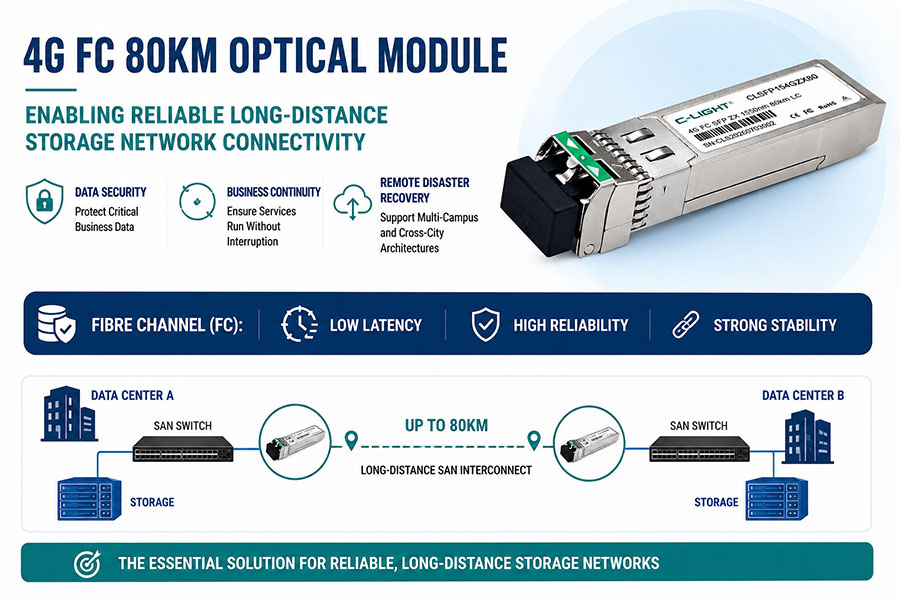
As enterprise data center scales continue to expand, demands for data security, business continuity, and remote disaster recovery are increasing rapidly. More organizations are now building multi-campus and even cross-city data center architectures. In this context, stable and reliable storage network interconnection has become critical.
Fibre Channel (FC), as a mature enterprise-grade storage networking technology, has long been widely used in mission-critical systems due to its low latency, high reliability, and strong stability. The 4G FC 80km optical module serves as an essential component for long-distance SAN (Storage Area Network) interconnects.
1、What Is a 4G FC 80km Optical Module?
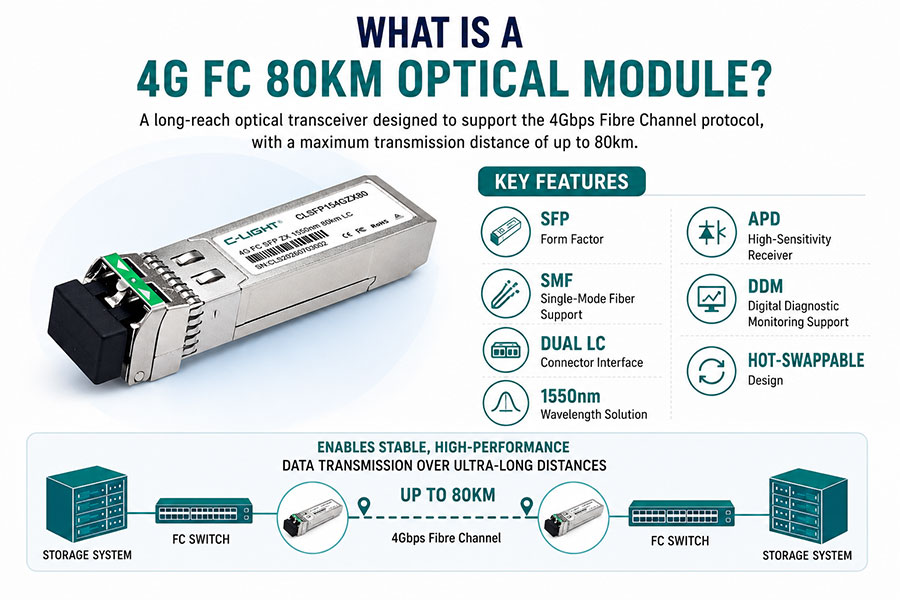
4G FC 80km optical transceiver is a long-reach optical module designed to support the 4Gbps Fibre Channel protocol, with a maximum transmission distance of up to 80km.
Typical features include:
SFP form factor
Single-mode fiber (SMF) support
Dual LC connector interface
1550nm wavelength solution
APD high-sensitivity receiver
DDM (Digital Diagnostic Monitoring) support
Hot-swappable design
It enables stable, high-performance data transmission over ultra-long distances.
2、Core Advantages of 4G FC 80km Optical Modules

Ultra-Long Transmission Distance
The 4G FC 80km module supports up to 80 kilometers of fiber transmission, making it suitable for:
Cross-region data center interconnects
Metro-area SAN networks
Remote disaster recovery centers
Core storage backbone networks
Long-distance data replication
It enables more flexible and scalable data center deployment strategies.
High Stability and Low Latency
Fibre Channel networks are inherently designed for:
Low network latency
High transmission stability
Lossless data communication
Extremely low bit error rates
This makes them ideal for:
Enterprise databases
Financial trading systems
Healthcare data platforms
Mission-critical storage systems
Core application servers
Even over long distances, FC networks maintain highly stable and reliable performance.
Mature and Reliable FC Ecosystem
Although data center networking technologies continue to evolve, many traditional enterprise SAN infrastructures still rely on 4G FC architecture.
Key advantages include:
Mature and proven technology
Stable deployment model
Strong compatibility
Well-established operations ecosystem
High long-term reliability
As a result, 4G FC remains highly valuable in legacy enterprise environments and industry-specific private networks.
3、Typical Application Scenarios

Disaster Recovery (DR)
4G FC 80km modules are widely used in:
Primary and backup data centers
Active-active data center architectures
Disaster recovery systems
Remote data replication
They significantly enhance enterprise data protection capabilities.
Data Center Interconnect (DCI)
Used for SAN storage interconnection between geographically separated data centers, enabling:
Data synchronization
Storage mirroring
Business continuity
This ensures stable operation of critical enterprise applications.
Enterprise SAN Networks
Suitable for:
Financial institutions
Healthcare systems
Government and enterprise data centers
Telecom operators
Large-scale database systems
It meets high-reliability storage interconnection requirements.
4、Why Is Fibre Channel Still Widely Used?

Although high-speed Ethernet continues to evolve, Fibre Channel still offers clear advantages in enterprise storage environments:
More stable data transmission
Lower network latency
Mature SAN ecosystem
Higher reliability
Better suitability for mission-critical systems
In many large-scale traditional enterprise data centers, FC remains a core storage networking architecture.
5、C-LIGHT 4G FC 80km Optical Module Solution

As a professional provider of high-speed optical communication solutions, C-LIGHT offers highly reliable products including:
4G FC optical transceivers
Long-distance Fibre Channel optical modules
Enterprise-grade SAN storage interconnect solutions
Key Product Advantages:
High compatibility design
Strict reliability testing
Stable ultra-long-distance transmission
Industrial-grade robustness
Compatible with mainstream switches and storage systems
Widely used in:
Enterprise SAN networks
Disaster recovery systems
Data center interconnect (DCI)
Cloud storage infrastructure
Core storage networks
6、Conclusion
With the continuous growth of enterprise data security and business continuity requirements, the 4G FC 80km optical module continues to play an important role in traditional SAN storage networks.
Its ultra-long transmission distance, high stability, and mature Fibre Channel ecosystem enable enterprises to build more secure, efficient, and reliable long-distance storage interconnection architectures, ensuring continuous operation of mission-critical systems.
7、Frequently Asked Questions (FAQ)
A 4G FC 80km optical module is a long-distance Fibre Channel (FC) transceiver that supports 4Gbps data transmission and can reach up to 80km over single-mode fiber. It is commonly used in enterprise SAN (Storage Area Network) environments and data center interconnect applications.
It is widely used in:
Data Center Interconnect (DCI)
Disaster Recovery (DR) systems
Enterprise SAN storage networks
Remote data replication
Financial and government core systems
It is designed for mission-critical storage communication over long distances.
Most 4G FC 80km modules use the 1550nm wavelength, which is optimized for long-distance transmission in single-mode fiber networks due to its low attenuation characteristics.
It requires single-mode fiber (SMF) to achieve stable long-distance transmission up to 80km. Multimode fiber is not suitable for this type of module.
Key advantages include:
Ultra-long transmission distance (up to 80km)
Low latency and high stability
Lossless data transmission (Fibre Channel protocol)
High compatibility with SAN equipment
Mature and reliable enterprise storage ecosystem
Fibre Channel remains widely used because it offers:
Lower and more predictable latency
Higher stability for storage traffic
Dedicated lossless architecture
Strong enterprise SAN ecosystem
Proven reliability for mission-critical workloads
They are typically compatible with:
SAN switches
Storage arrays (EMC, HPE, IBM, etc.)
Enterprise Fibre Channel directors
Data center storage networking equipment
Compatibility depends on MSA standards and vendor certification.
Important considerations include:
Ensure correct wavelength matching
Use proper single-mode fiber (SMF)
Verify link budget and optical power levels
Maintain clean fiber connectors
Confirm switch/storage compatibility
Proper link design is critical for long-distance stability.
Yes. It supports DDM (Digital Diagnostic Monitoring), which allows real-time monitoring of:
Optical power (Tx/Rx)
Temperature
Voltage
Module status
This helps improve network maintenance efficiency and fault diagnosis.
| Feature | Short-reach FC Module | 80km FC Module |
|---|---|---|
| Distance | Up to a few km | Up to 80km |
| Wavelength | Typically 850nm / 1310nm | Typically 1550nm |
| Receiver | PIN | APD high sensitivity |
| Use case | Intra-data center | Inter-city SAN / DCI |
 >

 >
 >
 >
 >
 >
 >
 >